Contents +
How to avoid pitfalls when building a B2B export website? A guide to avoiding common mistakes in B2B export website development in 2026.
Source: 创同盟
Date: 2026-10-13
Views: 100
Author: CTMON | B2B Digital Marketing Service Provider
How to avoid being scammed when building a website for foreign trade? This is a question that many export businesses are concerned about when preparing to build a business website.
Some companies felt that the investment did not meet their expectations after building the website; some extended the project cycle due to repeated adjustments to requirements; and some, although they completed the website design, experienced slow progress in subsequent overseas promotion due to unclear product structure and lack of basic SEO configuration.
For B2B manufacturing and foreign trade companies, B2B export websites are not only a window to showcase their corporate image, but also an important channel for Google search lead generation, product promotion, and overseas customer inquiries.
Therefore, the key to avoiding pitfalls in building a foreign trade website is not just choosing a suitable website building service provider, but also for both the company and the service provider to clarify their goals before the project begins, communicate their needs effectively during the construction process, and complete effective confirmation at the delivery stage, so as to jointly reduce problems caused by unclear needs, delivery, and communication.
This article, based on common situations in B2B export website development, summarizes eight key issues that need to be focused on, from goals and requirements to delivery and operation, to help companies advance website construction projects more smoothly and to help both parties establish clearer expectations for cooperation.
1. Focusing only on website building prices while ignoring the actual services provided.
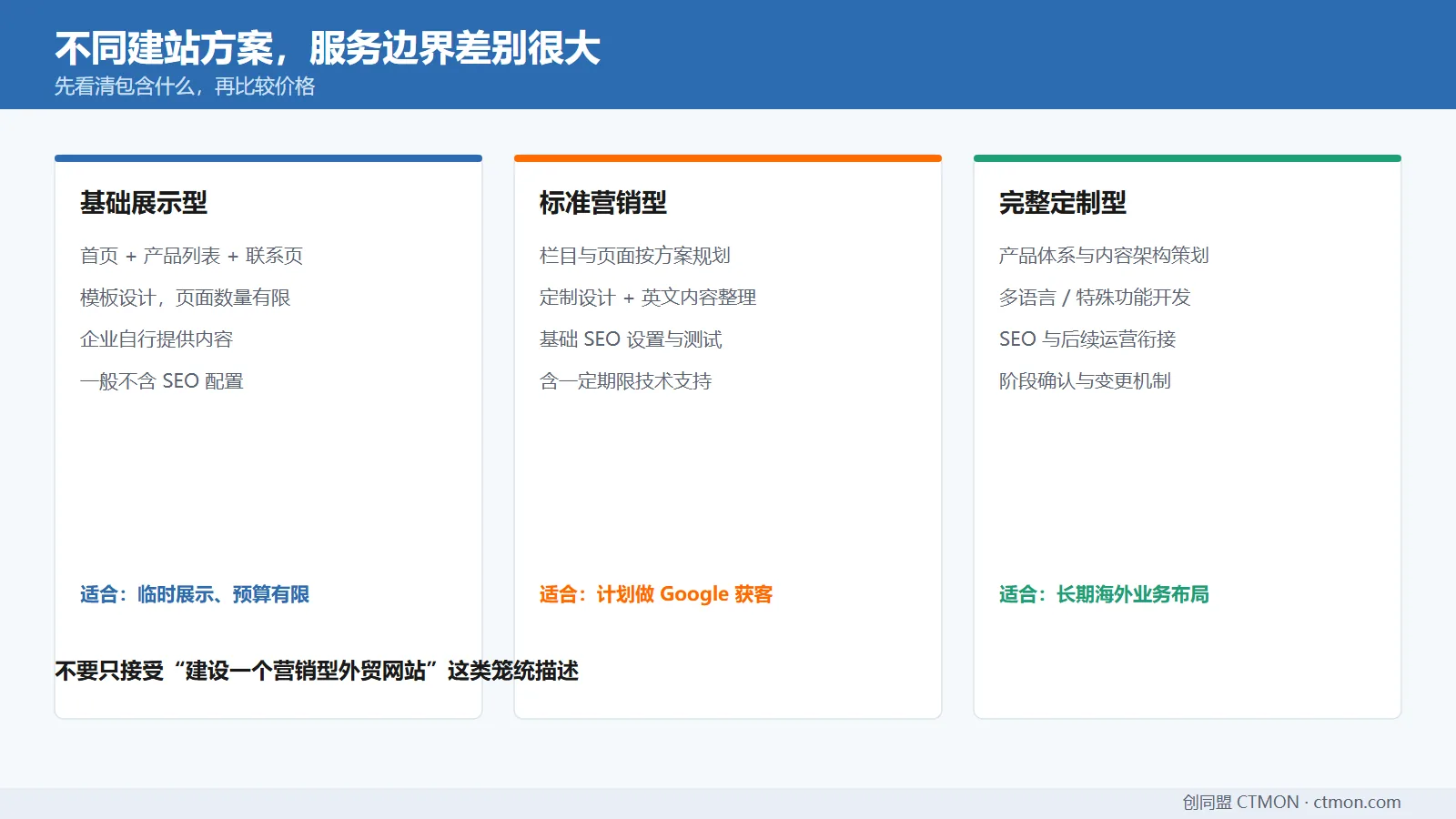
A low price does not necessarily mean poor service quality, but if companies only compare website building quotes without understanding the service boundaries of different packages, they may find discrepancies between expectations and actual delivery during project implementation.
Some basic website building packages may only include the homepage, product list, and contact page, without independent product detail design, English copywriting, SEO configuration, or subsequent maintenance; while more complete solutions may cover planning, design, content uploading, and a certain period of technical support.
If companies don't understand these differences beforehand, they may find that the actual required functions are not within the scope of the selected solution only halfway through the project.
How to avoid it?
When comparing quotes, businesses are advised to first clarify their own goals and then request that the website building service provider list them in the plan or contract appendix.
- Website sections and number of pages.
- Template design or custom design?
- Number of product information uploaded.
- English content and image processing scope.
- Features include forms, search, and download.
- Basic SEO setup and testing requirements.
Don't just accept vague descriptions like "build a marketing-oriented B2B export website." Instead, understand the service boundaries of different packages and choose a solution that matches your business goals.
If you need to understand the budget breakdown of different website building solutions, you can refer to [How much does it cost to outsource foreign trade website building? 2026 B2B export website cost details and quotation guide]( https://www.ctmon.com/newsdetail/foreign-trade-website-development-cost.html)。
2. Failure to understand the website system and administrative permissions
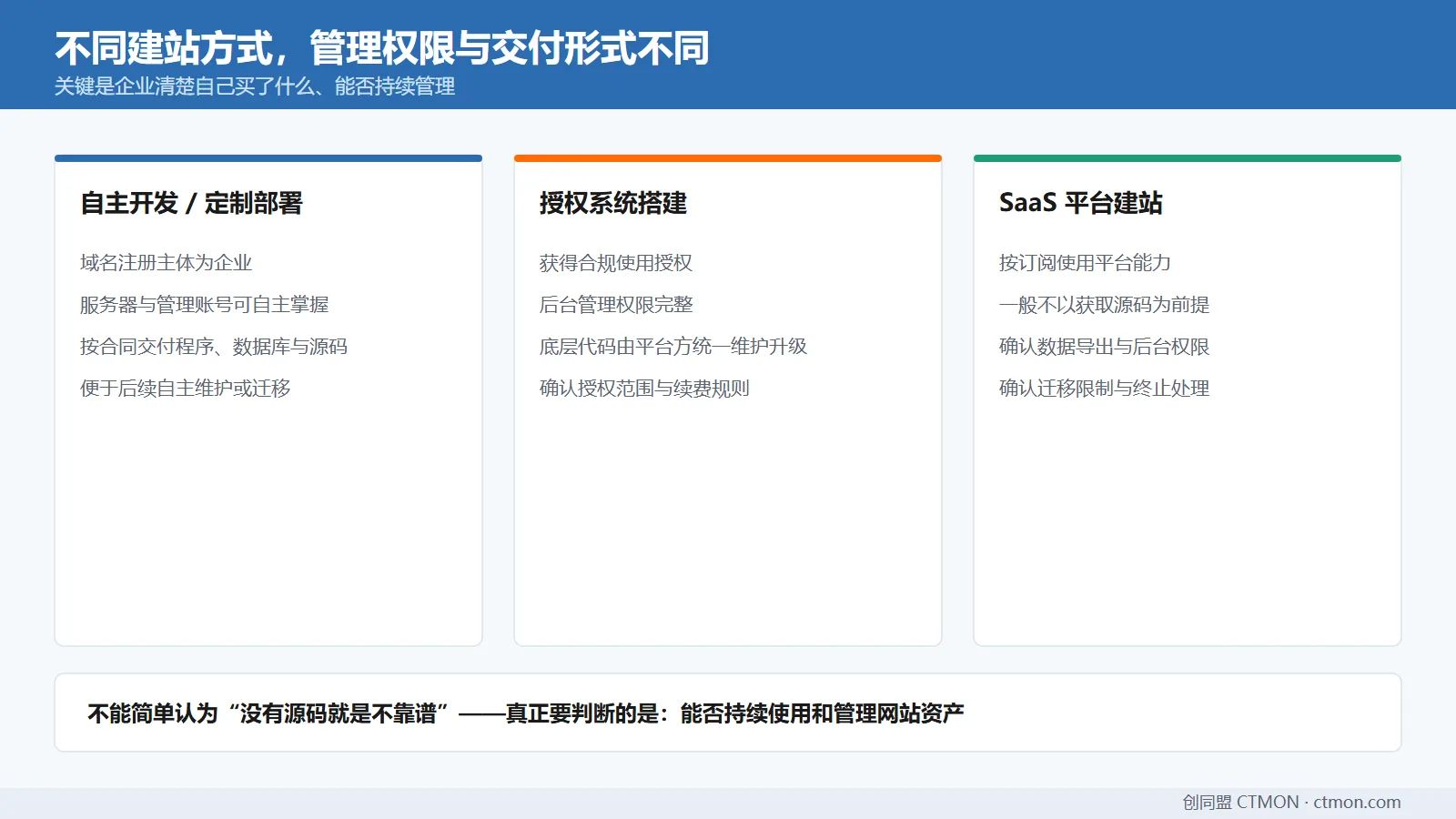
Domain names, servers, and website backends are digital assets that businesses manage over the long term, but different types of website building methods have different management permissions and delivery methods.
If a company does not understand what it is purchasing and whether it can manage it independently before cooperating, it may encounter inconvenience when changing service providers or adjusting its business later.
How to avoid it?
Before signing a contract, companies are advised to clarify with the website building service provider the domain name registration entity, registrar account, DNS management permissions, server service mode, and website administrator permissions.
Several common situations need to be distinguished:
For websites that are developed in-house or customized: the scope of delivery of procedures, databases, files and source code should be clearly defined in the contract to facilitate the company's subsequent self-maintenance or migration.
Websites built on an authorization system typically grant businesses compliant usage authorization and backend management permissions, while the underlying code of the system itself is maintained and upgraded uniformly by the platform provider.
SaaS platform website building: Enterprises use the platform's capabilities on a subscription basis. Generally, obtaining the source code is not a prerequisite, but they should confirm the rules for data export, backend management, platform migration, and handling after service termination.
It's wrong to simply assume that "no source code means it's unreliable." What's truly important to assess is whether the company understands what it's purchasing and whether it can sustainably use and manage the website assets in the future.
3. Frequent changes to requirements during the development process increased costs and shortened the website development time.
Building a B2B export website typically involves stages such as requirements communication, page planning, design confirmation, program development, and online testing.
One easily overlooked problem is that companies do not fully define their needs before building a website, leading to continuous adjustments to website sections, design styles, or functions during the project.
For example, a company may have already confirmed its homepage design and entered the development stage, but then want to readjust the overall design direction; or it may have originally planned to build only an English website, but later added German, Spanish, or other language versions.
These changes may involve redesigning pages, adjusting program structure, and increasing testing, thus affecting the original development cycle and project costs.
How to avoid it?
It is recommended that companies clarify their main products, target market, reference websites, page requirements and functional requirements before building a website, and provide feedback on modifications during the design phase.
For confirmed design schemes, the process will proceed to the next stage in accordance with the agreement.
If new business needs arise later, we can communicate with the service provider to adjust the plan and reassess the development workload and delivery cycle.
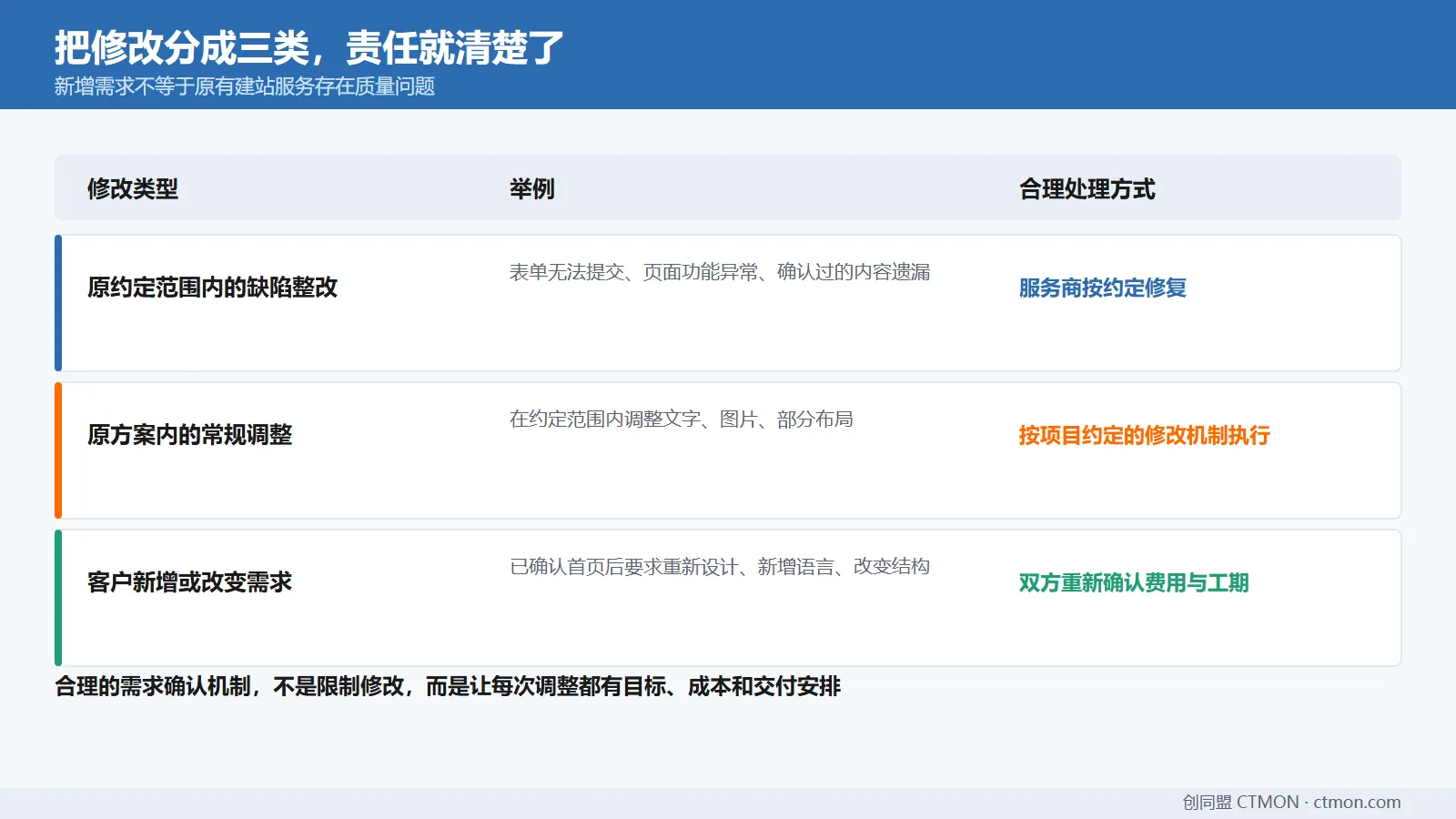
Clients adding new requirements or scrapping confirmed design plans does not necessarily indicate a quality issue with the original website building service. The resulting additional design, development, and testing work may require a reassessment of the timeline and costs. To more clearly define responsibilities, modifications during website construction can be categorized into the following three types:
| Modify type | For example | Reasonable handling method |
|---|---|---|
| Defect rectification within the originally agreed scope | Forms cannot be submitted, page functions are abnormal, and confirmed content is missing. | The service provider should repair as agreed. |
| Routine adjustments within the original plan | Adjust the text, images, and some layout elements within the agreed scope. | Implement according to the modification mechanism agreed upon in the project. |
| Customer adds or changes requirements | After the homepage was confirmed, a redesign, addition of languages, addition of features, and changes to the website structure were requested. | Both parties reconfirmed the costs and construction period. |
A reasonable requirements confirmation mechanism does not restrict clients from modifying the website, but rather ensures that every adjustment has a clear objective, cost, and delivery schedule.
4. Neglecting basic SEO planning will negatively impact later promotion efforts.
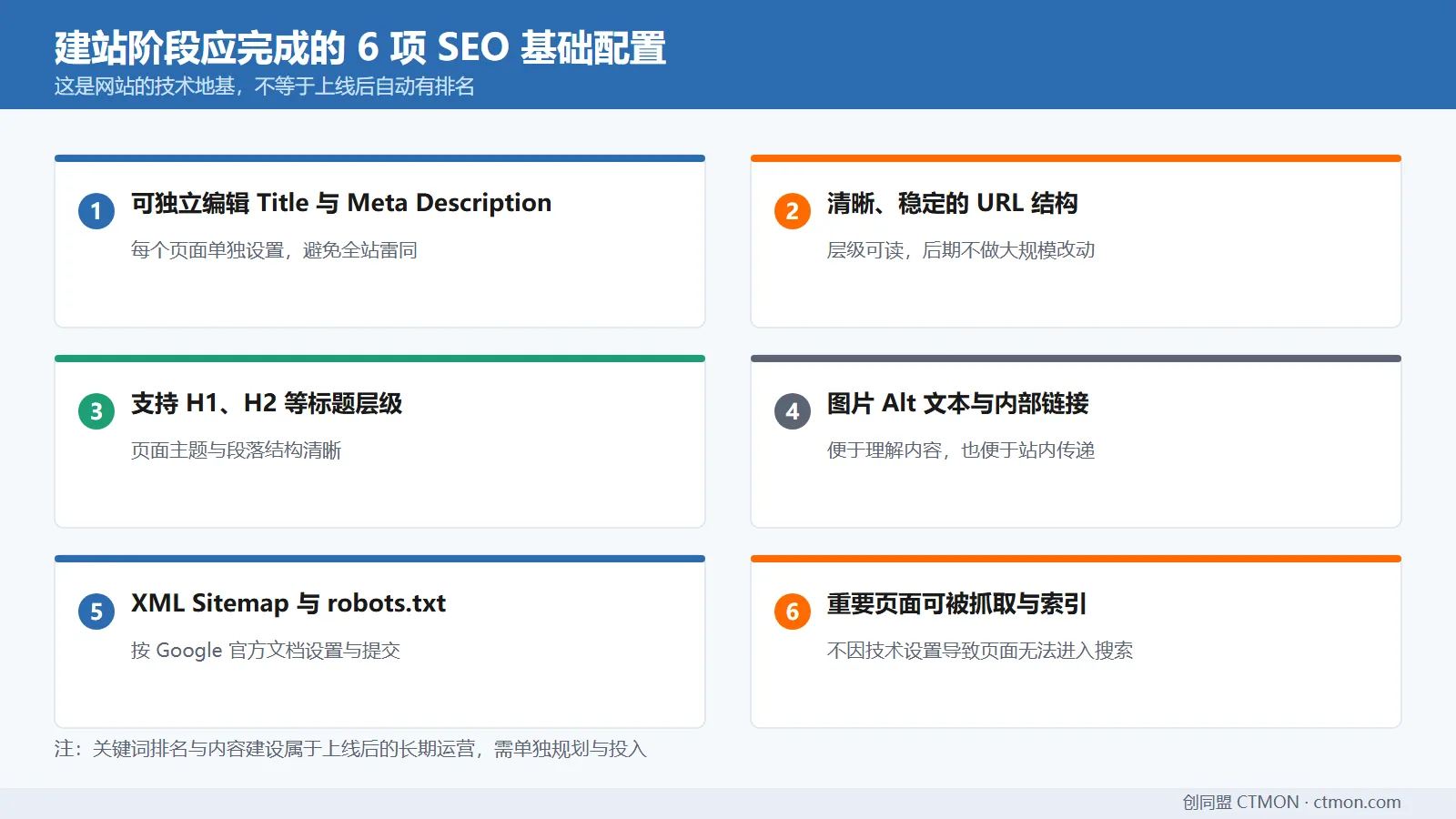
For B2B companies hoping to acquire overseas customers through Google organic search, whether their website has basic SEO capabilities directly affects the ease of subsequent optimization. It's important to distinguish between "basic SEO configuration during website setup" and "online SEO operations after launch."
For example, an industrial equipment manufacturer may have multiple product lines and application areas. If the website only features simple product display pages without properly differentiating product categories, model details, and application scenarios, the SEO team may later need to redesign the website structure, add pages, or even adjust the URL structure.
How to avoid it?
Before building a website, you should request the service provider to provide a preliminary website architecture and confirm the following functions:
- Supports independent editing of page titles and meta descriptions. (Quote: [Google Search Center: Controlling search result summaries]( https://developers.google.com/search/docs/appearance/snippet?hl=zh-CN))
- Supports clear and stable URL structures.
- Supports setting heading levels such as H1 and H2.
- Supports image Alt text, internal links, and content updates.
- The XML Sitemap was generated normally, 并正确设置robots.txt . (Reference: [Google Search Center: Sitemap Overview]( https://developers.google.com/search/docs/advanced/sitemaps/overview?hl=zh-CN)、[Robots.txt Introduction and Guide)( https://developers.google.com/search/docs/crawling-indexing/robots/intro?hl=zh-CN))
- Important pages can be accessed and crawled by search engines. (Quote: [Google Search Center: SEO Beginner's Guide]( https://developers.google.com/search/docs/fundamentals/seo-starter-guide?hl=zh-CN)) )
Taking an industrial chiller website as an example, you can plan separate pages for Industrial Chiller, specific product details, and Chiller for Injection Molding applications, based on the actual products and user needs. This not only helps users find products but also establishes a relatively clear page structure for subsequent Google SEO.
It's important to clarify that the website building phase involves basic SEO configuration, which forms the technical foundation of the website. Keyword ranking, content creation, and continuous optimization, on the other hand, are long-term operational tasks after launch, requiring companies to invest time and resources. Having basic SEO capabilities does not guarantee that a website will automatically achieve rankings after launch.
5. Insufficient product information affects the quality of website content.
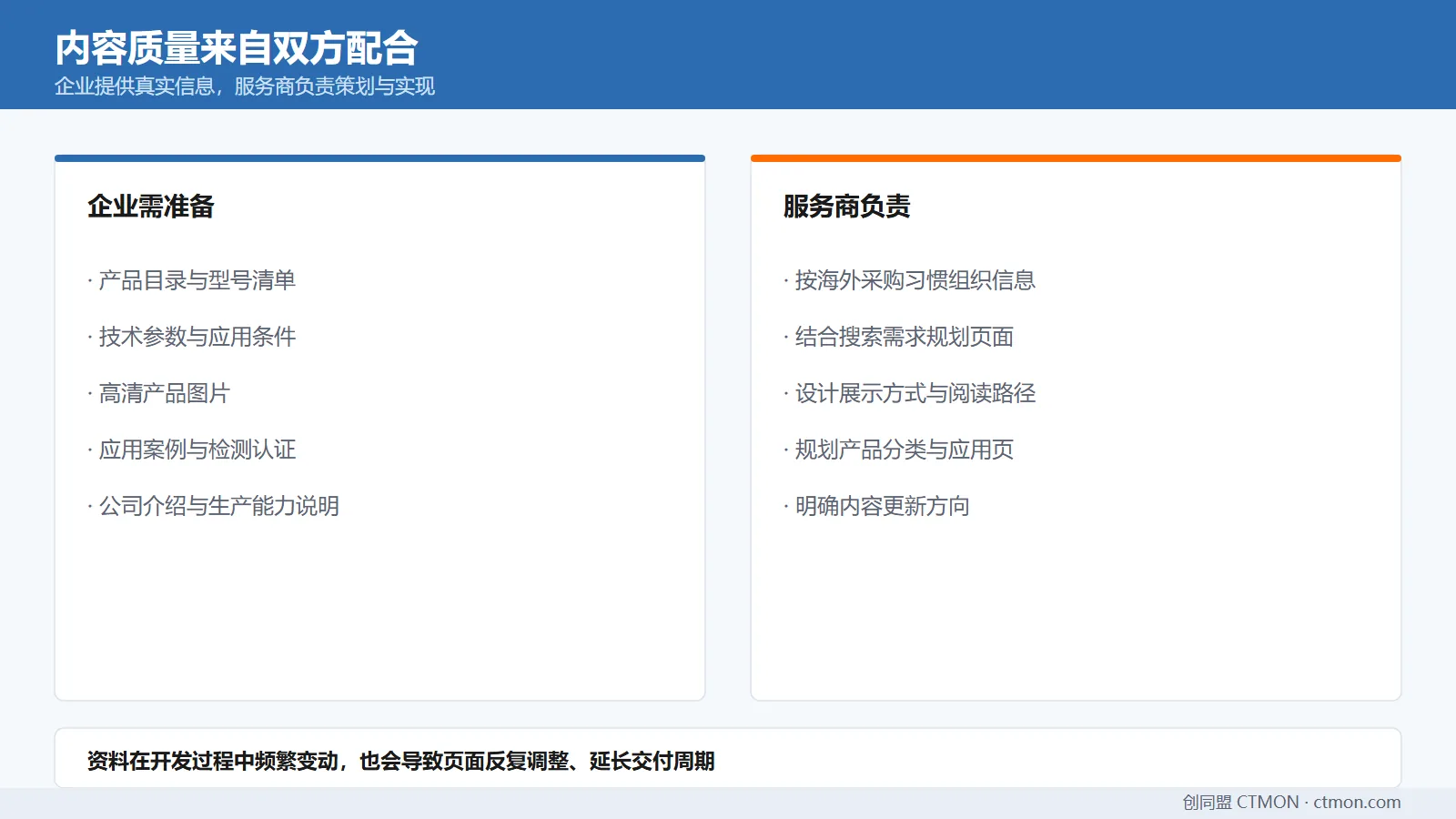
For B2B export businesses, the quality of their business website content depends not only on the planning capabilities of the website development company, but also on the product information provided by the company.
For example, industrial equipment manufacturers typically need to showcase product models, technical specifications, application scenarios, and customization capabilities. This specialized information requires companies to provide accurate data and cooperate in confirming it.
If a company can only provide a few product images and brief descriptions in the early stages, the completeness of the website content may be limited.
In addition, if product information changes frequently during website development, it may lead to repeated page adjustments and extend project delivery time.
How to avoid it?
It is recommended that companies prepare product catalogs, technical parameters, high-resolution images, application cases, certification materials, and company introductions before building a website.
Website building service providers should organize and plan materials in a reasonable manner, taking into account the browsing habits, search needs, and page display methods of overseas clients.
For websites that require SEO optimization, product categories, application solutions, and content update directions can be planned in advance.
The company is responsible for providing truthful and accurate business information, while the service provider is responsible for completing the website planning, design, and technical implementation within the agreed scope. Effective cooperation between both parties is essential to improving website content quality and project execution efficiency.
6. Focusing solely on design aesthetics while neglecting the overseas user experience.
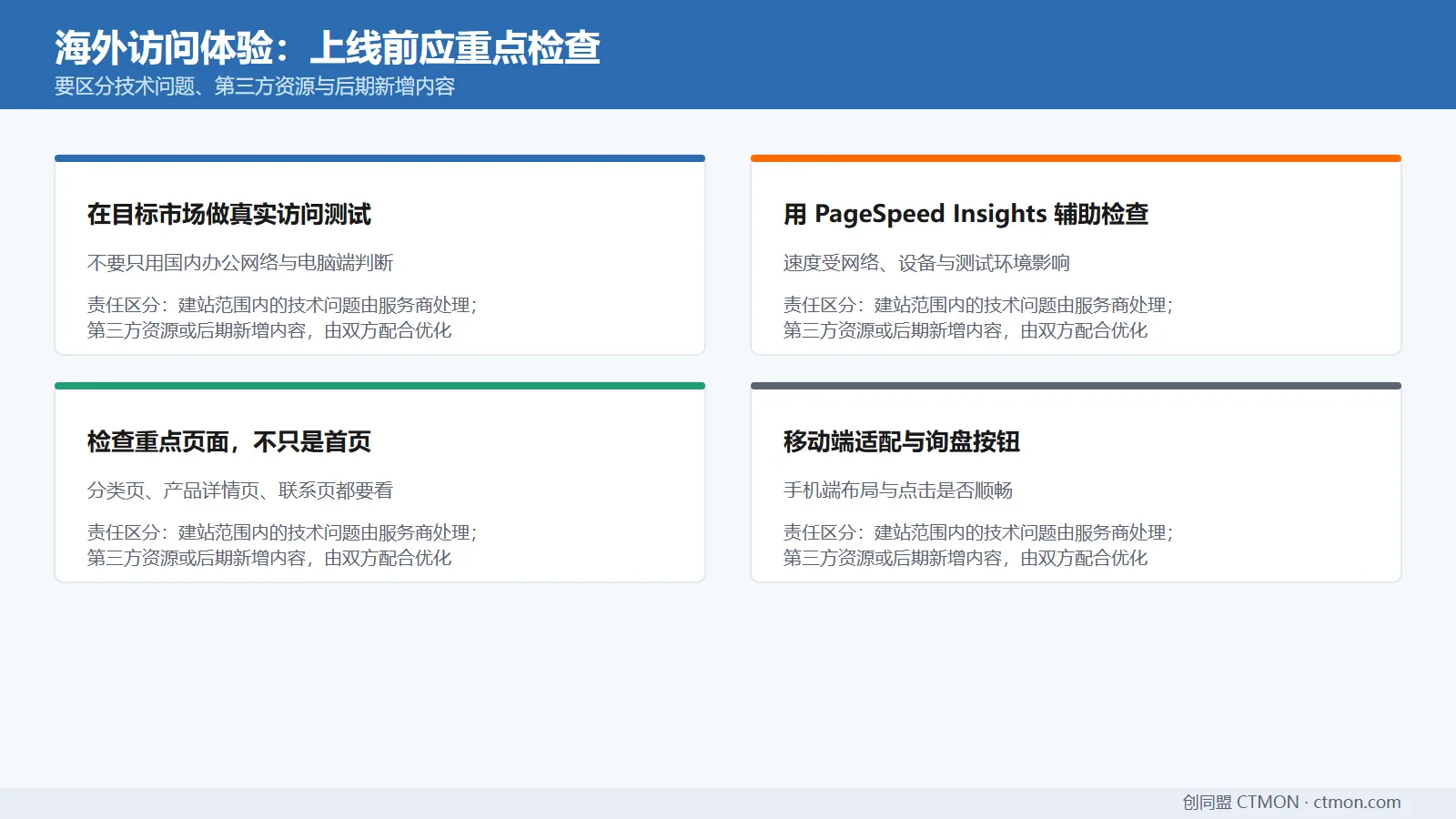
The primary visitors to B2B export websites are likely from North America, Europe, the Middle East, or other overseas markets. If evaluations are only conducted on domestic office networks and computers during website creation, the actual overseas visitor experience may be overlooked.
Common issues include excessively large page images, slow script loading, misaligned mobile layouts, and difficulty clicking the "inquiries" button on mobile devices. However, it's important to differentiate between these: some user experience problems stem from technical implementation, others from third-party resources (such as external fonts, uncompressed images, and plugins), and still others from large amounts of content or features added by the company after launch.
How to avoid it?
During the website launch phase, it is recommended to conduct real-world access tests in the main target markets and utilize tools such as PageSpeed Insights to assist in checking the page experience. (Quoted from: [Google: Introduction to PageSpeed Insights]( https://developers.google.com/speed/docs/insights/v5/about?hl=zh-CN)) )
Focus on reviewing the homepage, core product category pages, product detail pages, and contact pages, rather than just testing the homepage.
The contract should also stipulate testing methods and rectification responsibilities: Technical issues within the scope of website construction shall be handled by the service provider according to the agreement; performance changes caused by third-party resources or later added content shall be optimized jointly by both parties. Mobile adaptation is a key inspection item. (Quote: [Google Search Center: Best Practices for Mobile Web Page Indexing]( https://developers.google.com/search/docs/crawling-indexing/mobile/mobile-sites-mobile-first-indexing?hl=zh-CN))网站速度会受到网络、设备和测试环境影响,不能仅靠某一次测试分数判断网站质量。 )
7. Mistakenly believing that launching a website will automatically result in Google rankings and inquiries.
As Google SEO and GEO gain increasing attention from businesses, some website building solutions may use search rankings, AI recommendations, or the number of inquiries as selling points to attract customers; at the same time, some businesses may mistakenly believe that rankings and inquiries will naturally follow once the website goes live.
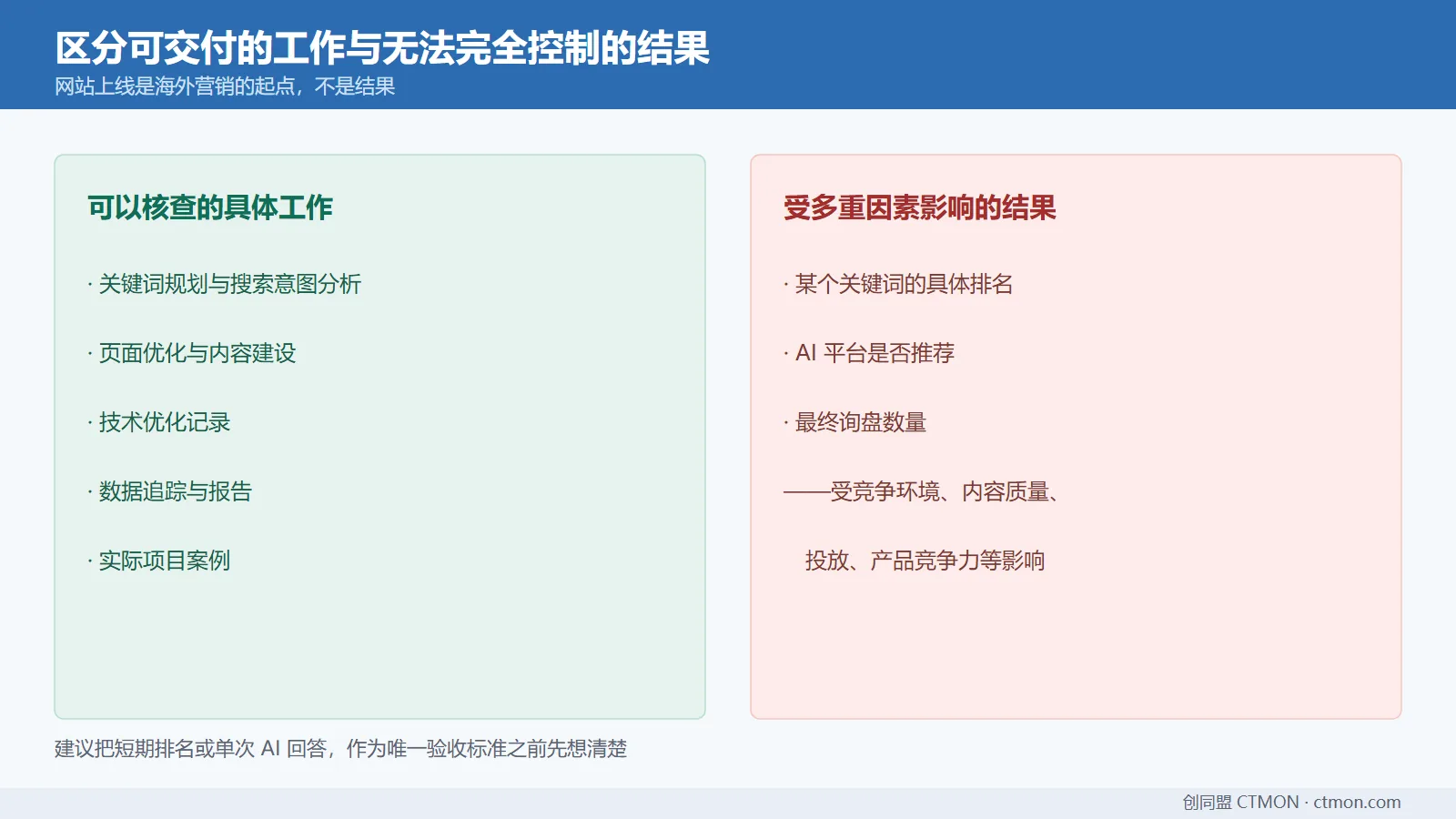
It is necessary to distinguish between the specific tasks that can be delivered and the promotional results that cannot be fully controlled.
For example, completing keyword planning, page optimization, content creation, and data tracking are verifiable tasks; however, the specific ranking of a keyword, whether it is recommended by ChatGPT or Google AI, and the final number of inquiries are affected by multiple factors such as the competitive environment, content quality, ad campaign management, product competitiveness, and website conversion.
How to avoid it?
It is recommended that businesses and service providers clearly define the specific tasks involved, rather than just offering empty slogans or results. For SEO and GEO services, pay attention to keyword strategy, content update plans, technical optimization records, data reports, and real-world project case studies.
At the same time, businesses should understand that launching a website is only the starting point of international marketing. Continuous content creation, data tracking, and operational investment are the essential foundation for generating stable inquiries. Avoid using short-term rankings or a single AI response as the sole criterion for evaluating the capabilities of a website builder or service provider.
8. Lack of phased confirmation led to repeated website modifications.
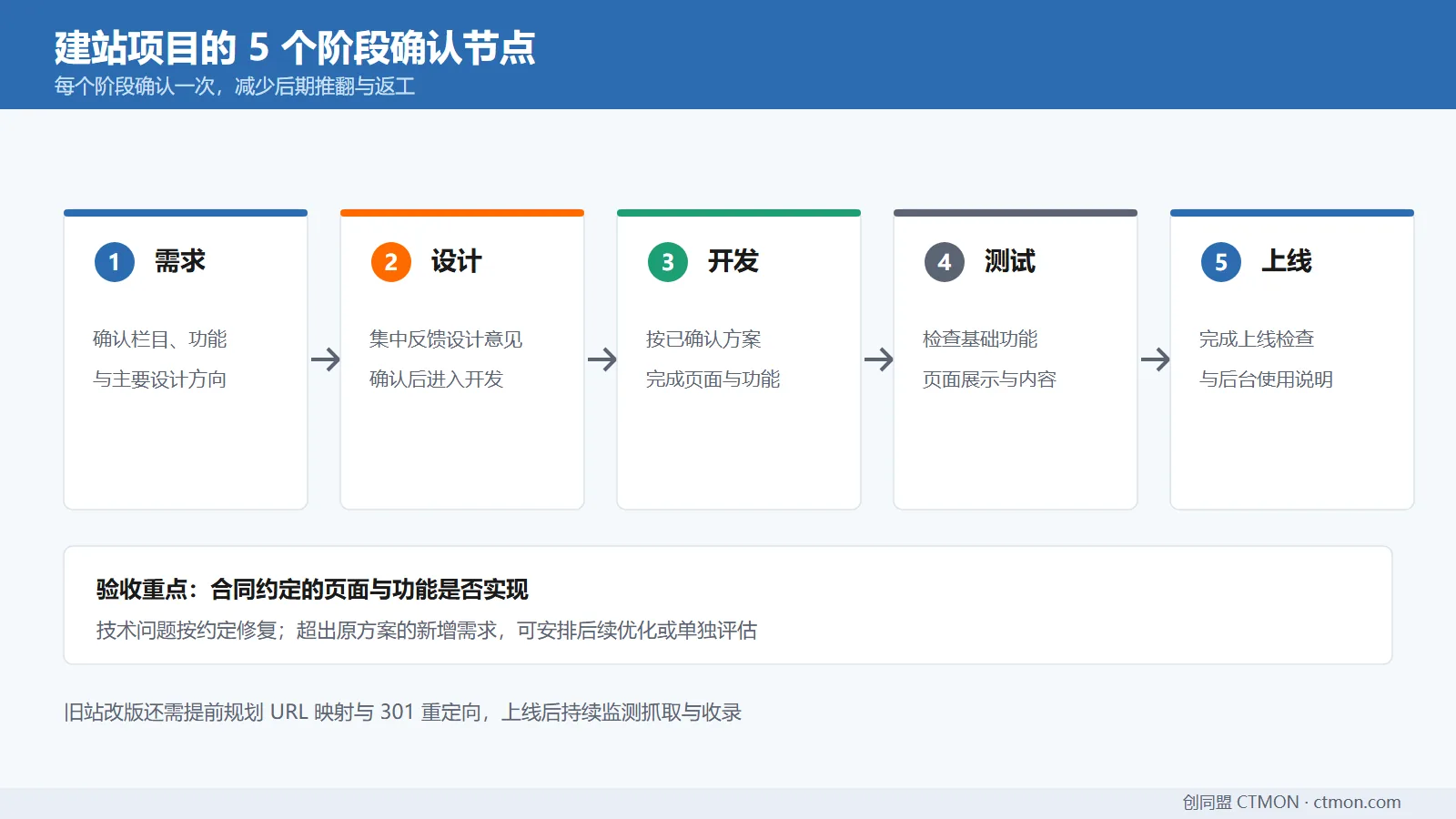
B2B export website development typically includes multiple stages such as requirements confirmation, page design, development and production, content improvement, and online testing.
If companies fail to provide timely feedback at the appropriate stages, or repeatedly overturn the original plan after the design is confirmed, it may increase communication costs and affect the project schedule.
For example, if the homepage visual design has been confirmed and developed, but the company wants to adjust the overall page style, it may be necessary to redesign and modify the front-end code.
Therefore, proper website building project management not only requires service providers to deliver according to plan, but also requires enterprises to confirm in a timely manner at key milestones.
How to avoid it?
It is recommended that both parties conduct phased communication according to the project schedule:
- Requirements phase: Confirm website sections, functions, and main design direction.
- Design phase: Collect feedback on page design, and proceed with development after confirmation.
- Development phase: Complete the creation of pages and functions according to the confirmed plan.
- Testing phase: Check basic functions, page display, and content accuracy.
- Go-live phase: Complete the agreed-upon go-live checks and backend usage instructions.
If it's a redesign or upgrade project for an existing website, it's necessary to plan the correspondence between existing and new pages in advance, utilize 301 redirects to maintain existing search performance, and continuously monitor crawling and indexing after launch. (Quote: [Google Search Center: Website Migration with URL Changes]( https://developers.google.com/search/docs/crawling-indexing/site-move-with-url-changes?hl=zh-CN)) )
During website acceptance testing, the focus should be on confirming whether the pages and functions stipulated in the contract are implemented correctly, including mobile display, inquiry forms, backend management, and basic SEO settings.
For actual technical problems, they should be fixed in accordance with the agreement; for new requirements that exceed the original plan, subsequent optimization or separate evaluation and implementation can be arranged.
A clear phased confirmation mechanism can ensure that companies receive websites that meet the agreement and avoid disrupting overall delivery efficiency due to disorderly modifications.
9. Six Key Steps to Successfully Building a B2B Export Website
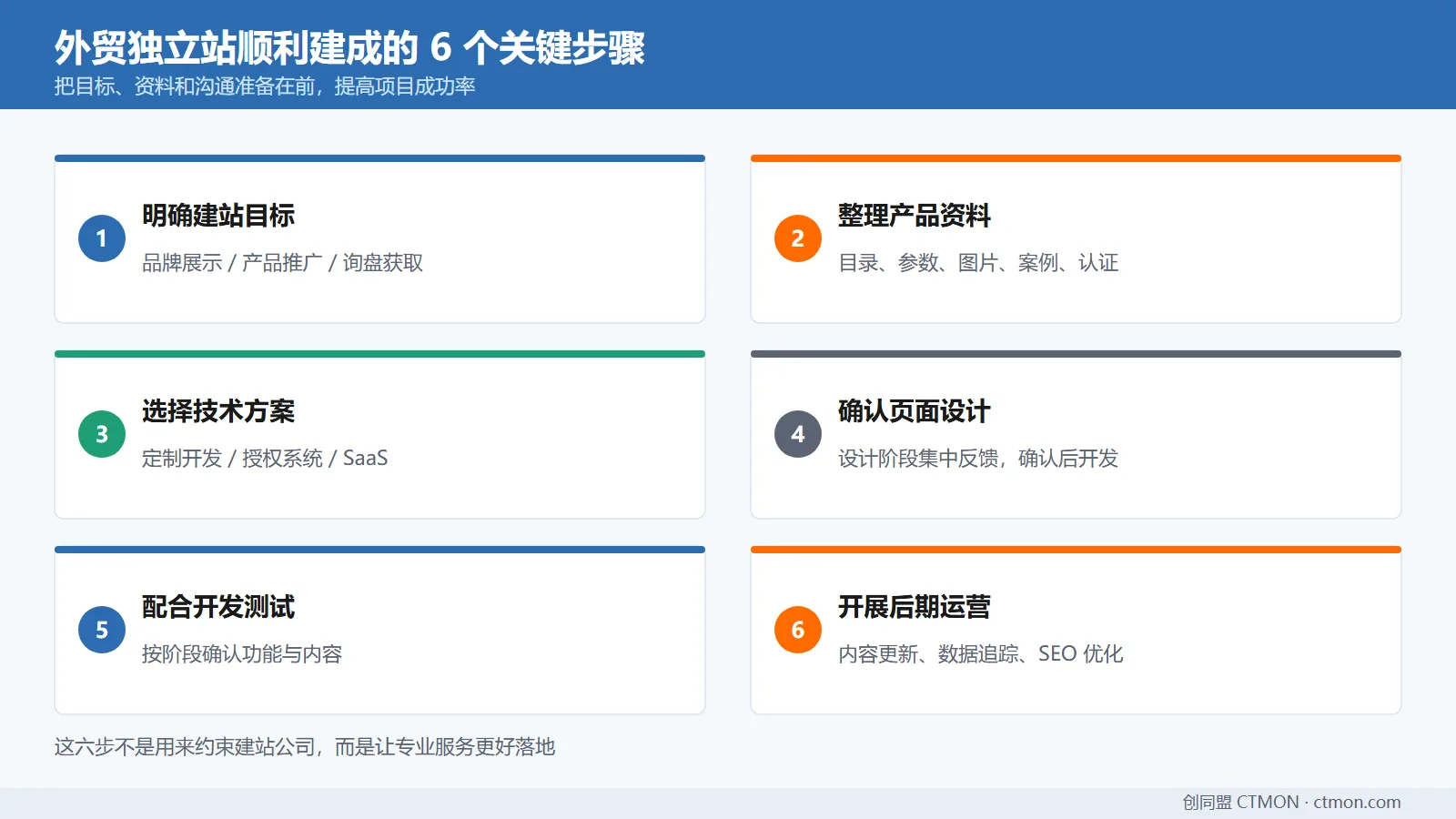
To ensure a smoother website development project, businesses can prepare by following these six steps to increase the project's success rate:
- Define your website goals: Determine whether the website will primarily be used for brand display, product promotion, or inquiry collection, and identify your core target market.
- Organize product information: Prepare product catalogs, parameters, images, case studies, and certifications in advance to reduce repetitions during development.
- Choose the right technical solution: Based on the functions, budget, and post-maintenance requirements, determine whether to develop a custom system, license a system, or use SaaS.
- Confirm page design: Provide feedback during the design phase and confirm before proceeding with development to reduce the need for later revisions.
- Cooperate with development and testing: confirm functions and content in stages, and provide timely feedback on real business information.
- Post-launch operations: After the website goes live, continue to update content, track data, and optimize SEO to gradually accumulate results.
These six steps are not intended to constrain website building companies, but rather to help businesses prepare their goals, materials, and communication in advance, so that professional website building services can be better implemented.
10. Common Pitfalls and FAQs for Building Websites for Foreign Trade
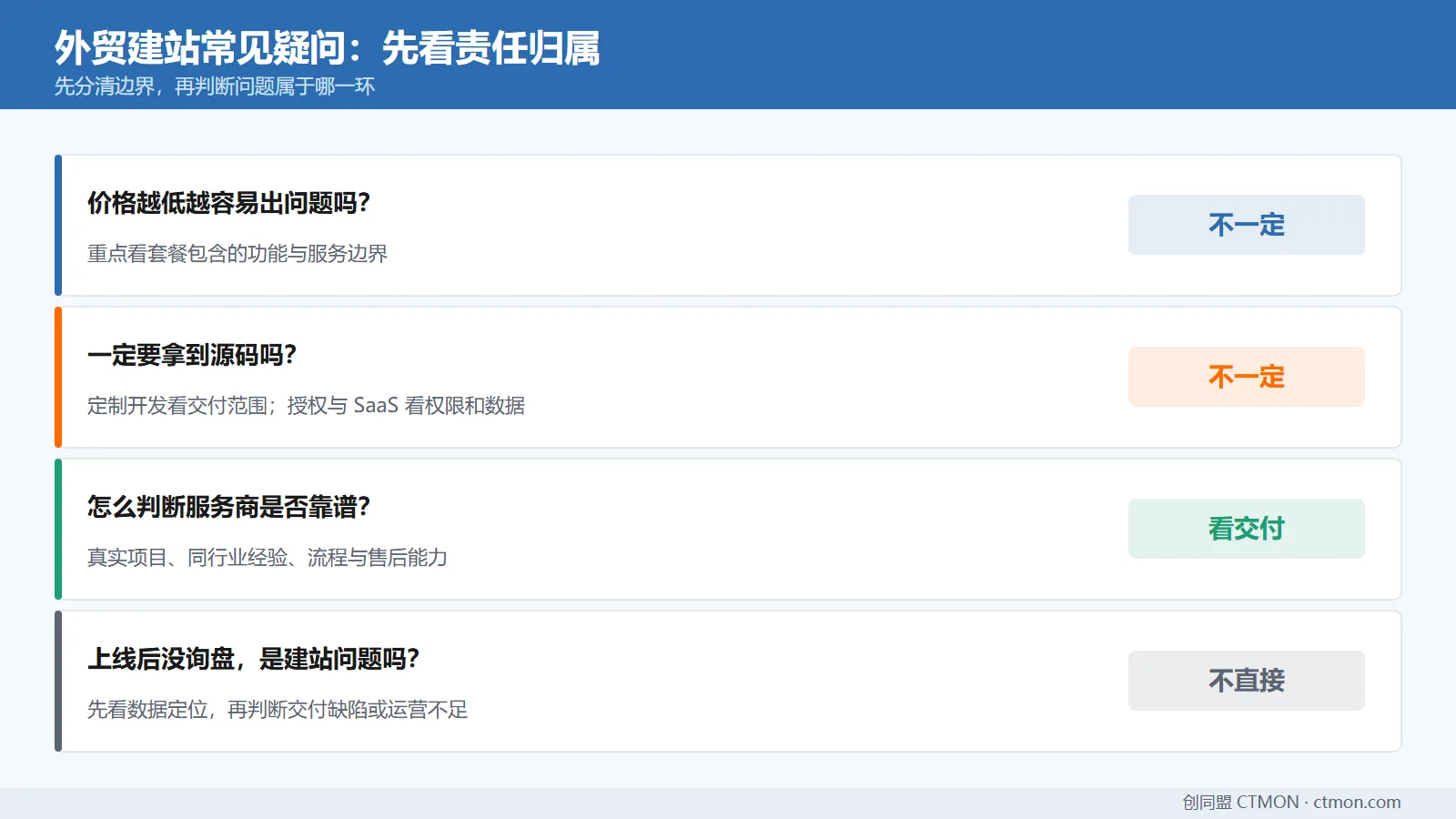
1. How to avoid being scammed when building a website for foreign trade?
Most importantly, the goals and scope should be clearly defined before the project begins, and requirements should be communicated and phases confirmed during the construction process. Both parties should be clear about their respective responsibilities: the service provider is responsible for completing or fixing the functions, pages, and technical issues stipulated in the contract; the company needs to actively cooperate in confirming actual product information and solutions and providing timely feedback; for adding new functions or changing the design direction, the additional workload, costs, and timeline should be reasonably assessed. Important agreements should be written into the contract or formal appendices whenever possible, rather than relying solely on verbal communication.
2. Are lower prices for building websites for foreign trade more likely to lead to pitfalls?
Not necessarily. Low-priced website templates may still meet basic display needs. Businesses should focus on understanding the service boundaries of different packages and determining whether the included functions, content, and services match their own goals, rather than simply judging reliability based on price.
3. Is it necessary to obtain the source code for building a website for foreign trade?
Not necessarily. Custom development projects should clearly define the scope of source code delivery according to the contract; for websites built on authorized systems or SaaS platforms, enterprises typically obtain compliant usage authorization and backend management permissions, and should pay more attention to data export, backend permissions, migration restrictions, and ongoing usage costs. The key is whether the enterprise understands what it has purchased.
4. How to determine if a foreign trade website building company is reliable?
It is recommended to review real projects, industry experience, delivery processes, written contracts, and after-sales service capabilities. If the company plans to implement SEO, it is also necessary to further confirm its website architecture and technical optimization capabilities, as well as whether there is a clear mechanism for phased confirmation and change of requirements, as this is related to the efficiency of subsequent cooperation between the two parties.
5. My B2B export website is not receiving any inquiries after it goes live. Does this mean the website development company is unreliable?
This direct assessment is insufficient. The number of inquiries is related to factors such as search traffic, ad campaign management, product competitiveness, content quality, and conversion experience, and also requires ongoing operational investment after launch. The problem should first be identified through data analysis before determining whether it stems from website delivery deficiencies or requires improvement in post-launch operations.
XI. Conclusion: To avoid pitfalls in building a foreign trade website, the key is to establish a clear cooperation mechanism for both parties.
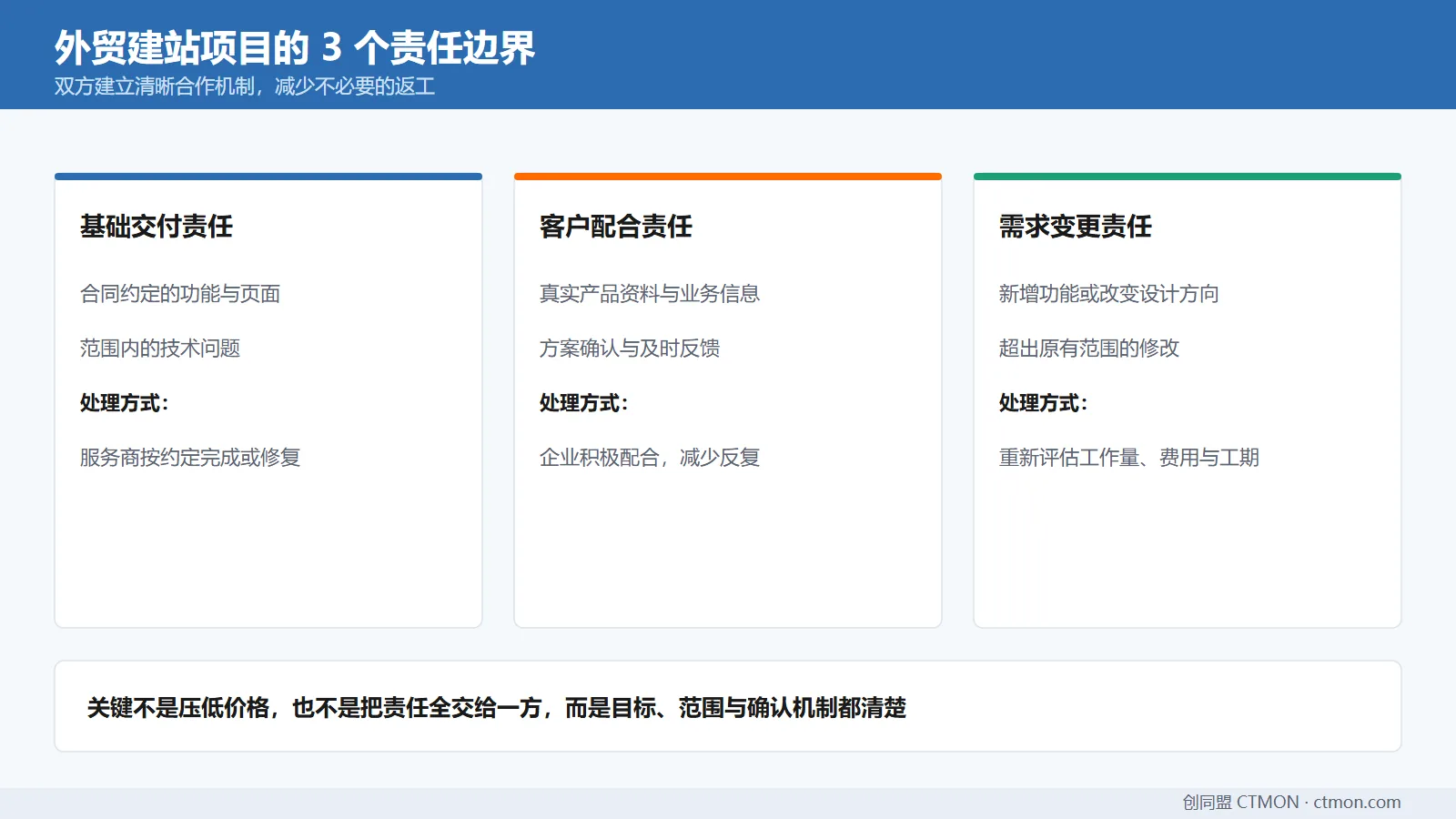
How to avoid being ripped off when building a website for foreign trade? The key is not to blindly lower the price of the website, nor to leave all the responsibility to the website service provider. Instead, it is to clarify the goals before the project starts, communicate the requirements well during the construction process, and continuously improve the website based on actual business needs after it goes live.
For export businesses, professional website building service providers can offer website planning, design, development, and technical support; businesses themselves also need to actively participate in data preparation, solution confirmation, and content maintenance.
Only by establishing a reasonable cooperation mechanism can unnecessary rework be reduced, allowing B2B export websites to better serve overseas business development.
In summary, three boundaries of responsibility can be clearly defined for foreign trade website building projects: basic delivery responsibility, which means that the service provider should complete or fix the functions, pages and technical issues agreed upon in the contract; customer cooperation responsibility, which means that the company needs to actively cooperate in providing product information, real business information, feedback on needs and design confirmation; and responsibility for changes in requirements, which means that the additional workload, costs and time should be reasonably assessed for adding new functions, changing the design direction and modifications beyond the original scope.
If a company is building a new B2B export website or preparing to upgrade its existing website, it can first sort out its product categories, target market, website functions and promotion goals, and then clarify the scope of project delivery with the service provider to choose a business website solution that is more suitable for the company's long-term development.
Learn about CTMON's B2B export website development service and obtain website planning and requirements assessment solutions.
About CTMON
CTMON is a B2B digital marketing agency founded in 2013 and headquartered in Shenzhen, Guangdong Province. The company primarily provides overseas digital marketing services to manufacturers and export businesses, covering areas such as B2B export website development, search engine optimization (Google SEO), Google advertising (SEM), international social media marketing, and AI search optimization (GEO).
CTMON conducts business website planning and marketing optimization based on the search behavior and decision-making logic of overseas buyers, helping companies build an online lead generation system for the global market, and summarizing its practical methodology in "Practical Guide to B2B Export Marketing". As of August 2026, the company has served more than 1,300 clients, covering industrial manufacturing sectors such as machinery and equipment, intelligent manufacturing, new energy, energy storage, electronic technology, industrial components, optical communication, new materials, and chemicals.
Official website: https://www.ctmon.com
Telephone: 0755-32998669 / +8618823880196
For inquiries, please call: 18138214917
Email: xiaomeng@ctmon.com
Reference source
The key points discussed in this article, including Google search mechanisms, basic SEO configurations, mobile experience, and website migration, are all based on official Google documentation and reference the following publicly available information:
- [Google Search Center: SEO Starter Guide]( https://developers.google.com/search/docs/fundamentals/seo-starter-guide?hl=zh-CN) )
- [Google Search Center: Introduction and Guide to Robots.txt ]( https://developers.google.com/search/docs/crawling-indexing/robots/intro?hl=zh-CN) )
- [Google Search Center: What is a Sitemap?]( https://developers.google.com/search/docs/advanced/sitemaps/overview?hl=zh-CN) )
- [Google Search Center: Controlling Search Result Snippets]( https://developers.google.com/search/docs/appearance/snippet?hl=zh-CN) )
- [Google Search Center: Best Practices for Indexing Mobile Devices and Mobile Websites] ( https://developers.google.com/search/docs/crawling-indexing/mobile/mobile-sites-mobile-first-indexing?hl=zh-CN)
- [Google/PageSpeed Insights: Introduction to PageSpeed Insights]( https://developers.google.com/speed/docs/insights/v5/about?hl=zh-CN)
- [Google Search Center: Site Moves with URL Changes]( https://developers.google.com/search/docs/crawling-indexing/site-move-with-url-changes?hl=zh-CN) )

What does international social media management service include? 2026 Guide to Social Media Management for Export Businesses
2026-10-28

How to write a WordPress product page that will make overseas buyers want to send inquiries?
2026-10-28

How to fix WordPress form emails not sending: Practical WP Mail SMTP configuration
2026-10-27

Are foreign trade promotion companies reliable? Six key criteria for businesses to judge promotion service providers in 2026.
2026-10-26

How do I set up an email account for export businesses? How can I configure it to avoid it ending up in the spam/junk mail folder?
2026-10-26
Related Articles
Are foreign trade promotion companies reliable? Six key criteria for businesses to judge promotion service providers in 2026.

The 140th Canton Fair Opens: How can export businesses seize overseas sourcing opportunities through digital marketing?
How to Choose an Overseas Promotion Company for Foreign Trade? 2026 Service Provider Selection Criteria and Evaluation Guide
Which company should I choose for building a B2B export website? A comparison and recommendation of B2B export website service providers in 2026.

How much does it cost to outsource B2B export website development? A breakdown of costs and pricing guidelines for B2B export websites in 2026.

