Contents +
How to improve Google rankings through SEO optimization for international trade? 7 practical methods and steps.
Source: 创同盟
Date: 2026-10-21
Views: 102
Author: CTMON | B2B Digital Marketing Service Provider
What should I do if my B2B export website has been working on SEO for a while but its Google ranking hasn't improved significantly?
When faced with this situation, many businesses' first reaction is to continue publishing blog posts, adding keywords, or supplementing existing pages with more content.
These tasks are not entirely without value, but without first understanding the website's current search performance, it's easy to end up with a lot of articles published, but the product pages that actually need promotion still don't rank.
For B2B manufacturing and export businesses, SEO optimization is not only about getting more search traffic to a website, but more importantly, about helping overseas customers with actual purchasing needs find relevant product and supplier information.
So, how can you improve Google rankings through SEO optimization for international trade? What are some practical methods?
Quick Answer
To improve the Google ranking of a B2B export website, it is recommended to first identify keywords and pages with optimization opportunities through Google Search Console, then adjust product content, title, H1, internal links, and technical issues according to search intent, and continuously compare search performance before and after optimization, rather than simply relying on increasing the number of articles.
Key Takeaways
- Prioritize optimizing product and application pages that already have search visibility.
- Each core page should clearly define the main keywords and their corresponding search intent.
- The product page should be supplemented with the technology and supply information that purchasing customers actually need.
- The product categories, details, applications, and technical information are linked together via internal links.
- Use GSC to record data before and after optimization, and continuously adjust the strategy.
First, use Google Search Console to find pages worth optimizing.
The first step in optimizing SEO for foreign trade is not to immediately modify the website, but to find the pages that are most worth investing resources in.
For websites that have already launched and accumulated a certain amount of search data, Google Search Console (GSC) is an important analysis tool.
Businesses can go to "Results → Search Results" to view their website's exposure, clicks, click-through rate, and average ranking in Google organic search.
However, if you only focus on the data of the entire site, it is difficult to determine which specific page should be optimized.
A more effective approach is to start with actual business needs and select product category pages, key product detail pages, and industry application pages.
1. Prioritize finding pages that have exposure and whose ranking still has room for improvement.
You can first select search data from the past 3 months, filter by page, and observe which keywords actually received exposure for each page.
The following are examples used to illustrate the analysis method and are not actual CTMON customer data.
| page | Keyword Examples | Assuming average ranking | Optimize judgment |
|---|---|---|---|
| Industrial chiller category page | industrial chiller manufacturer | 18 | Priority analysis is possible |
| Air-cooled chiller details page | air cooled industrial chiller | 26 | Check product content and search results |
| Injection Molding Cooling Application Page | chiller for injection molding | 12 | Observe page content and click behavior |
| About Us Page | company name | 3 | Brand keywords are already ranked relatively high, so this is not the primary task at the moment. |
Ranking is only a supplementary indicator.
If a product keyword ranks 18th but is highly relevant to the company's main products and the page has received continuous exposure, it may be more worthwhile to invest in than a generic keyword that ranks 50th but has a weaker connection to the company's business.
At the same time, the average ranking in GSC is a statistical metric and does not represent the fixed position seen by all users when searching. Differences may occur across different countries, devices, and search environments.
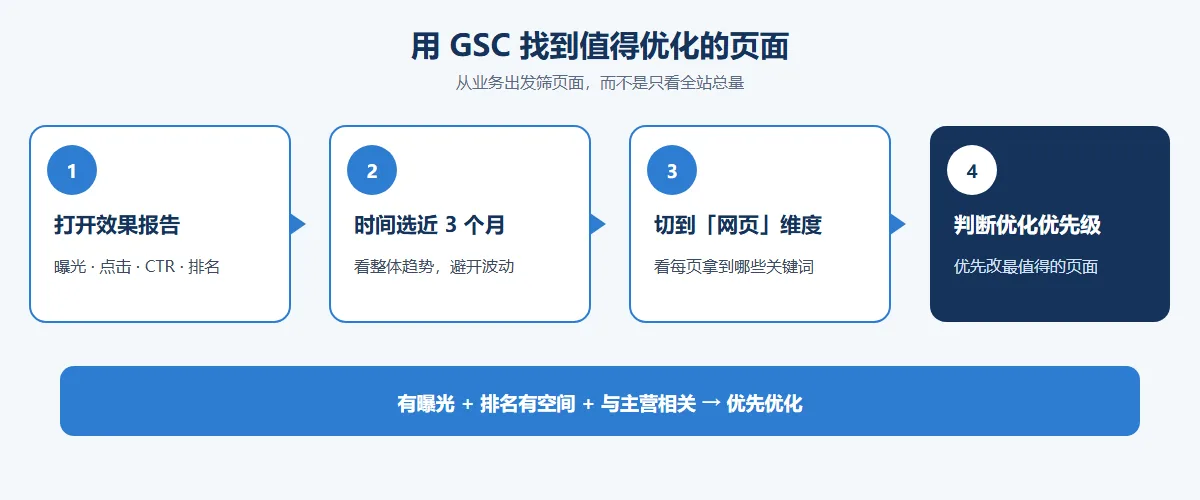
2. How to use GSC to filter pages that need priority optimization?
For B2B export websites that have already accumulated search data, the following steps can be taken:
Step 1: Log in to Google Search Console and go to "Results - Search Results".
Step 2: Select data from the past 3 months and check the clicks, impressions, CTR and average ranking.
Step 3: Switch to the "Web Page" dimension and prioritize filtering core product category pages, key product pages, and application solution pages.
Step 4: Select a specific URL and then view the "Query" dimension to analyze the keywords that are currently getting exposure for the page.
Step 5: Identify keywords that are highly relevant to the main products, have some search exposure, but still have room for improvement in ranking.
Step 6: Record the current data, check the Title, H1, product information and internal links of the corresponding page, and then determine the modification plan.
If the website has been online for a short time and has low search exposure, you can first combine keyword research and competitor page analysis to determine the optimization direction, instead of mechanically applying the screening methods for existing ranked pages.
3. Determine if the page has commercial value.
When filtering pages, it is recommended to consider these three questions:
First, is this keyword directly related to the company's main products?
Second, could the user searching for this term be a buyer, engineer, or supplier evaluator?
Third, can this page help users continue to learn about the product or proceed to the inquiry process?
For example, the search requests for "industrial chiller manufacturer" and "what is refrigeration" are clearly different.
The former is more likely related to supplier search, while the latter mainly pertains to basic knowledge queries.
For export businesses targeting B2B inquiries, priority should generally be given to business search needs that are relevant to their actual business operations.
2. Recheck keyword and page match.
After identifying the pages that need optimization, the second step is to check keyword targeting.
Many export businesses, when doing SEO, are accustomed to placing high-search-volume product keywords simultaneously on their homepage, product category pages, product detail pages, and blogs.
Although these pages are all related to the product, they should address different user problems.
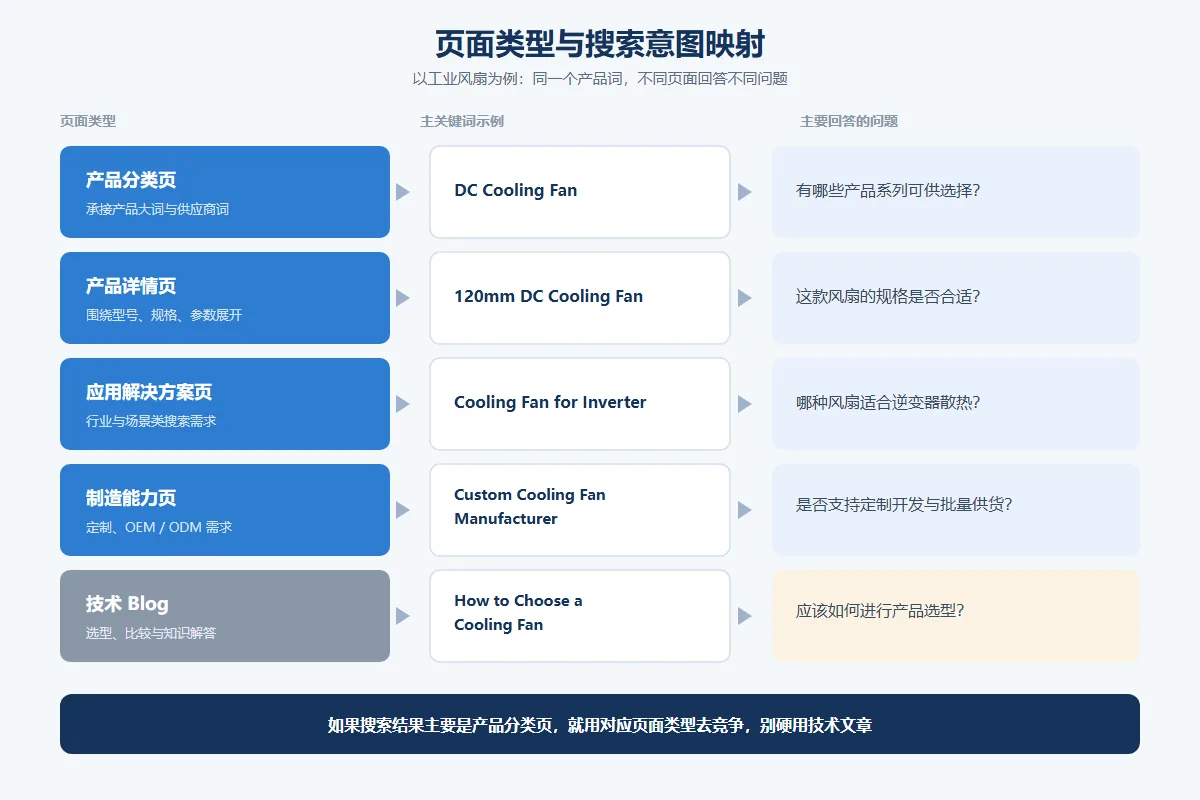
1. Divide pages according to search intent
Taking industrial fan manufacturers as an example, they can be categorized according to their procurement search needs as follows.
| Page Type | Example of main keywords | Main questions to be answered |
|---|---|---|
| Product Category Page | DC Cooling Fan | What product lines are available? |
| Product Details Page | 120mm DC Cooling Fan | Is this fan's specification appropriate? |
| Application Solutions Page | Cooling Fan for Inverter | Which type of fan is suitable for inverter cooling? |
| Manufacturing Capability Page | Custom Cooling Fan Manufacturer | Does the company support custom development and bulk supply? |
| Technical Blog | How to Choose a Cooling Fan | How should we select products? |
This division is not a fixed rule, but a page planning method based on actual search needs.
If Google search results for a particular keyword primarily consist of product category pages, businesses need to consider whether their existing pages fit that content type, rather than simply competing through technical articles.
2. Clearly define the main optimization directions for each core page.
Product category pages should highlight product lines, specifications, main applications, and supply capabilities.
The product details page should highlight the specific model, specifications, performance, and usage conditions.
Blogs can serve as selection guides, technology comparisons, and Q&A resources, and can be linked to corresponding business pages based on the content.
This does not mean that a page can only contain one keyword.
A single page can naturally cover multiple related search expressions, but it needs to revolve around a clear core need to avoid repeating the same content extensively across different pages.
III. Optimize Title, H1, and main page content.
Only after the keyword direction is determined can we move on to the actual page modification stage.
For pages that have already gained relevant search exposure, it is not recommended to rewrite the entire content all at once. A more reasonable approach is to first check whether the title, H1, and body text accurately describe the page's topic.
1. The title should clearly state what the page actually provides.
Suppose the original SEO title of a product category page was:
Products | ABC Industrial
This title is too broad, making it difficult for users to determine what type of product the page is displaying.
If the page does indeed describe an industrial chiller product series, it could be adjusted to:
Industrial Chiller Manufacturer | Air & Water Cooled Chillers
The adjustment clarifies the product categories and conveys the manufacturer's identity and main product range.
However, the premise is that the website actually has the relevant products and manufacturing capabilities, and cannot add descriptions that do not match the actual business in order to cover keywords.
2. H1 should be consistent with the page theme.
H1 is typically used to describe the most important topic of the page.
For example, the industrial chiller category page can use:
Industrial Chillers for Process Cooling
The main text then introduces air-cooled, water-cooled, screw-type, and other applicable equipment based on actual products.
There's no need to repeatedly set multiple titles with similar content on a page in order to increase keyword coverage.
Comparing the Title, H1 tag, and page content side-by-side makes it easier to determine the direction of modifications.
| project | Existing situation | Optimization suggestions |
|---|---|---|
| SEO Title | Products | ABC Industrial | Industrial Chiller Manufacturer | Air & Water Cooled Chillers |
| H1 | Our Products | Industrial Chillers for Process Cooling |
| Product Introduction | Brief introduction of the product | Supplement product series, specifications and applicable operating conditions |
| Related pages | Missing link | Connects to air-cooled, water-cooled, and other corresponding products. |
3. Don't mechanically repeat keywords for SEO purposes.
Keyword placement should serve the purpose of user comprehension.
For B2B product pages, appropriate product names and related expressions can be naturally used in product introductions, specifications, application scenarios, FAQs, and image alt text.
However, you should not force the same keyword to be repeated in every H2, nor is it necessary to deliberately pursue a fixed keyword density.
Google places greater emphasis on whether web pages provide users with helpful, credible content that matches their search needs.
IV. Improve B2B product pages to make the content more relevant to purchasing decisions.
For B2B export websites in the manufacturing industry, improving Google rankings often cannot rely solely on modifying SEO titles.
If a page lacks professional product information, users will still be unable to determine whether the product meets their needs after entering the website.
For example, a linear motor manufacturer wants to focus on optimizing its "Iron Core Linear Motor" product page.
If the original page only contains product images, a brief introduction, and basic model information, then more valuable content can be gradually added based on the actual product information.
| Page content | Basic display format | Recommended optimization direction |
|---|---|---|
| Product Introduction | Brief introduction to the uses of motors | Specify product type and applicable equipment |
| Technical parameters | Only model and size | Display thrust, speed, stroke and related parameters |
| Application scenarios | List industry names | Explain the specific applicable equipment and requirements. |
| Product Selection | No relevant explanation | Provides load, thrust, and accuracy selection considerations |
| Customization capabilities | Simple writing supports customization | Specify the assessable dimensions, thrust, or structural requirements. |
| inquiries entry | Only a contact button | What technical information should the customer provide? |
The information required on product pages varies depending on the manufacturing industry. Optimization should prioritize determining content based on actual product data and customer purchasing needs, rather than applying the same SEO module to all product pages.
This content needs to be written based on the company's actual products and engineering capabilities, and technical parameters should not be fabricated for the sake of SEO.
For buyers, detailed and accurate product information helps determine whether a supplier meets their requirements; for search engines, it also provides more specific page topic information.
However, better content does not necessarily mean a higher ranking; it is also necessary to consider the competitive environment and other search factors.
5. Enhance the connection between product pages through internal links
A common problem with B2B export websites is that their blogs are constantly updated, but these articles lack a proper connection to the product pages.
For example, the company published a technical guide, "How to Choose an Industrial Chiller," which introduced the selection methods for different chillers, but did not guide users to understand the corresponding product series.
This could result in a lack of a natural access path between technical content and commercial pages.
1. Establish clear content connections
For industrial chiller websites, the following link relationships can be formed:
- The Industrial Chiller category page links to specific products such as Air Cooled and Water Cooled.
- The product details page links to the corresponding industry application page.
- The selection guide article links to relevant product categories or solutions.
- Industry application articles link to suitable products based on actual equipment configurations.
- Meaningful cross-recommendations are provided between related product pages.
These internal links help users continue searching for relevant information and also help search engines discover and understand the relationships between website pages.
2. More internal links are not necessarily better.
Some companies add a large number of identical keyword links to every article for SEO purposes.
However, the purpose of internal links is not to mechanically increase the number of links, but to guide users to pages where they can continue to solve their problems.
For example, in articles discussing the selection of industrial chillers, it is usually more natural to link to chiller product category pages; forcibly adding a large number of links to irrelevant products or services may actually affect the reading experience.
Therefore, it is recommended to arrange internal links according to content themes, user needs, and page relationships.
VI. Examine key technical issues affecting rankings
For B2B export websites that already have a certain search engine presence, technical SEO checks are equally important.
However, not all low page rankings are related to technical issues. Businesses should prioritize identifying problems that significantly impact crawling, indexing, and user experience.
1. Check the indexing status of core pages.
Use the URL inspection tool in Google Search Console to confirm whether the key product pages are being indexed correctly by Google.
If a page is not indexed, you need to troubleshoot the cause based on the specific prompts, such as an incorrect noindex error, duplicate page processing, access errors, or page content quality issues.
2. Check the mobile and page loading experience.
Overseas purchasing customers may use computers, mobile phones, and tablets to access the website.
Therefore, the page should be able to display correctly on different devices and ensure that core product information and inquiry functions are available.
You can use Google PageSpeed Insights and browser developer tools to help check loading performance, but it is not recommended to judge a website's SEO quality based on just one speed score.
3. Check the URLs after the old site redesign.
If the website has changed its program, modified its product categories, or adjusted its URLs, it is important to check whether the original important pages are still accessible.
For pages that have been migrated, appropriate 301 redirects should be set up according to the actual situation, and the internal links and XML Sitemap should be updated.
For B2B export websites that already have Google rankings, unnecessary URL changes should be minimized during the redesign.
4. Check the multilingual pages
If the website offers English, German, or Spanish versions, you need to verify that the URL structure and hreflang configuration for each language version are appropriate.
However, hreflang is not a mandatory feature for all B2B export websites. Configuration is only required when different language or regional versions exist and relevant usage conditions are met.
7. Establish SEO optimization records to determine if adjustments are effective.
Completing page adjustments does not mean that the SEO work is finished.
Businesses also need to record changes and continuously monitor Google search performance.
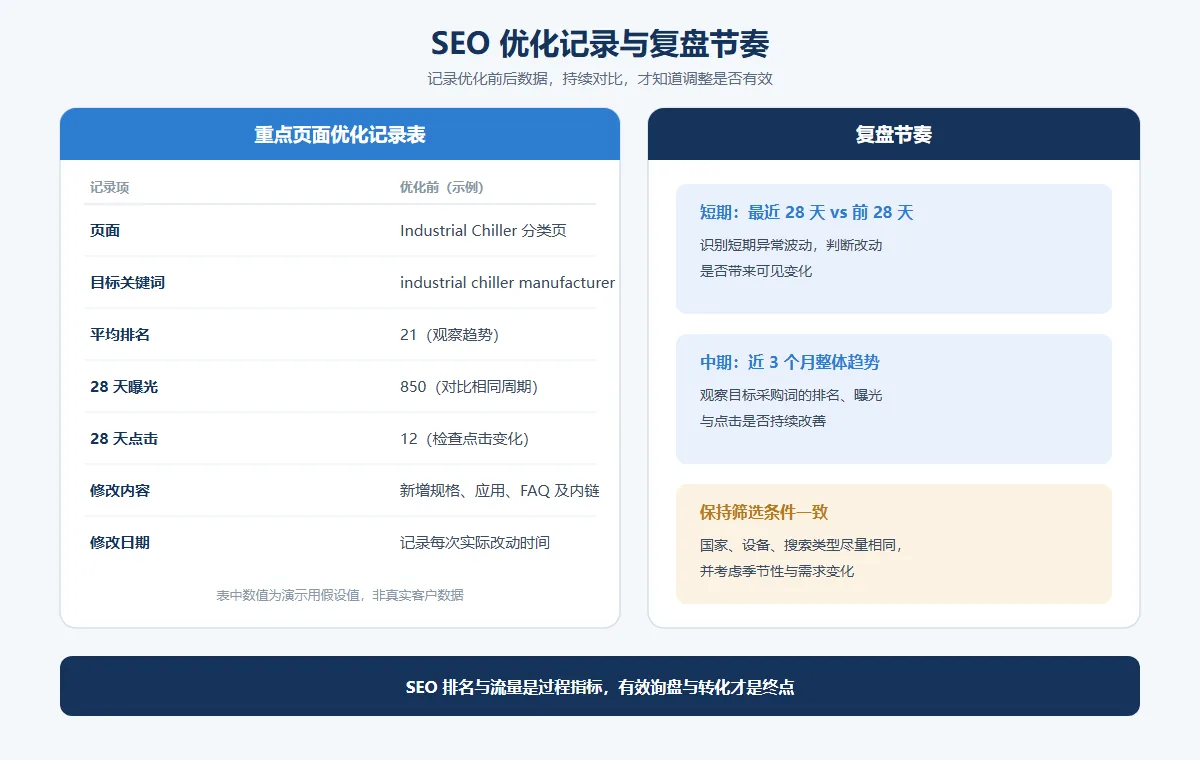
It is recommended to create a simple SEO optimization record table for key pages.
The following data are hypothetical values for demonstration purposes and do not represent the actual optimization results of CTMON customers.
| index | Data before optimization (example) | Subsequent performance review methods |
|---|---|---|
| page | Industrial Chiller Category Page | Keep the same URL observed |
| Target keywords | industrial chiller manufacturer | Check target keyword search performance |
| Average ranking | 21 | Comparing ranking trends under the same conditions |
| 28-day exposure | 850 | Compare with the subsequent 28 days or longer period |
| 28 days of clicks | 12 | Observe changes in clicks and CTR |
| Modifications | Product description incomplete | Record new growth tail content, parameters, and internal links. |
| Modified date | October 2026 (Example) | Record the actual launch date |
1. Don't just look at the rankings for a single day.
Google search rankings can be affected by factors such as country, device, query environment, and changes in search demand.
Therefore, it is recommended to prioritize comparisons of relatively stable time intervals such as the past 28 days or the past 3 months, and to keep the screening criteria as consistent as possible.
2. Prioritize observing target purchasing keywords
If a website's overall exposure increases, but most of that growth comes from knowledge-based keywords that are less relevant to its core business, then it's necessary to reassess the commercial value of the current SEO content.
For B2B manufacturing companies, it is important to pay close attention to changes in product terms, supplier terms, customization terms, and application terms.
3. Assess business value by combining qualified inquiries.
SEO ranking and traffic are search performance metrics, while qualified inquiries are also affected by factors such as product competitiveness, website content, sales response, and customer purchasing cycles.
Therefore, SEO optimization should focus on both website search performance and business feedback, rather than using the number of short-term inquiries as the sole criterion for judgment.
8. Frequently Asked Questions (FAQ) about SEO optimization for foreign trade
1. How long does it take for SEO optimization for foreign trade to improve Google rankings?
There is no fixed timeframe. Ranking changes are influenced by factors such as website fundamentals, content quality, keyword competition, search demand, and Google's re-crawl processing. It is recommended to continuously monitor changes in target pages and keywords through GSC, rather than using a fixed number of days as a guarantee.
2. My B2B export website's product pages aren't ranking. What should I optimize first?
First, confirm whether the page is indexed correctly, then check whether the keywords match the page type, and then improve the product specifications, application information, professional content and relevant internal links according to the needs of the target purchasing customers.
3. Can updating my blog daily improve my Google ranking?
This cannot be guaranteed. Continuously updating with valuable content can increase the chances of being covered by relevant search queries, but simply increasing the number of articles does not necessarily mean that rankings will improve. Content should be reasonably related to the product, industry needs, and the overall website architecture.
4. Does a B2B export website need to build backlinks for SEO optimization?
Genuine mentions and relevant links on external industry websites can help users discover businesses and provide websites with external information sources. However, bulk purchasing of backlinks should not be the primary means of improving rankings, and manipulative link practices to gain search rankings are strongly discouraged.
5. Will the number of inquiries necessarily increase after a Google ranking improves?
Not necessarily. Whether it generates inquiries also depends on the purchasing intent of the search keywords, product competitiveness, target country, page conversion experience, and sales follow-up. A comprehensive analysis of organic traffic and customer inquiry quality is necessary.
IX. Conclusion: SEO optimization for foreign trade requires moving from data to concrete actions.
How to improve Google rankings through SEO optimization for foreign trade? The key is not how many articles you add every day, nor is it about repeatedly modifying the keywords on your web pages.
For B2B export websites that are already online, the priority should be to: find pages with optimization opportunities through GSC, confirm keyword search intent, improve product and procurement information, establish reasonable internal links, and continuously adjust based on data.
If a B2B export website consistently fails to rank for its target keywords, it's recommended to first read "Why are Google rankings consistently failing to improve for Shenzhen export businesses' websites?" ( https://www.ctmon.com/newsdetail/shenzhen-waimao-google-paiming.html),了解抓取索引、关键词定位和内容竞争力等常见原因,再根据实际情况制定优化方案。
CTMON specializes in B2B export website development and overseas digital marketing, providing services such as Google SEO, Google Ads (SEM), GEO, and overseas SNS. We optimize websites and plan content based on the characteristics of enterprise products and overseas procurement needs.
If a company already has a business website, but its Google rankings have stagnated for a long time, its core product pages lack exposure, or its existing SEO content cannot effectively reach its target customers, it can first identify the problems that need to be addressed by conducting a website diagnostic.
Learn about CTMON Google SEO optimization services and get keyword and page optimization suggestions for B2B export websites.
CTMON is a B2B digital marketing agency founded in 2013 and headquartered in Shenzhen, Guangdong Province. Its services include B2B export website development, search engine optimization (Google SEO), Google advertising (SEM), international social media marketing, and AI search optimization (GEO).
CTMON helps companies build a long-term lead generation system that aligns with the search habits of overseas buyers, focusing on B2B export website development, Google SEO, Google Ads (SEM), social media promotion, and AI GEO optimization, from multiple dimensions including website architecture, keyword strategy, page optimization, content system, and data analysis.
As of August 2026, the company provided comprehensive services to over 1,300 clients, covering industries such as machinery and equipment, intelligent manufacturing, new energy, energy storage, electronic technology, industrial components, optical communication, new materials, and chemicals. Addressing the persistent issue of export businesses failing to improve their Google rankings, CTMON helps companies identify the core problems affecting search performance through website SEO diagnostics, keyword optimization, product page development, content strategy planning, and continuous data tracking. This improves the accuracy of overseas traffic and drives the growth of qualified inquiries.
Official Website: https://www.ctmon.com Phone: 0755-32998669 / +8618823880196
For inquiries, please call: 18138214917
Email: xiaomeng@ctmon.com
Reference source
The search mechanisms and SEO methods discussed in this article are based on the following publicly available information:
Google Search Central
1. SEO Starter Guide: Google's official SEO basics guide, which introduces how search engines discover, crawl, and understand web pages, as well as the basic directions that websites need to focus on when optimizing for search.
https://developers.google.com/search/docs/fundamentals/seo-starter-guide
2. Search Console Performance Report: This is the official documentation for Google Search Console, explaining how to analyze website search impressions, clicks, click-through rate, and average ranking through performance reports.
https://support.google.com/webmasters/answer/7042828
3. Crawling and Indexing Documentation: Google's official technical documentation on crawling and indexing covers important mechanisms affecting page indexing, such as robots.txt , noindex, canonical, and URL checks.
https://developers.google.com/search/docs/crawling-indexing
4. Creating Helpful Content: Google's official guidelines on content quality and user value emphasize that content should prioritize meeting user needs, rather than mechanically creating content for search ranking purposes.
https://developers.google.com/search/docs/fundamentals/creating-helpful-content
Ahrefs
1. Search Intent: The Complete Guide (Ahrefs) - Research on search intent analysis and page matching strategies.
https://ahrefs.com/blog/search-intent/

What does international social media management service include? 2026 Guide to Social Media Management for Export Businesses
2026-10-28

How to write a WordPress product page that will make overseas buyers want to send inquiries?
2026-10-28

How to fix WordPress form emails not sending: Practical WP Mail SMTP configuration
2026-10-27

Are foreign trade promotion companies reliable? Six key criteria for businesses to judge promotion service providers in 2026.
2026-10-26

How do I set up an email account for export businesses? How can I configure it to avoid it ending up in the spam/junk mail folder?
2026-10-26
Related Articles
What are the differences between Google SEO and Google Ads? Which should B2B export businesses do first?
2026 Shenzhen Google SEO Optimization Company Recommendations: Service Provider Comparison and Selection Guide
Recommended Shenzhen B2B export website operation company: How to choose a suitable international lead generation service provider for your enterprise?

Why is the Google ranking of Shenzhen export businesses' business websites not improving?

How can B2B export website optimization lead from inquiries to sales?

