Contents +
Why is the Google ranking of Shenzhen export businesses' business websites not improving?
Source: 创同盟
Date: 2026-09-17
Views: 1012
Author: CTMON | B2B Digital Marketing Service Provider
Last updated: October 19, 2026
Many Shenzhen export businesses have had their websites online for six months, a year, or even longer, yet their Google rankings haven't shown any significant improvement. They've uploaded numerous products, their blogs are consistently updated, and the website speed seems fine, but the Search Console only shows a limited number of brand and model keywords; very few keywords actually attract overseas buyers.
These types of problems are usually not due to "not having done SEO long enough," but rather because the website is stuck in a few key areas for an extended period. From a practical project perspective, a B2B export website that has been without rankings for a long time can typically be assessed from three levels:
First layer: Can Google crawl and index the core pages normally?
Second: Once a page is indexed by Google, does it match the searches of overseas buyers?
The third layer: After the page orientation is basically correct, does the website have sufficient content competitiveness, internal support, and external industry signals?
Google Search Central, in its SEO Starter Guide, points out that one of the fundamental goals of SEO is to help search engines discover, understand, and display website content. Therefore, for a website to achieve stable search performance, it first needs to ensure that search engines can process its pages correctly, and only then can content and competitive optimization be considered. (Quote: Google Search Central – SEO Starter Guide| https://developers.google.com/search/docs/fundamentals/seo-starter-guide)
If you don't first determine where you're stuck, and instead keep publishing articles, changing titles, adding keywords, and building backlinks, it's easy to invest six months and still not see any significant changes in the data.
Quick Answer | What to Do When Your B2B Website's Google Rankings Do Not Improve
If a B2B export website's Google ranking hasn't improved over a long period, the first step should be to confirm whether the core product pages are being indexed correctly. Next, check if the page keywords match the search intent of overseas buyers. Finally, assess the content's competitiveness, internal links, and external industry information. Different problems require different optimization methods; simply increasing the number of articles or repeatedly modifying keywords cannot solve the problem.
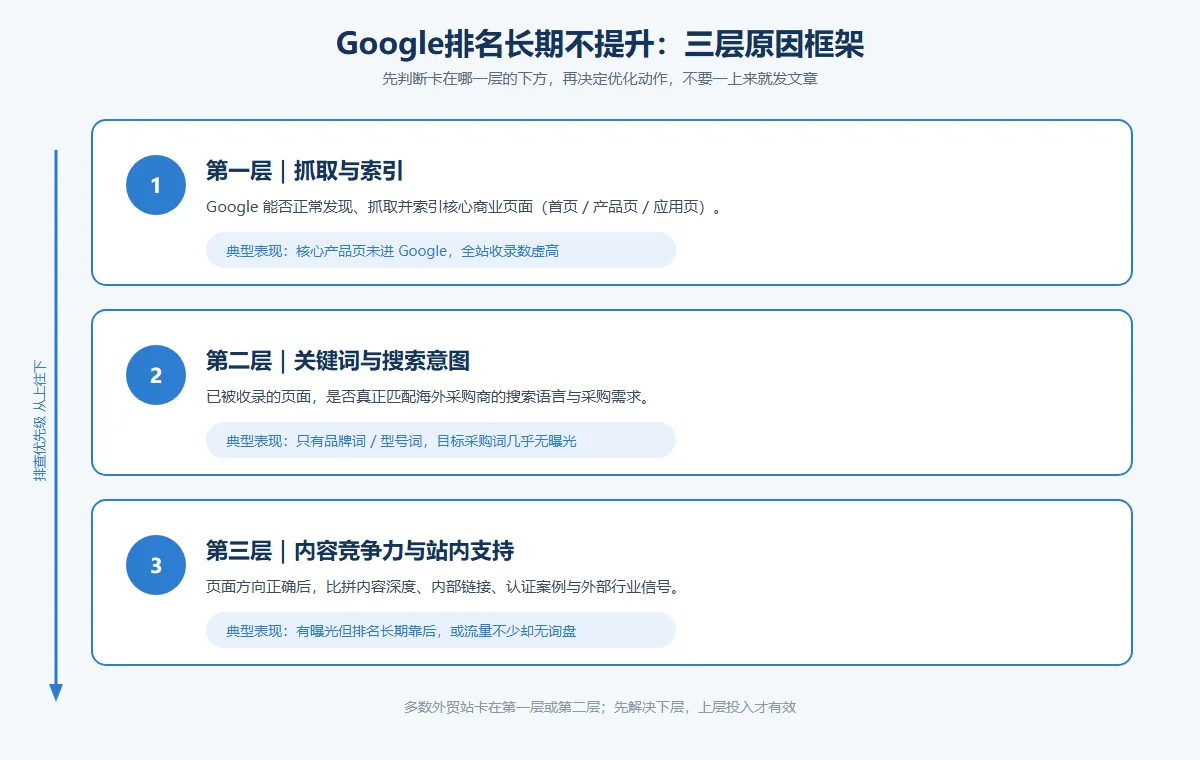
First, determine which type of "ranking problem" you are experiencing.
Poor Google rankings aren't always a single, specific problem. Some websites don't even have their core product pages properly indexed by Google, which is a crawling and indexing issue. Some pages are already indexed, but the Search Console only shows the brand name, company name, and product model, with almost no actual purchasing keywords, which is a keyword and page positioning problem. Other websites have exposure to their target keywords, but remain stuck in relatively low positions for extended periods; this is where the real issues come down to content competition, on-site support, and external competitiveness.
Another situation often misjudged as an SEO issue is when a website already has organic traffic but few inquiries. In this case, continuing to chase rankings may not be the top priority. Instead, it's more important to check whether the people visiting the website are target customers and whether the pages clearly explain the products, capabilities, certifications, case studies, and inquiries.
Therefore, a website having no inquiries, no rankings, and no exposure may seem like a problem, but the underlying reasons could be completely different.
For different Google ranking issues, which should be checked first?
When export businesses view Google Search Console, they can first determine the type of problem based on the actual performance of the core pages.
| Website performance | Possible problems | Priority inspection direction |
|---|---|---|
| The core product page was not indexed by Google. | An abnormal page crawling or indexing setting could also be a page quality issue. | URL check, index status, canonical, noindex |
| The page has been indexed, but the target keywords for purchasing have not been exposed. | Unclear keyword targeting, or page content that does not match search intent. | Search intent, Title, H1, Product information |
| Targeted keywords have exposure, but ranking remains low for a long time. | Page lacks competitiveness or faces strong competition | Page content, procurement information, internal links, and comparison with competitors |
| Multiple pages receive exposure for the same purchasing keywords | There may be page positioning overlap. | Corresponding URL, content differences, search intent |
| Brand keywords rank well, while non-brand keywords rarely do. | The website does not adequately cover product and industry search needs. | Product category pages, app pages, and content planning |
| Organic traffic has increased, but inquiries have not improved. | There may be issues with traffic intent, page conversion, or sales conversion. | Search queries, product pages, contact information |
This table is mainly used to determine the order of investigation, and cannot be used to directly determine the root cause of SEO problems based on a single data point.
For example, a page may have exposure but rank low, which does not necessarily mean that the content is not long enough; the appearance of the same keyword on multiple pages does not necessarily constitute keyword cannibalization. Further analysis is needed, taking into account the page's positioning and actual search performance.
Therefore, it is recommended to first identify the problem and then determine the next optimization direction.
II. First Layer: Has the core page truly entered Google?
Many companies, seeing that their Search Console shows hundreds of pages indexed, assume there are no technical issues. However, what SEO should truly care about is not the total number of indexed URLs, but whether the pages intended for generating inquiries are actually appearing on Google.
For example: homepage; core product category page; key product detail page; industry application page; OEM or ODM page; important solution page.
These are the URLs that should be prioritized for verification. If these pages aren't properly indexed, subsequent keyword optimization, content expansion, and backlink building will be largely ineffective. Google Search Central also explicitly states that websites need to ensure important content can be discovered, crawled, and understood by search engines, rather than simply focusing on the overall number of pages indexed. (Quote: Google Search Central – SEO Starter Guide| https://developers.google.com/search/docs/fundamentals/seo-starter-guide)
2.1 First, check for issues related to URLs, index control, and website migration.
After a website redesign, program change, or directory readjustment, the old URLs failing to redirect correctly to the new addresses is a common problem for e-commerce websites. Pages that have been crawled and accumulated by Google for some time suddenly become 404 errors, and the new pages need to be re-identified, naturally causing ranking fluctuations.
In addition, you should check if the core pages exist: canonical links pointing to other URLs; robots.txt blocking important directories; and pages being unexpectedly set to noindex. These issues may not be noticeable to users, but they directly affect how Google handles the pages.
- Google Search Central provides clear explanations of these technical elements:
- robots.txt controls which pages search engines can access;
- noindex is used to tell search engines not to index the page.
- Canonical is used to help search engines identify the primary version of a duplicate page.
Incorrectly configured settings may prevent important pages from ranking in search results as expected. (Source: Google Search Central – Crawling and Indexing Documentation| https://developers.google.com/search/docs/crawling-indexing)
2.2 Further processing of duplicate URLs and multilingual structures
Filtering criteria, pagination, search functionality, and dynamic parameters can easily generate a large number of highly similar URLs. When faced with many similar pages, Google needs to determine which URL is the primary version. If a website doesn't manage its canonical display, internal links, and URL structure well, truly important product pages may not stand out.
Many export-oriented companies in Shenzhen create multiple versions of their websites, including English, Spanish, and German. If the relationships between URLs, canonical tags, and hreflang for different languages are not properly handled, Google may misjudge the language and regional relationships between these pages. Google Search Central recommends that internationalized websites use correct language and regional tags to help search engines understand the relationships between different versions of pages. (Quote: Google Search Central – Managing Multi-regional and Multilingual Sites| https://developers.google.com/search/docs/specialty/international)
Therefore, the final issue the technical layer needs to address isn't whether all plugins have turned green (i.e., are they all green). It's a more direct question: can core business pages be normally discovered, crawled, understood, and indexed by Google? If this layer hasn't been resolved, adding more content will usually just create more pages waiting to be processed.
2.3 How to confirm whether the core product pages are being indexed correctly by Google?
For B2B export websites that are already online, you can use the URL inspection tool in Google Search Console to check them.
Step 1: Organize key URLs.
Prioritize checking the homepage, main product category pages, key product detail pages, and application solution pages, rather than checking all blogs at once.
Step 2: Check the index status of the specific page.
Enter the target URL into the URL inspection tool in Search Console to view Google's known indexing status, canonical URL, and related crawling information.
If a page is not indexed, further investigation should be conducted based on the reasons displayed by the tools, rather than directly assuming that there is a technical problem with the website.
Step 3: Check if the webpage meets expectations.
For pages that need to participate in Google ranking, it is necessary to pay attention to whether there are unexpected noindex, incorrect canonical settings, abnormal loading of important resources, and other issues that prevent Google from retrieving content.
Step 4: Re-verify after repair.
After making the relevant adjustments, you can use URL inspection tools to perform real-time testing and request re-indexing if applicable.
It's important to note that requesting indexing does not guarantee that Google will immediately include the site or rank it. The website still needs to provide genuine, accessible, and valuable page content.
For B2B export websites in the manufacturing industry, prioritizing ensuring that core business pages meet the requirements for normal search engine participation is more meaningful than simply pursuing the overall number of pages indexed.
Third, the second layer: Does the page match real purchasing searches?
In actual foreign trade website optimization, this layer is often more common than purely technical issues. The website is already accessible to Google and the pages are indexed, but the Search Console just doesn't consistently show search terms with real commercial value.
The most typical scenario is that companies build their websites according to their internal product systems, rather than organizing the pages according to how customers search. Google Search Central emphasizes in its SEO basics guide that search optimization is not just about getting pages to appear in search results, but more importantly, about helping search engines understand page content and enabling users to find information relevant to their needs.
3.1 The company's internal product language needs to be translated into the procurement search language.
Companies may internally use model numbers, series names, or technical designations, such as "CTMON-A100." These names are very clear to the company itself, but buyers typically do not search using the company's internal naming system on Google.
Overseas buyers are more likely to search for: product name + manufacturer; product name + supplier; product name + OEM; product name + custom; product name + application; ...
In other words, businesses want to convey, "What products do we offer?" Customers, however, are searching for, "Who can provide products that meet my purchasing criteria?" Truly effective keyword optimization isn't about stuffing a few high-search-volume words into the title and body text, but rather about first determining: what kind of purchasing search intent does this page intend to cater to?
Semrush points out in its search intent analysis that keywords typically correspond to different types of user needs, such as seeking information, comparing solutions, or finding suppliers. Keyword selection should not only focus on search volume, but also consider the user's actual search purpose to determine what content the page should provide. (Quote: Semrush – Search Intent| https://www.semrush.com/blog/search-intent/)
Therefore, for B2B export websites, the effectiveness of a product page does not depend on the number of keywords appearing, but rather on: whether the page matches the procurement stage; whether it covers the information needed for user decision-making; and whether it answers the questions customers have when choosing a supplier.
Fourth, keyword competition between pages is more common than keyword shortage.
A common problem for foreign trade manufacturing companies' websites is that they have many models under the same product series, so each page is optimized around the same broad product keyword.
The category page is using "Product Manufacturer"; Product A is using "Product Manufacturer"; Product B is also using "Product Manufacturer"; the application page is also using "Product Manufacturer." From a business perspective, this is called "increasing keyword coverage." However, from the perspective of the overall website structure, it easily becomes multiple pages simultaneously answering the same search question.
The result is that although the website has many pages, very few URLs can consistently achieve high rankings.
4.1 Different pages should be assigned different search tasks.
A more reasonable approach is to break down the page tasks. Product category pages are better suited for handling: broad product keywords; manufacturer; supplier; product category. Their purpose is to help buyers understand: product range; product series; specifications; and supply capabilities.
Specific product pages are better suited to focus on: model number; size; power; structure; materials; performance parameters, etc., rather than having every model compete for the same broad product keyword.
The application page is responsible for product search needs within specific industries or scenarios, such as: industry; application; solution. The OEM page is responsible for: custom; private label; OEM; ODM.
Blog and Guide pages are better suited for addressing: how to choose; comparison; and technical questions.
For example: How to choose the right industrial fan?Product A vs Product B: Which solution fits your application?
Ahrefs, in its analysis of keyword research and search intent, also emphasizes that different pages should match different search needs. If multiple pages are optimized for the same keywords and the same intent, it may be difficult for the search engine to determine which page should be the primary result. (Source: Ahrefs – Search Intent / Keyword Cannibalization | https://ahrefs.com/blog/search-intent/、https://ahrefs.com/blog/keyword-cannibalization/). The website should form a mutually supportive search structure rather than have every page compete for the same keyword.
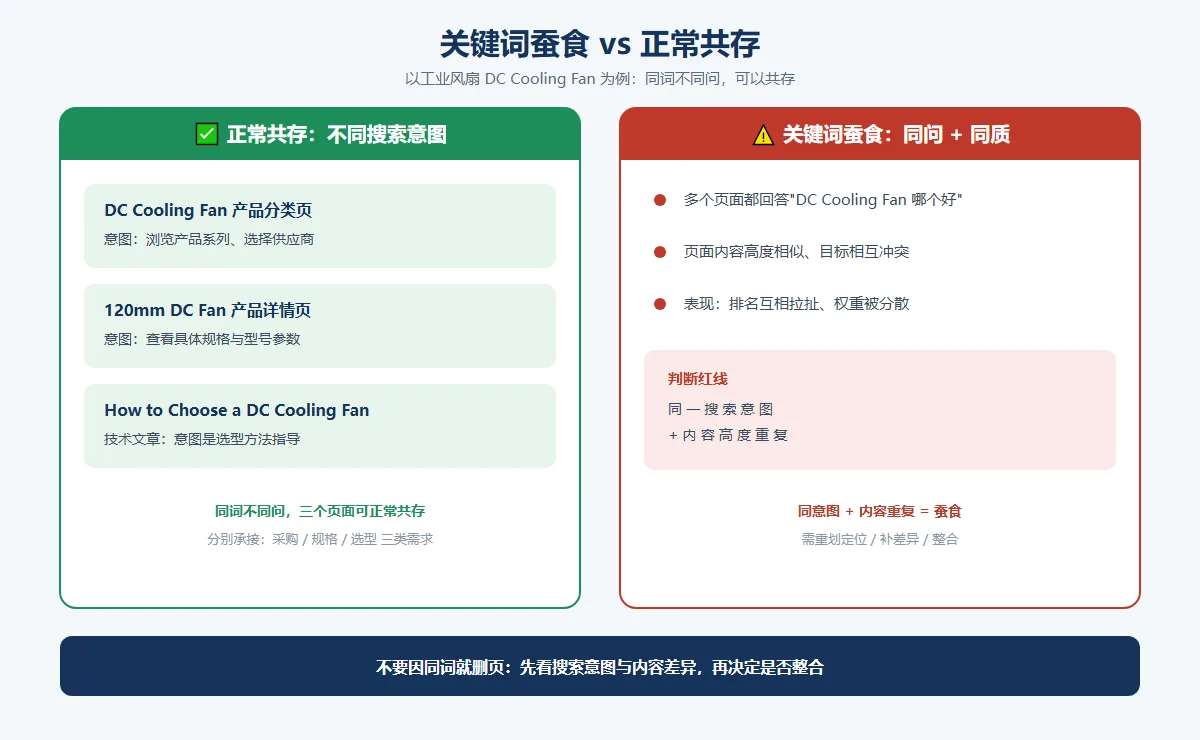
4.2 How to determine if a website is experiencing keyword cannibalization?
If multiple pages are optimizing for the same product keyword, it doesn't necessarily mean that the website is experiencing keyword cannibalization.
What really needs to be focused on is whether these pages are answering the same search question, and whether there is unnecessary content duplication or conflicting objectives between multiple pages.
For example, an industrial fan manufacturer may possess:
- DC Cooling Fan Product Category Page
- 120mm DC Fan Product Details Page
- How to Choose a DC Cooling Fan (Technical Article)
Search terms related to "DC Cooling Fan" may appear on all three pages, but they correspond to product procurement, specific specifications, and technical selection needs, and can coexist normally.
Businesses can use Google Search Console to filter a core search query, then switch to the "Web Pages" dimension to observe which URLs received relevant exposure and clicks.
If multiple pages consistently cater to the same procurement needs and have highly similar content, further investigation is needed to determine whether keyword targeting should be redefined, differentiated content added, or duplicate pages consolidated.
It is not recommended to delete or redirect pages simply because multiple URLs contain the same keyword.
A comprehensive judgment should be made based on user search intent, page content, historical performance, and business value.
Fifth, what truly affects a page's competitiveness is not just content length.
Many companies, seeing their competitors ranking highly, immediately increase the word count. So: a product page that was originally 500 words is expanded to 1500 words; 1500 words is then expanded to 3000 words. But page length itself isn't the key. What should really be compared is: once a purchasing customer enters the page, can they quickly determine whether this supplier is suitable for further communication?
Google Search Central emphasizes in its content quality guidelines that website content should prioritize helping users solve problems, rather than mechanically increasing the amount of content for the sake of search ranking.
5.1 The product page needs to be supplemented with purchasing information, not word count.
For B2B product pages, customers typically don't just look at the product name, product image, and basic parameters. They will continue to make judgments:
Which applications is the product suitable for? Does it match the specifications? Can it be customized? Are there different material and structural options? Does it support OEM or ODM? Does it have relevant certifications and testing documentation? What is the MOQ? How are samples made? What is the approximate delivery time? Does the company truly have the production and delivery capabilities?
If your page only has product images, basic parameters, and a short company introduction, while your competitors have already covered all aspects of application, selection, customization, certification, and procurement, even if both sides use the same keywords, the competitiveness of your pages will be completely different.
So the real question isn't, "Should we write another 1000 words?" but rather, "What information is missing from this page that could influence a customer's purchasing decision?"
6. Why is my website still not ranked after six months of operation?
Another common misconception among export businesses is that the longer a website has been online, the more "weight" Google should gradually give it. In reality, website age does not automatically translate into improved rankings for target keywords. Even if a website has been running for a year, if:
- The keyword positioning of the core pages remains unclear;
- The product content is highly similar to that of competitors;
- There are no internal links between important pages;
- The website has not generated any industry buzz externally;
- Time itself will not automatically resolve these problems.
Google Search Central's content quality guidelines emphasize that websites need to consistently provide helpful content to users, rather than simply relying on website age or increasing page count to improve search performance. What should really be observed is: has Google's understanding of the website changed over the past six months or a year?
For example:
- Have non-brand search terms increased?
- Have the core pages started to get more exposure for purchasing keywords?
- Are the average rankings of target procurement keywords gradually improving, and are key product pages beginning to receive more stable relevant search exposure?
- Has organic click-through rate gradually increased?
If these intermediate metrics remain unchanged for an extended period, the focus should not be on waiting, but rather on re-evaluating the page and keyword strategies.
6.1 How should I monitor SEO progress if my website ranking doesn't show a significant improvement?
For export businesses that are doing SEO, it is not recommended to only look at the ranking of a single keyword on a single day.
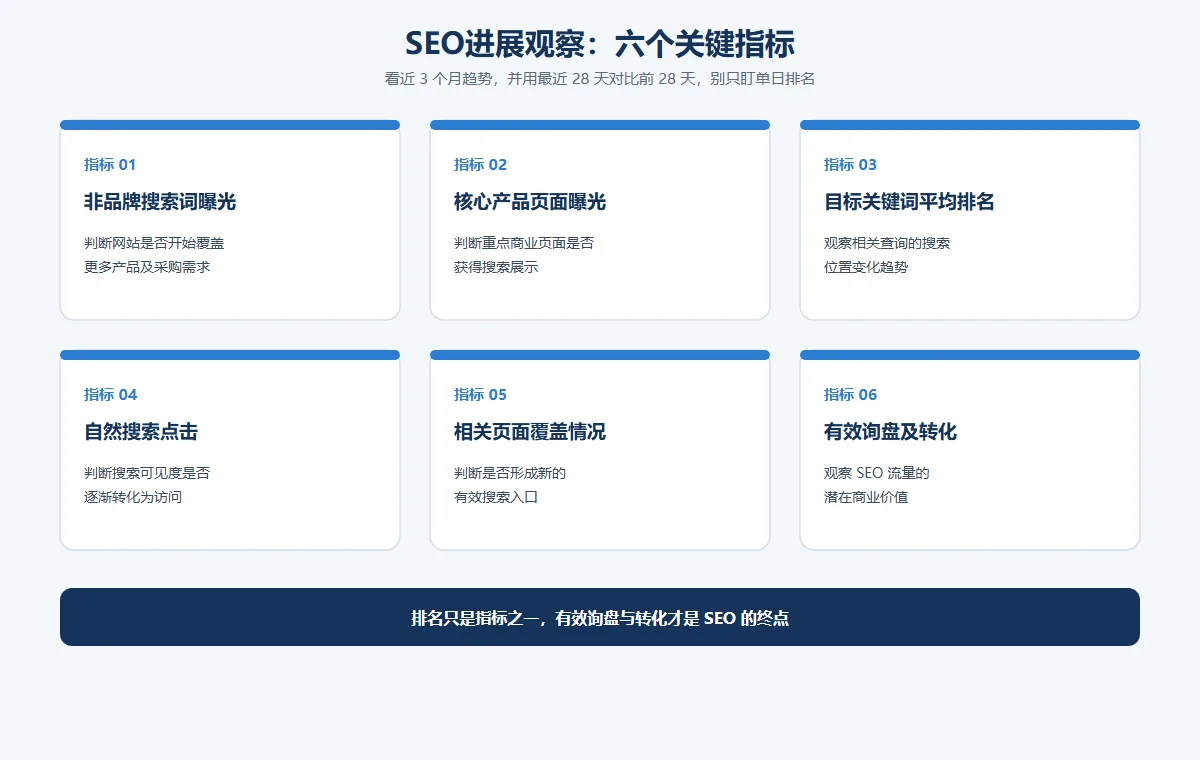
A more reasonable approach is to combine data from Google Search Console, including queries, web pages, clicks, impressions, and average rankings, and observe the changes over a period of time.
The following indicators are worth paying close attention to:
| Observation indicators | Main purpose |
|---|---|
| Non-brand search terms exposed | Determine if the website is starting to cover more products and purchasing needs. |
| Core product page exposed | Determine whether key business pages are displayed in search results |
| Average ranking of target keywords | Observe the search location trends of related queries |
| Organic search clicks | Determine if search visibility gradually translates into visits. |
| Related page coverage | Determine whether a new effective search entry point has been formed. |
| qualified inquiries and conversion | Observing the potential business value of SEO traffic |
It is recommended to use data from the past 3 months to observe the overall trend, and at the same time, combine the changes from the last 28 days to the previous 28 days to identify short-term anomalies.
When conducting analysis, try to keep the conditions such as country, device, and search type consistent, and take into account seasonality, changes in market demand, and data fluctuations.
For example, an industrial equipment company may not see a significant increase in organic clicks, but its core product category pages are starting to receive more exposure to non-branded purchasing keywords, and the ranking of related keywords is gradually improving. This may indicate that the page is gaining more search opportunities.
Conversely, if a website continues to publish a large number of articles, but the core product page does not receive relevant search exposure for purchasing, it needs to reassess its content direction rather than simply increasing the update frequency.
VII. Summary: If your Google ranking isn't improving, first identify the root cause.
For foreign trade manufacturing companies in Shenzhen and other regions, if their business website's Google ranking has not improved for a long time, it is usually necessary to analyze aspects such as page indexing, keyword positioning, content competitiveness, and website structure step by step.
Different problems require different solutions. If a page is not indexed, indexing issues should be investigated first; if there is exposure but a lack of target keywords, the page positioning should be checked; if the content direction is clear but the ranking is still low, further evaluation of product information, internal links, and the competitive landscape is needed.
Once the cause is identified, what should be the next step?
You can continue reading "How to Improve Google Rankings Through Foreign Trade SEO Optimization? 7 Practical Methods and Steps" to learn how to use Google Search Console to filter and optimize pages, and how to advance SEO work through keyword mapping, product page adjustments, and continuous performance review.
CTMON provides B2B foreign trade and manufacturing companies with overseas digital marketing services such as Google SEO, business website construction, Google Ads and GEO. It can also conduct SEO diagnosis, keyword planning and content optimization based on the actual situation of the website.
If an existing B2B export website consistently lacks exposure for target purchasing keywords, it's advisable to first analyze key pages and search data before determining the next stage of optimization.
Learn about CTMON Google SEO services and get SEO diagnostic advice for B2B export websites.
Founded in 2013 and headquartered in Shenzhen, Guangdong Province, CTMON is a service provider specializing in B2B digital marketing. Its services cover B2B export website development, Google SEO, Google Ads (SEM), international social media marketing, and AI search optimization (GEO).
As of August 2026, the company has served more than 1,300 clients, covering industries such as machinery and equipment, intelligent manufacturing, new energy, energy storage, electronic technology, industrial components, optical communication, new materials, and chemicals.
Official website: https://www.ctmon.com
Telephone: 0755-32998669 / +8618823880196
For inquiries, please call: 18138214917
Email: xiaomeng@ctmon.com
Reference source
The Google search mechanism, SEO methodology, and industry practices discussed in this article are based on the following publicly available information:
Google Search Central
1. SEO Starter Guide: Google's official SEO basics guide, which introduces how search engines discover, crawl, and understand web pages, as well as the basic directions that websites need to focus on when optimizing for search.
https://developers.google.com/search/docs/fundamentals/seo-starter-guide
2. Crawling and Indexing Documentation: Google's official technical documentation on crawling and indexing covers important mechanisms affecting page indexing, such as robots.txt , noindex, and canonical.
https://developers.google.com/search/docs/crawling-indexing
3. Canonicalization Documentation: Google's official documentation on duplicate URL handling and canonicalization.
https://developers.google.com/search/docs/crawling-indexing/consolidate-duplicate-urls
4. Managing Multi-regional and Multilingual Sites: Google's official documentation on multilingual and multi-regional website structures and the use of hreflang.
https://developers.google.com/search/docs/specialty/international
5. Creating Helpful Content: Google's official guidelines on content quality and user value emphasize that content should prioritize meeting user needs, rather than mechanically creating content for search ranking purposes.
https://developers.google.com/search/docs/fundamentals/creating-helpful-content
6. Google Search Console Performance Report: Official documentation for Google Search Console, used to analyze website search impressions, clicks, keyword searches, and page performance.
https://support.google.com/webmasters/answer/7042828
Semrush
1. Search Intent: What It Is and How to Optimize for It Semrush. Research on search intent explains the different types of needs behind user searches and how keyword placement needs to be determined in conjunction with user objectives.
https://www.semrush.com/blog/search-intent/
2. Keyword Research Guide Semrush explains the methodology of keyword research, including keyword selection, search demand analysis, and competition analysis.
https://www.semrush.com/blog/keyword-research/
Ahrefs
1. Keyword Research Guide (Ahrefs): A methodological guide to keyword research and search demand analysis.
https://ahrefs.com/blog/keyword-research/
2. Search Intent: The Complete Guide Ahrefs: Research on search intent analysis and page matching strategies.
https://ahrefs.com/blog/search-intent/
3. Keyword Cannibalization: What It Is and How to Fix It (Ahrefs) This section analyzes the keyword cannibalization problem and explains how multiple pages competing for the same keyword can lead to fragmented search performance.
https://ahrefs.com/blog/keyword-cannibalization/
What does international social media management service include? 2026 Guide to Social Media Management for Export Businesses
2026-10-28
How to write a WordPress product page that will make overseas buyers want to send inquiries?
2026-10-28

How to fix WordPress form emails not sending: Practical WP Mail SMTP configuration
2026-10-27
Are foreign trade promotion companies reliable? Six key criteria for businesses to judge promotion service providers in 2026.
2026-10-26
How do I set up an email account for export businesses? How can I configure it to avoid it ending up in the spam/junk mail folder?
2026-10-26
Related Articles
What are the differences between Google SEO and Google Ads? Which should B2B export businesses do first?
2026 Shenzhen Google SEO Optimization Company Recommendations: Service Provider Comparison and Selection Guide
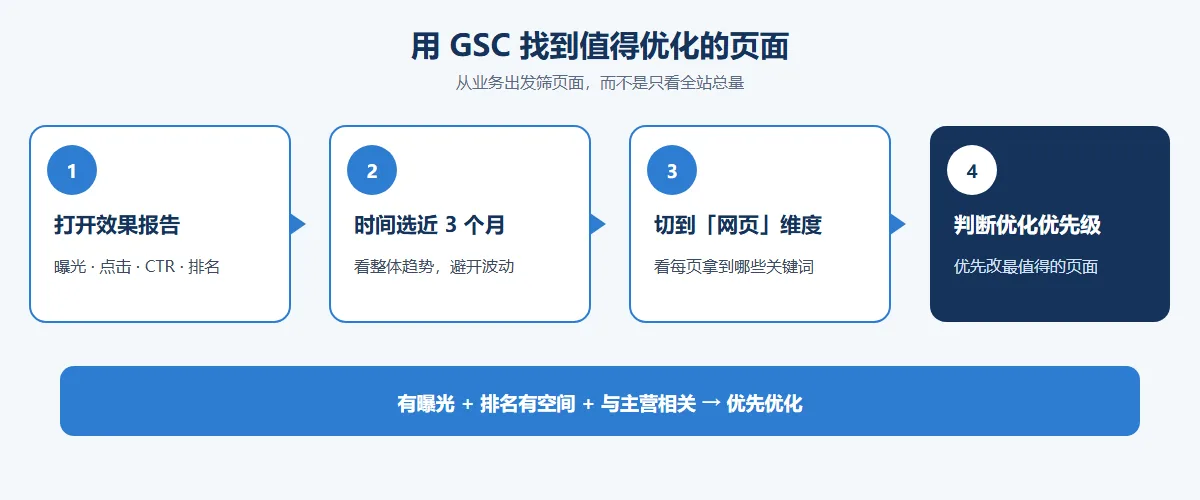
How to improve Google rankings through SEO optimization for international trade? 7 practical methods and steps.
Recommended Shenzhen B2B export website operation company: How to choose a suitable international lead generation service provider for your enterprise?

How can B2B export website optimization lead from inquiries to sales?