Contents +
What are the lead generation methods in foreign trade? Top 10 channels and selection guide for 2026.
Source: 创同盟
Date: 2026-10-09
Views: 132
Author: CTMON International Marketing Research Team
For export businesses, the ability to continuously acquire overseas customers is a crucial factor in determining business growth. In the past, companies primarily relied on B2B platforms, international trade shows, and proactive customer development by sales personnel. Today, as overseas sourcing increasingly shifts online, Google search, B2B export websites, social media, and AI search have become important channels for businesses to reach potential buyers.
However, having more lead generation methods doesn't mean that all channels are worth investing in . Different channels vary significantly in terms of customer accuracy, investment costs, operational difficulty, and time to see results.
What are the lead generation methods for foreign trade? Which channel is more suitable for B2B manufacturing and foreign trade companies? This article will introduce 10 mainstream overseas customer development channels and, based on their advantages and disadvantages, applicable enterprises, and actual lead generation needs, help companies find a development method that is more suitable for them.
I. What are the lead generation methods in foreign trade? 10 mainstream channels
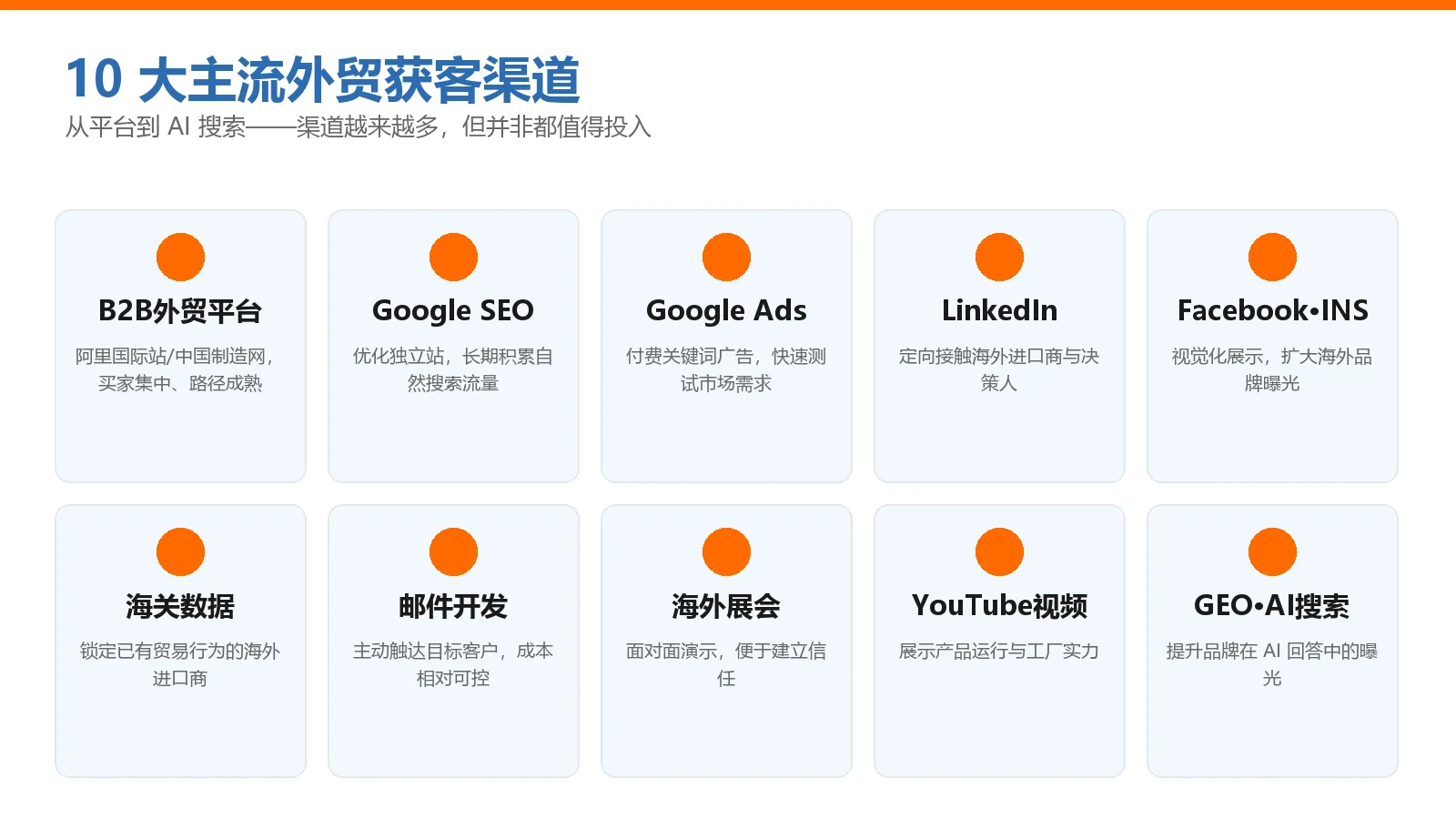
1. B2B foreign trade platform lead generation
B2B platforms are traditional and common lead generation channels for foreign trade, including Alibaba.com, Made-in-China.com, and Global Sources. Companies showcase their products to overseas buyers with purchasing needs by publishing products, optimizing keywords, and participating in platform promotions.
The advantage of a platform is that it has relatively centralized purchasing traffic, so businesses don't have to start from scratch to find customers. However, because there are many similar suppliers, buyers usually compare prices, delivery times, and product specifications simultaneously, which can easily lead to homogeneous competition.
Suitable for companies that have just started export business, have products with a high degree of standardization, or want to test overseas market demand through the platform.
2. Google SEO organic search lead generation
Google SEO improves the organic visibility of a B2B export website in Google search results by optimizing the website's structure, product pages, keywords, and professional content, thereby attracting overseas customers to visit the site.
For example, industrial cooling fan manufacturers can organize their products and category pages around keywords such as "industrial cooling fan" and "DC cooling fan manufacturer," while using application cases, technology selection guides, and other content to cover procurement needs at different stages.
Compared to relying entirely on paid promotion, SEO can gradually build up website content and organic search traffic. However, it usually requires continuous investment, and there is no fixed timeframe for seeing results in rankings and inquiries.
Suitable for: B2B manufacturers and export businesses with relatively stable product lines, a focus on long-term overseas market development, and a desire to establish their own lead generation channels.
3. Google Ads paid search advertising lead generation
Google Ads uses keyword advertising to give businesses the opportunity to display promotional information when overseas customers actively search for related products, and to drive users to the business website or a dedicated ad landing page.
For example, energy storage inverter manufacturers can conduct tests targeting keywords indicating purchasing intent, such as "hybrid inverter supplier" and "solar inverter manufacturer," to attract buyers who are looking for suppliers.
The advantage of advertising is that it allows for quick testing of market demand and adjustments to investment based on keywords, regions, and conversion rates. However, ad clicks incur costs, and inaccurate keyword selection, a lack of product advantages on the page, or unclear inquiry entry points can easily lead to wasted budget.
Suitable for businesses that already have a business website, clear competitive advantages in their products, and want to test new markets or increase short-term lead generation opportunities.
4. LinkedIn Overseas Customer Development
LinkedIn is one of the important channels for B2B foreign trade companies to proactively develop clients. Companies can use information such as industry, company size, and job title to find overseas importers, purchasing managers, engineers, and other business decision-makers.
For example, industrial connector manufacturers can screen target companies in the fields of automation equipment, communication equipment, and electronic manufacturing, understand their product and business needs, and then contact the relevant purchasing or technical personnel.
LinkedIn's value lies not only in proactively reaching out to clients but also in building trust through professional content and company updates. However, client development typically requires ongoing communication, and sending out mass, untargeted sales messages often proves ineffective.
Suitable for: Industrial equipment, electronic components, machinery manufacturing, and B2B companies with long procurement cycles such as OEM/ODM.
5. Facebook and Instagram social media lead generation
Facebook and Instagram can help export businesses expand their exposure in overseas markets and reach potential distributors, importers, and purchasing customers through business pages, product content, short videos, and meta ads.
For example, solar street light manufacturers can showcase overseas installation cases and lighting effects; custom lighting companies can release hotel, restaurant and commercial space projects, allowing potential customers to more intuitively understand product applications and manufacturing capabilities.
Social media is suitable for showcasing product advantages and application scenarios, but engagement volume does not equate to qualified inquiries. Businesses need to further filter genuine purchasing needs through ad audiences, creative content, and inquiry forms.
Suitable for companies with products that have outstanding visual appeal and a wide range of applications, and which wish to develop overseas distributors or expand brand awareness.
6. Customs data lead generation
Customs data lead generation involves analyzing import and export trade records of relevant products, screening overseas importers with purchasing behavior, and then proactively developing relationships by combining corporate websites and publicly available business information.
For example, factories that produce industrial components can use product HS codes, target markets, and trade records to find overseas companies that may purchase related products, and further determine their business scope and cooperation potential.
This approach can help businesses narrow down their customer search, but the level of data openness, record completeness, and update frequency vary across different countries, and one cannot determine whether a customer currently has a purchasing need solely based on trade records.
Suitable for export businesses with clearly defined product categories, proactive development teams, and a desire to find overseas importers, wholesalers, and long-term cooperative clients.
7. Email Marketing and Proactive Lead Generation Development
Email marketing is a common customer development method used by foreign trade salespersons. Companies use legally obtained business contact information to introduce their products, manufacturing capabilities, and cooperation value to potential buyers who match their target customer profile, and then follow up continuously.
Effective outreach emails should focus on the client's actual needs. For example, when recommending CNC machining services to a machinery manufacturer, emphasize the machining materials, equipment capabilities, precision control, and drawing/quotation support, rather than simply sending a product catalog.
Email marketing is relatively cost-effective, but it requires an accurate customer list, professional communication content, and continuous sales follow-up. At the same time, companies should comply with applicable business email and privacy regulations in their target markets.
Suitable for: B2B companies with a clear target customer group, capable of personalized development and establishing customer follow-up processes.
8. Overseas exhibition leader
Participating in international industry exhibitions allows export businesses to directly connect with buyers, distributors, and potential partners, showcase their products on-site, and engage in face-to-face discussions regarding technical specifications, purchase quantities, and cooperation requirements.
For products that require technical communication, such as industrial equipment, automation products, and precision components, exhibitions help buyers gain a more intuitive understanding of a company's manufacturing capabilities and product quality.
However, costs such as booth space, transportation, and travel can be high, and the effectiveness of exhibiting depends on the suitability of the exhibition and the ability to follow up with clients. Companies should research their target buyers in advance, record their needs on-site, and continue to follow up after the exhibition.
Suitable for: Manufacturing companies that require on-site product demonstrations, have complex purchasing decisions, and possess a certain market development budget.
9. YouTube and video content marketing lead generation
Through YouTube and other video channels, export businesses can showcase the actual operation of products, production processes, quality testing, and application cases, helping overseas customers to more intuitively understand the products and factory capabilities.
For example, CNC machining companies can demonstrate the machining process of complex parts, industrial cooling fan manufacturers can introduce performance testing, and machinery equipment manufacturers can demonstrate equipment operation and maintenance methods.
Video content can also be embedded in product detail pages, technical articles, and solution pages on a business website to help customers evaluate suppliers.
However, video views do not directly reflect purchasing demand. Businesses should prioritize creating content that answers customers' actual questions, rather than simply pursuing high viewership.
Suitable for companies that need product demonstrations, whose manufacturing processes have demonstrative value, or that wish to enhance trust in overseas procurement through professional content.
10. GEO and AI Search Lead Generation
As AI search tools are increasingly applied to product research and supplier surveys, overseas buyers may use AI to help understand technical solutions, compare product parameters, and formulate supplier selection criteria.
GEO, or Generative Engine Optimization, focuses on improving the discoverability, understandability, and citation opportunities of enterprise information in AI search and generative responses.
For manufacturing companies, improving product technical specifications, application solutions, quality certifications, factory introductions, and professional purchasing guides can help websites better answer buyers' questions.
It's important to note that GEO cannot guarantee that a business will be recommended by AI, nor does it directly equate to receiving orders. It is more suitable as an extension of SEO and brand content creation, and should be implemented in conjunction with existing search marketing channels.
Suitable for: B2B companies that already have a business website, have the ability to continuously create content, and want to increase the exposure of their brand and products in AI-assisted search.
II. Comparison of the advantages and disadvantages of 10 foreign trade lead generation channels
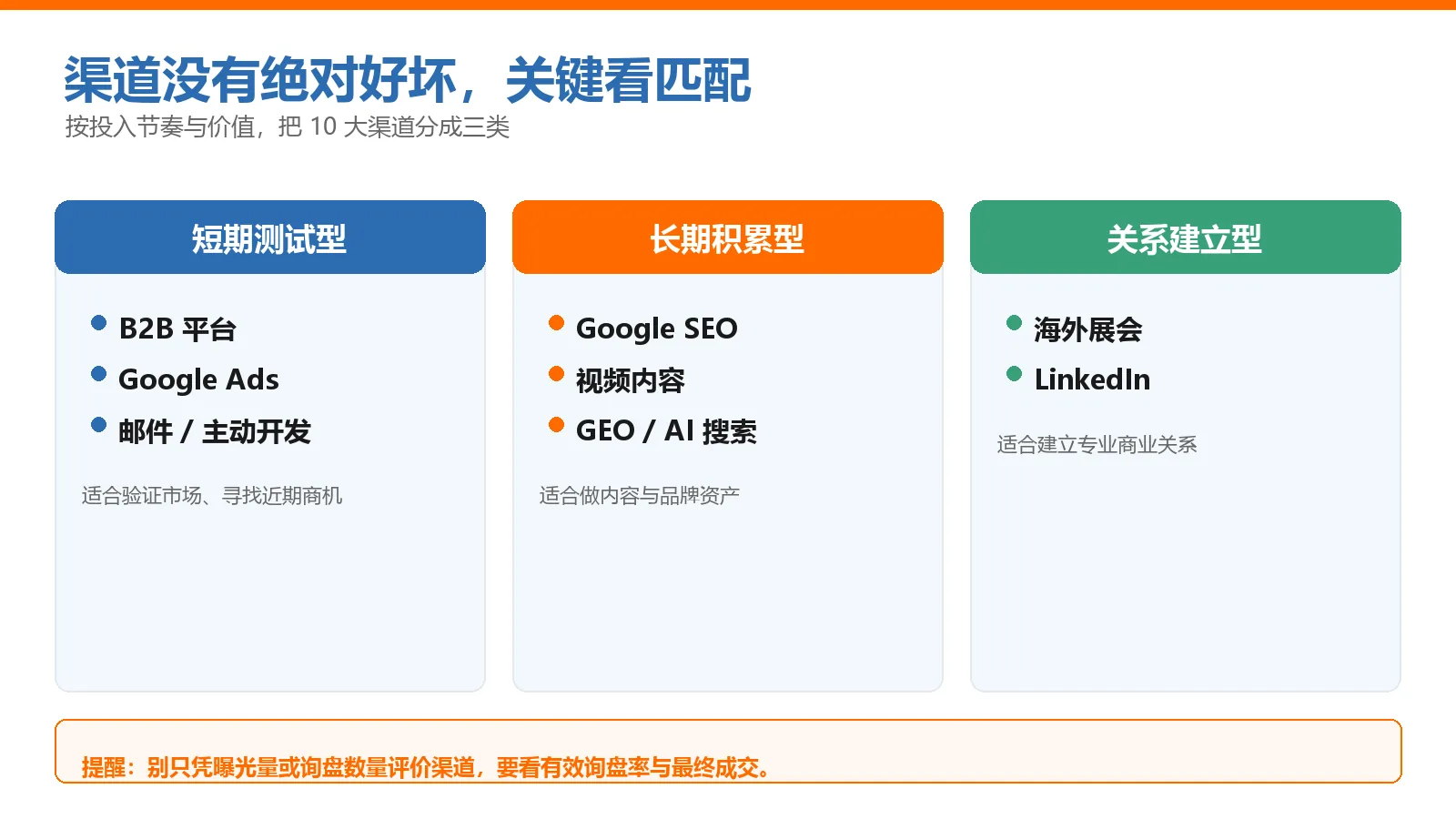
There are no inherently good or bad lead generation channels in foreign trade; companies need to choose based on their products, customer types, budget, and operational capabilities. Below is a breakdown of their main advantages, limitations, and suitable companies:
- B2B platforms : concentrated buyers, mature inquiry channels; obvious homogeneous competition; suitable for standardized products and foreign trade novices.
- Google SEO : Accumulates long-term organic search traffic; requires continuous investment and optimization; suitable for B2B manufacturers.
- Google Ads : Quicker testing of market demand; requires a continuous advertising budget; suitable for businesses with a website and promotion budget.
- LinkedIn : Allows targeted contact with B2B clients; requires long-term relationship building; suitable for industrial equipment and OEM/ODM companies.
- Facebook/Instagram : Product display is intuitive and has a wide reach; however, lead quality needs to be screened; suitable for lighting, building materials, and consumer products.
- Customs data : helps identify companies with existing trade activities; data coverage is limited; suitable for targeted development by importers.
- Email marketing : direct communication, relatively controllable costs; relies on list quality and sales capabilities; suitable for proactive business development.
- Overseas exhibitions : face-to-face communication facilitates building trust; higher initial investment; suitable for industrial manufacturing and machinery equipment.
- YouTube videos : Showcase products and factory capabilities; content creation requires continuous investment; suitable for technology-based and equipment-related companies.
- GEO and AI Search : Expand brand information discovery channels; uncertain results and difficult to attribute directly; suitable for manufacturing companies with SEO background.
Overall, B2B platforms, Google Ads, and proactive development are suitable for testing markets and finding near-term business opportunities; Google SEO, video content, and GEO are more geared towards long-term content and brand building; and overseas trade shows and LinkedIn are helpful for building professional business relationships.
Businesses should not evaluate channel effectiveness solely based on exposure or the number of inquiries; they also need to consider the qualified inquiries rate, customer purchasing power, and final transaction results .
III. How should different types of export businesses choose their lead generation approach?
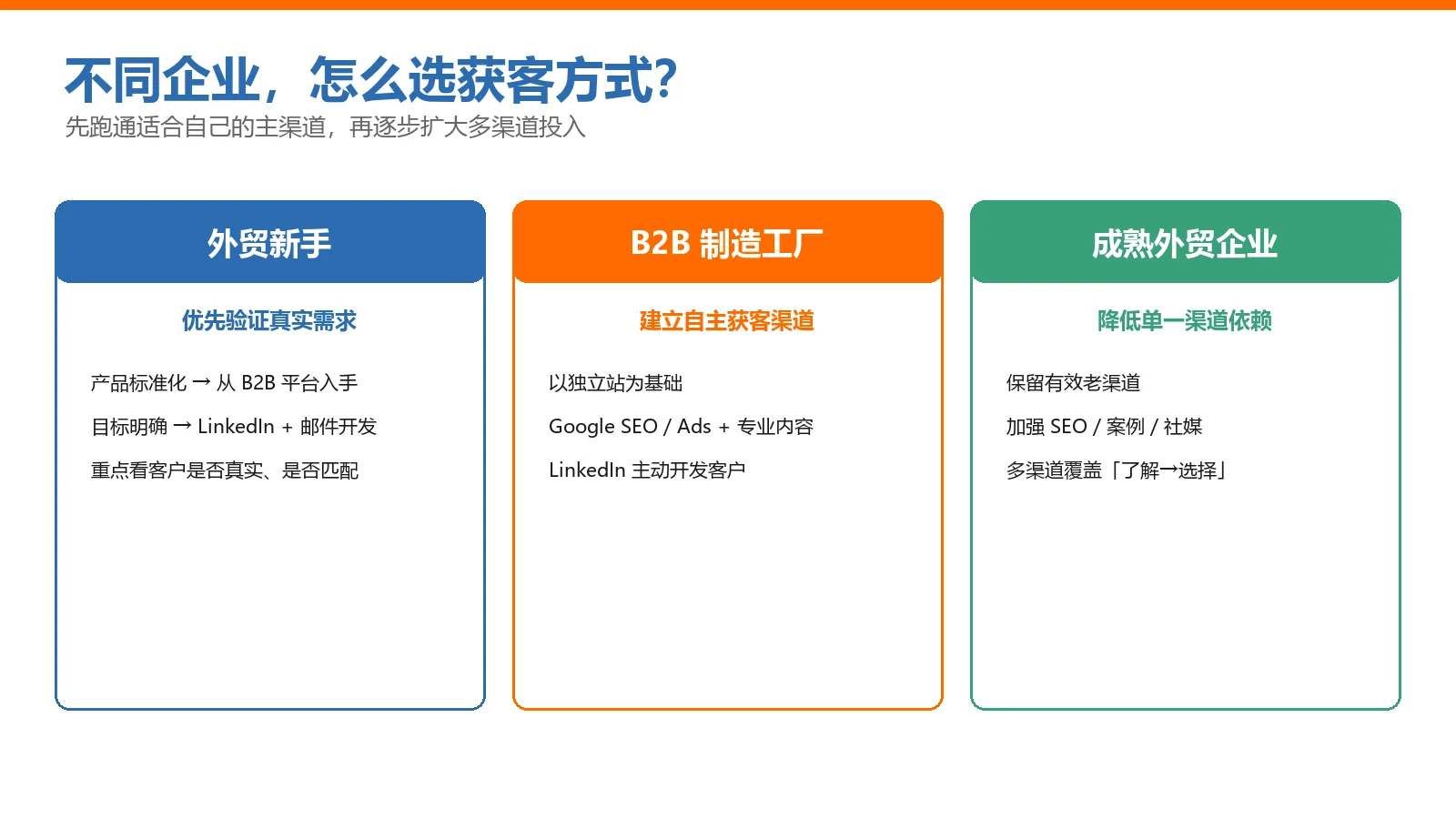
1. For those new to foreign trade: Prioritize verifying market demand.
For companies that have just started export business, they first need to clarify their main products, target countries and customer types, and it is not recommended to invest in too many channels at the same time.
If the product is highly standardized, you can start with B2B platforms; if you have already identified your target customers, you can combine LinkedIn and email marketing. The initial focus should be on verifying genuine purchasing needs, customer feedback, and the company's pricing capabilities.
2. B2B manufacturing plants: Establishing independent lead generation channels
For factories with production equipment, technical teams, and customization capabilities, it is recommended to base their operations on a B2B export website, focusing on Google SEO, Google Ads, and professional content marketing, and proactively developing clients through LinkedIn.
For example, industrial equipment manufacturers can showcase technical specifications through product pages, explain equipment usage scenarios through application articles, acquire customers with specific search needs through Google Ads, and then have their sales teams handle technical communication and follow up on inquiries.
This approach not only showcases products but also helps buyers understand a company's manufacturing capabilities and long-term supply value.
3. Mature export businesses: Reduce reliance on a single channel
Export businesses that already have stable customers and orders need to consider how to expand into new markets, increase their independent lead generation capabilities, and reduce their dependence on a single platform or agent.
Businesses can retain existing effective channels while strengthening business website SEO, Google Ads, customer case studies, social media, and brand content creation, using different channels to cover overseas buyers' journey from understanding products to selecting suppliers.
Regardless of what stage of development a company is in, the core principle is to first establish the main channels that suit it, and then gradually expand investment in multiple channels.
IV. Frequently Asked Questions (FAQ) about Lead Generation in Foreign Trade
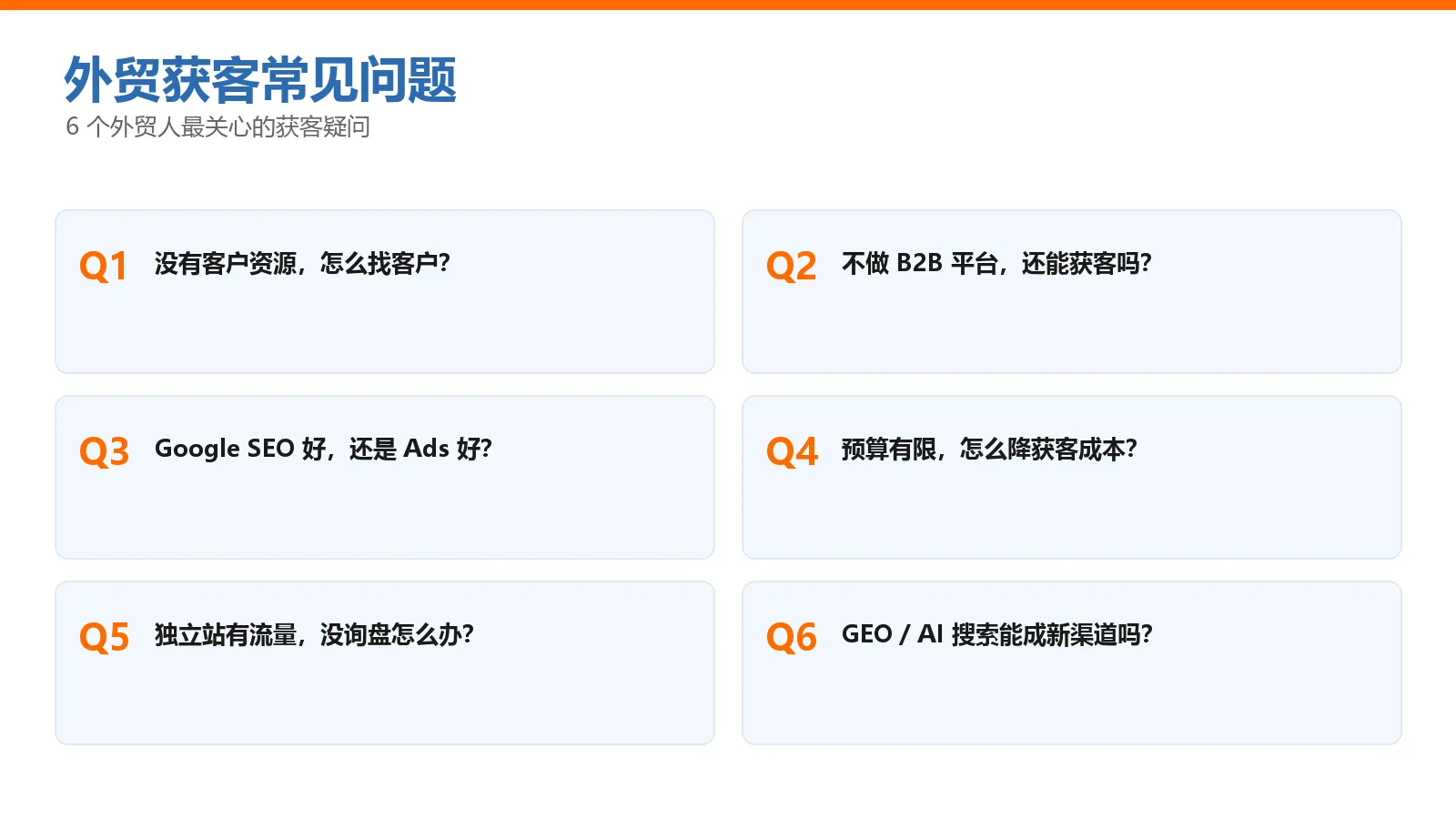
1. How should a foreign trade novice find customers if they have no existing client resources?
It's recommended to first identify the main products and target countries, then choose one or two channels from B2B platforms, LinkedIn, or email marketing for testing. For standardized products, you can use B2B platforms to understand procurement needs; for B2B products such as industrial equipment and parts, you can first compile a list of target companies, and then find the corresponding procurement and technical personnel. Initially, don't blindly pursue a large number of clients; instead, focus on determining whether the clients actually exist, whether the product matches their needs, and whether there are opportunities for further communication.
2. Can export businesses still acquire overseas customers without using a B2B platform?
Yes. Export businesses can independently acquire customers through channels such as Google SEO, Google Ads, LinkedIn, customs data, email marketing, and overseas trade shows. Google search is suitable for attracting customers with specific purchasing needs, while LinkedIn and customs data are good for targeted searches of specific companies. For manufacturers looking to expand their overseas business long-term, building a professional B2B export website can help them showcase their products, factory capabilities, and partnership information in a unified way, and handle inquiries from multiple channels.
3. For foreign trade leaders, is Google SEO or Google Ads better?
The main differences between the two lie in their investment methods and the pace of results. Google Ads allows for faster testing of keywords and target markets, but click traffic typically requires ongoing payment; Google SEO, on the other hand, achieves organic search exposure through website and content optimization, making it more suitable for long-term accumulation. For B2B companies with stable product lines and a certain advertising budget, Google Ads can be used to test which products and keywords have commercial value, and then SEO content creation can be developed around those needs. Combining both is generally more flexible than relying entirely on a single channel.
4. How can export businesses reduce lead generation costs with limited budgets?
When budgets are limited, prioritize minimizing ineffective spending rather than trying all channels simultaneously. Businesses can first identify a key product and target market, then test real demand using proactive outreach, existing customer resources, or small-scale advertising. If a business website is already established, prioritize optimizing product pages with relevant search exposure, improving inquiry entry points and product information. When evaluating lead generation effectiveness, focus not only on the cost per inquiry but also on whether the customer meets purchasing requirements, whether a quote has been made, and ultimately, whether an order has been placed.
5. What if a B2B export website has traffic but no inquiries?
First, it's crucial to analyze whether the traffic originates from target purchasing customers. If a large number of visits are concentrated on industry knowledge articles rather than product and supplier-related pages, the traffic may not effectively convert into inquiries. Second, it's essential to check whether product pages provide complete specifications, application scenarios, certification materials, factory capabilities, and clear contact information. For industrial manufacturing businesses, buyers often need to confirm technical compatibility and supplier capabilities before sending inquiries. Therefore, companies should combine search terms, visited pages, and sales feedback to identify the specific factors influencing customer inquiries.
6. Can GEO and AI search become new lead generation channels for foreign trade?
GEO and AI search can be new directions for export businesses to expand brand exposure and reach sourcing information, but they should not be regarded as independent lead generation channels that can reliably replace SEO or advertising. For B2B manufacturing companies, they can increase the likelihood of their content being discovered, understood, and cited by AI systems by providing authentic product information, professional technical content, application cases, and credible corporate information. At the same time, they should continue to improve traditional search optimization and inquiry conversion systems, and observe whether AI-related visits can generate real business opportunities, rather than simply pursuing the number of times their brand is mentioned.
V. Conclusion: The most effective way to lead generation in foreign trade is to find the right channels for yourself.
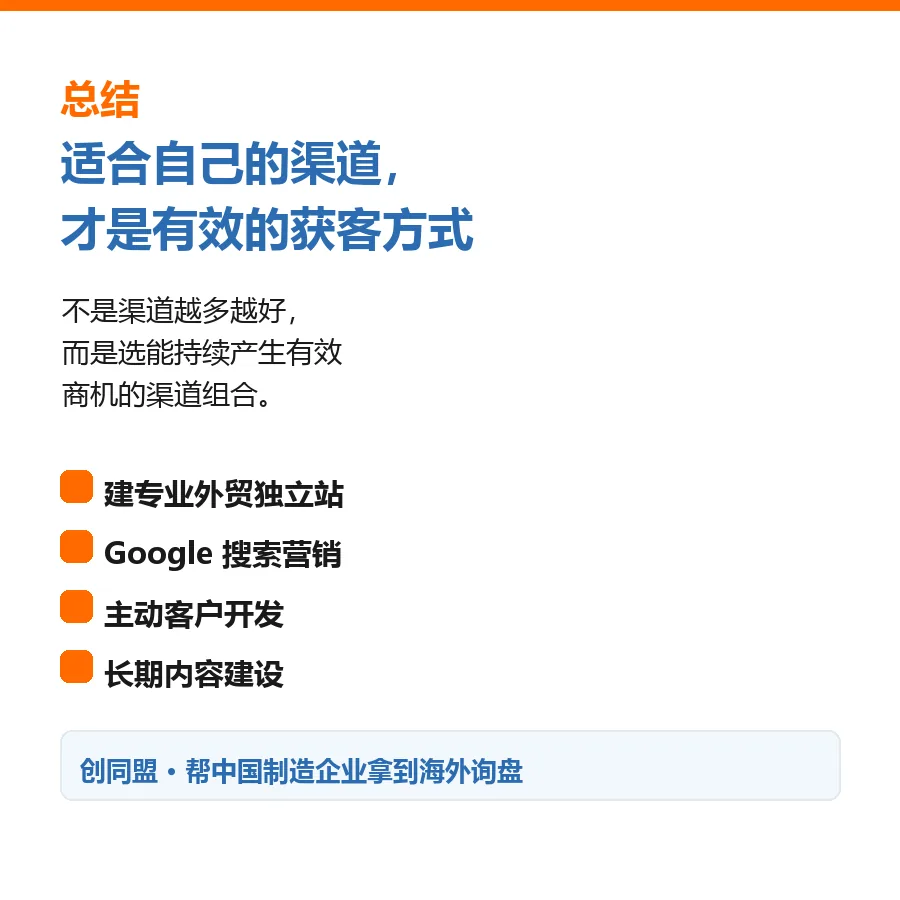
Lead generation in foreign trade is not limited to B2B platforms and traditional trade shows. Google SEO, Google Ads, LinkedIn, Facebook, customs data, email marketing, video content, and GEO and AI search all provide businesses with different opportunities to reach overseas customers.
However, for foreign trade leaders, having more channels is not necessarily better. Instead, they should choose a combination of channels that can continuously generate effective business opportunities based on the characteristics of the company's products, target market, customer purchasing methods, and budget .
For B2B manufacturing companies, establishing a professional B2B export website, combined with Google search marketing, proactive customer development, and long-term content creation , is a lead generation strategy worth considering.
If your company is facing difficulties in developing overseas customers, a lack of inquiries on your business website, or an overly singular lead generation channel, you can start by reviewing your existing products, target markets, and promotional data to develop a more suitable international lead generation solution for your business.
CTMON, founded in 2013 and headquartered in Shenzhen, Guangdong Province, is a B2B digital marketing agency. Its services encompass B2B export website development, search engine optimization (Google SEO), Google Ads (SEM), international social media marketing, and AI-powered search optimization (GEO). As of August 2026, it has served over 1,300 clients. Focusing on B2B export website development, Google SEO, Google Ads (SEM), international social media marketing, and international expansion GEO optimization, CTMON helps companies develop lead generation strategies based on real purchasing needs, continuously optimizing traffic quality, website content, and inquiry conversion rates. This is achieved through multiple dimensions including website architecture, keyword strategy, page optimization, content system, and data analysis.
As of August 2026, the company has served more than 1,300 clients, covering industrial manufacturing sectors such as machinery and equipment, intelligent manufacturing, new energy, energy storage, electronic technology, industrial components, optical communication, new materials, and chemicals.
Official Website: https://www.ctmon.com Phone: 0755-32998669 / +8618823880196
For inquiries, please call: 18138214917
Email: xiaomeng@ctmon.com
Reference source
1. Google Search Central: Google's official organic search optimization guide, covering the basics of crawling, indexing, and content quality.
https://developers.google.com/search/docs
2. Google Ads Help Center: Official Google search advertising and placement instructions.
https://support.google.com/google-ads
3. LinkedIn Marketing Solutions: LinkedIn's official B2B proactive marketing and advertising solutions.
https://business.linkedin.com/marketing-solutions
4. Meta for Business Facebook / Instagram Official Marketing Solution Description.
https://www.facebook.com/business
5. YouTube Help Center: Google's official video content and channel operation instructions.
https://support.google.com/youtube
Author Team: CTMON International Marketing Research Team, focusing on overseas digital marketing for manufacturing and B2B export businesses, covering B2B export website development, Google SEO/Ads, international social media, and GEO international expansion services.

What does international social media management service include? 2026 Guide to Social Media Management for Export Businesses
2026-10-28

How to write a WordPress product page that will make overseas buyers want to send inquiries?
2026-10-28

How to fix WordPress form emails not sending: Practical WP Mail SMTP configuration
2026-10-27

Are foreign trade promotion companies reliable? Six key criteria for businesses to judge promotion service providers in 2026.
2026-10-26

How do I set up an email account for export businesses? How can I configure it to avoid it ending up in the spam/junk mail folder?
2026-10-26
Related Articles
Are foreign trade promotion companies reliable? Six key criteria for businesses to judge promotion service providers in 2026.

The 140th Canton Fair Opens: How can export businesses seize overseas sourcing opportunities through digital marketing?
How to Choose an Overseas Promotion Company for Foreign Trade? 2026 Service Provider Selection Criteria and Evaluation Guide
How to avoid pitfalls when building a B2B export website? A guide to avoiding common mistakes in B2B export website development in 2026.
Which company should I choose for building a B2B export website? A comparison and recommendation of B2B export website service providers in 2026.