Contents +
Is your domain compliant? Don't let your domain ruin your business website's Google traffic and rankings.
Source: 创同盟
Date: 2025-07-16
Views: 2193
Table of Contents
Is your domain compliant? Don't let your domain ruin your business website's Google traffic and rankings.
1.90% of foreign trade websites fall into the same traps! Fatal oversights regarding domain name compliance.
2. Don't wait until customers are lost! Domain issues can cause a business website to lose trust.
3. Domain Names Hidden Deadly Traps? The Invisible Killer Behind Google Traffic Crash
4. How domain health affects Google SEO ranking
5. B2B export website domain name and SEO keyword matching degree test
6. Use Google SEM data to reverse-check for domain health risks.
7. Domain Health Issues and Solutions Comparison Table
8. Practical Steps for Domain Health Verification
CTMON Free Q&A
1. The pitfalls 90% of foreign trade websites fall into! Fatal oversights regarding domain compliance.
Domain compliance is an unspoken red line for B2B export websites , and 90% of companies pay a heavy price for ignoring it. One building materials B2B business website was flagged as "maliciously registered" by Google because its domain name contained infringing brand terms. This resulted in its Google SEO ranking being wiped out and its Google SEM ads being permanently banned, directly leading to the loss of overseas customer channels. More commonly, domains that haven't completed ICP filing (for foreign trade websites with domestic business) or violate target market privacy regulations (such as the EU GDPR) will be marked as "insecure," triggering warnings when users visit, and causing a precipitous drop in traffic.
Compliance is not only crucial for a website's survival but also significantly impacts the effectiveness of Google Ads (SEM). Compliant domains can achieve higher ad quality scores and lower costs per click. Export businesses should therefore make domain compliance an early priority when building their business website to avoid undermining the project through an oversight.
2. Don't wait until customers leave! Domain issues can erode trust in a business website.
A domain name is the "face" of a business website ; any problem can shake customer trust, especially for B2B business websites with long decision-making cycles. Lost trust means lost orders. A Shenzhen electronic-component exporter once used a number-heavy domain such as "elecparts888.com", which customers considered unprofessional. Within three months, page dwell time was below one minute and inquiry conversion was 60% lower than competitors. A domain previously used for spam or fraud may also be flagged as dangerous by browsers, prompting 47% of users to leave immediately, according to the B2B export marketing industry report cited in the original article.
The cost of restoring trust far exceeds the initial domain selection—a B2B export website specializing in machinery spent eight months changing its domain name and synchronizing brand information before its customer repurchase rate recovered to 70% of its previous level. This demonstrates that domain trust is directly linked to the core performance of a business website and should not be underestimated.
3. Domain Names Hidden Deadly Traps? The Invisible Killer Behind Google Traffic Crash
Seemingly normal domain names may hide "invisible traps" that can cause a business website's traffic to plummet. A lighting fixture company's Google business website in Shanghai once experienced a sudden drastic drop in traffic. An investigation revealed that the domain was being maliciously redirected to a violating website, leading Google to classify it as part of a "spam site cluster," resulting in an 83% decrease in organic traffic within 30 days. Another common trap is "domain age fraud"—purchasing "old" domains that have actually been penalized by Google. Google will impose hidden penalties on these domains, meaning that no matter how good Google's overall SEO is, the ranking will never improve.
These traps are difficult to spot: many companies notice them only after traffic falls sharply. Recovery can take 3-6 months, disrupting international website lead generation. Regularly checking domain reputation and history is therefore important for protecting Google traffic.
4. How domain health negatively impacts Google SEO rankings
Domain health is the foundation of Google SEO ranking; any health issues will directly drag down ranking performance. Domains with low health (such as those with a large number of invalid backlinks or those repeatedly penalized by Google) will be placed in the "low-quality pool," making it difficult to reach the first page even with precise SEO keyword placement. For example, the domain of a certain furniture B2B export website was used for spamming backlinks, causing its core keyword "solid wood furniture wholesale" to consistently rank below page 20, despite effective content and internal link optimization.
More importantly, domain health affects Google's trust in a website. Healthy domains can have new pages indexed faster and receive more value from backlinks. Unhealthy domains, even with backlink SEO, may struggle to gain authority. A sound domain-health foundation is therefore important for improving Google rankings.
5. B2B export website domain name and SEO keyword matching degree test
The relevance of a B2B export website's domain name to its SEO keywords directly impacts user clicks and Google's assessment. Highly relevant domains (e.g., domains containing "valves-industry" for the keyword "industrial valves") allow users to quickly identify the website's theme, resulting in a 35% higher click-through rate compared to mismatched domains (data source: Google Search Console case study). Relevance can be assessed from two aspects: first, keyword relevance. For example, for a business website selling mechanical parts, a domain containing "machinery-parts" is better than a simple letter combination; second, avoiding keyword stuffing. Domains excessively containing keywords (e.g., "brand name + bicyclebike.com ") will be flagged as spam by Google, which is detrimental.
A hardware B2B business website changed its domain name from " hw-trading.com " (where "hw" is an abbreviation for "hardware" but not explicitly stated) to " hardware-supplier.com ". Three months later, the number of keywords ranking in the top 50 of the website increased by 42%. This demonstrates that proper keyword matching is a positive factor for Google SEO .
6. Use Google SEM data to reverse-check for domain health risks.
Google SEM data serves as a barometer of domain health; abnormal data often indicates potential problems. If the click-through rate (CTR) of SEM ads suddenly drops, and creative and bidding issues are ruled out, it may mean the domain has been marked as "irrelevant" by users or has entered Google's "low-quality domain list." For example, the SEM ad CTR of a toy B2B export website in Guangzhou dropped from 3.2% to 1.1%. Investigation revealed that a DNS resolution error had briefly redirected the domain to a gambling website. Although the issue was resolved, user trust in the domain decreased, directly impacting clicks.
Another key metric is "ad approval rate": for healthy domains, SEM ad approval typically takes less than 24 hours; frequent delays or rejections may indicate a history of violations, requiring immediate verification to determine if the domain is on Google's "highlighted watchlist." By reviewing Google SEM data, subtle domain health issues can be identified promptly, clearing obstacles for Google Ads optimization .
7. Domain Health Issues and Solutions Comparison Table
| Common health problems | Impact on Google SEO/SEM | Solution |
| The domain has a history of spam backlinks. | Ranking suppressed, low ad quality score | Use Google's backlink blocking tool to block bad backlinks and continuously add high-quality Google backlinks for SEO. |
| It was used for illegal content. | Marked by Google, traffic restricted. | Change the domain name or submit an appeal, and provide proof of rectification. |
| Unrelated to SEO keywords | Low click-through rate, difficulty in improving ranking | If feasible, change the domain name, or strengthen the connection between content and keywords. |
| Registration information is inaccurate (EU market) | Ads rejected, low user trust | Update registration information and synchronize it to the WHOIS database. |
Note: Data is from 127+ B2B export website domain optimization case studies; specific results may vary by industry.
8. Practical Steps for Domain Health Verification
Step 1: Check the domain registration history (to determine if it is an old domain).
-
- Tool: Whois query (Recommended website: whois.com )
-
- Instructions: Enter the domain name and view the "Registration Date", "Expiration Date", and "Previous Owners". If it shows "Previously Registered", further verification of usage records is required.
-
- Note: If a domain name has multiple ownership transfer records, it carries a higher risk and requires thorough investigation.
Step 2: Check if there is a website creation history.
-
- Tool: Wayback Machine (website: web.archive.org )
-
- Instructions: Enter the domain name to view historical snapshots. If there are archived pages, check each page for content violations (such as spam or infringing information).
-
- Example: If the snapshot shows that the domain name has been used for gambling or the sale of counterfeit goods, resolutely abandon the registration.
Step 3: Google Indexing and Backlink Detection
-
-
- Command 1: site:域名 → Check if there are any historical indexed pages. If so, it means the page was previously used. Tool: Google Search (using advanced commands)
-
- Command 2: link:domain → Check backlink records. If there are a large number of backlinks from spam websites (such as pornographic or gambling sites), be wary.
-
Step 4: Google Blacklist Detection
-
- Tool: Bannedcheck (website: bannedcheck.com )
-
- Instructions: Enter the domain name to check if it has been blocked by Google AdSense or other search engines. If "Banned" is displayed, it means the domain has a serious violation record.
Step 5: Spam blacklist detection
-
- Tool: Blacklistalert (URL: blacklistalert.org )
-
- Instructions: Enter the domain name to check if it is on the email blacklist. If multiple "Listed" messages are displayed, it means the domain has been used for mass spam, which will affect the delivery rate of corporate emails.
CTMON Free Q&A
Domain health is fundamental to building an export website , directly impacting Google traffic , rankings, and customer trust. Through compliance checks, historical verification, and matching optimization, a domain can become a positive asset rather than a stumbling block for your B2B export website . For professional domain health diagnostic services, consult CTMON ( www.ctmon.com ). We have provided domain optimization solutions for over 100 export businesses, helping you mitigate risks and improve marketing effectiveness.
Related Recommendations
What does international social media management service include? 2026 Guide to Social Media Management for Export Businesses
2026-10-28
How to write a WordPress product page that will make overseas buyers want to send inquiries?
2026-10-28
How to fix WordPress form emails not sending: Practical WP Mail SMTP configuration
2026-10-27
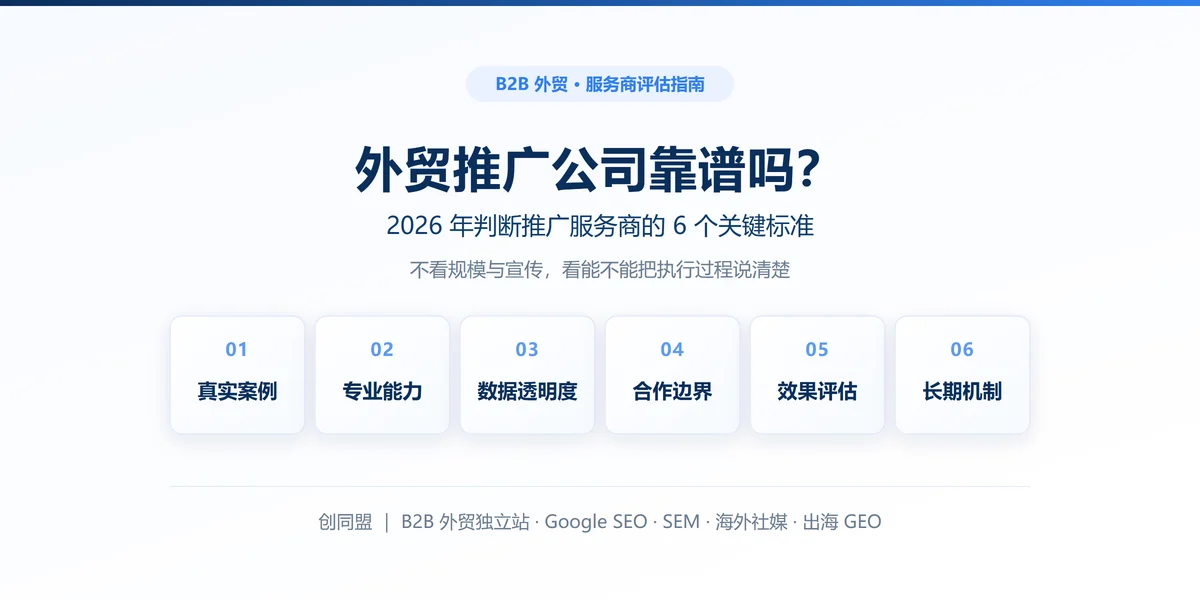
Are foreign trade promotion companies reliable? Six key criteria for businesses to judge promotion service providers in 2026.
2026-10-26
How do I set up an email account for export businesses? How can I configure it to avoid it ending up in the spam/junk mail folder?
2026-10-26
Related Articles
Are foreign trade promotion companies reliable? Six key criteria for businesses to judge promotion service providers in 2026.

The 140th Canton Fair Opens: How can export businesses seize overseas sourcing opportunities through digital marketing?
How to Choose an Overseas Promotion Company for Foreign Trade? 2026 Service Provider Selection Criteria and Evaluation Guide
How to avoid pitfalls when building a B2B export website? A guide to avoiding common mistakes in B2B export website development in 2026.
Which company should I choose for building a B2B export website? A comparison and recommendation of B2B export website service providers in 2026.

