Contents +
Electronic Components Industry | How to Create a Business Website for Capacitor Products: Five Practical Steps – Categories, Keywords, Structure, Product Pages, and Conversion
Source: 创同盟
Date: 2026-09-21
Views: 887
Capacitors are one of the largest categories of electronic components: ranging from through-hole ceramic capacitors costing a few cents each to bolt-on aluminum electrolytic capacitors costing hundreds of dollars, the price spans four orders of magnitude. Overseas buyers in this industry—purchasing and engineering personnel from power supply manufacturers, inverter manufacturers, home appliance manufacturers, and automotive electronics manufacturers—have largely shifted their supplier search methods online: first, they Google specifications, then compare parameters, and only then send inquiries.
This means one thing:
A business website is essentially a "selection map" for engineers and purchasing personnel.
The quality of the roadmap directly determines whether inquiries will come in. This article breaks down the implementation of a business website for the capacitor industry into five steps, providing a checklist for each step that can be followed directly.
Step 1: Translate the product categories into the "customer's language".
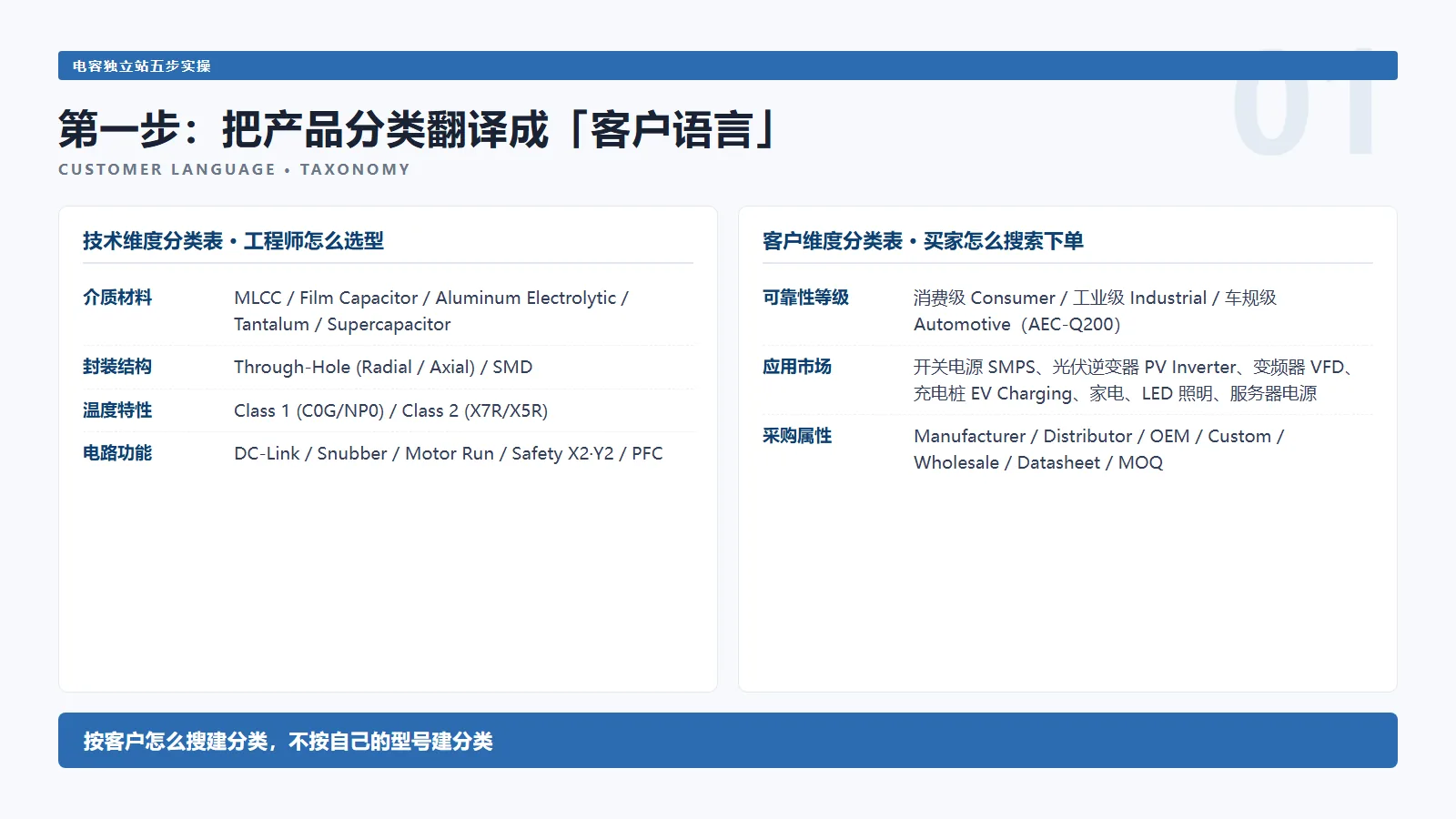
Most capacitor manufacturers' business websites categorize their products by model number, rather than by how customers search. The correct approach is to create two separate categorization tables.
First slide: Technical Dimension Classification Table (How Engineers Choose)
| Classification Dimensions | English name | Keyword Value |
|---|---|---|
| Dielectric materials | MLCC / Film Capacitor / Aluminum Electrolytic / Tantalum / Supercapacitor | Product Category Roots |
| Packaging structure | Through-Hole (Radial / Axial) / SMD | Specification words |
| Temperature characteristics | Class 1 (C0G/NP0) / Class 2 (X7R/X5R) | Required parameters for ceramic capacitors |
| Circuit function | DC-Link / Snubber / Motor Run / Safety X2/Y2 / PFC | High-intention function words |
Taking aluminum electrolytic capacitors as an example, the technical aspects can be explored further:
- Based on electrolyte type: Liquid, Solid Polymer, Hybrid
- Based on terminals: Radial Lead, Snap-in, Screw Terminal, and SMD (Surface Mount Device).
- Based on characteristics: Low ESR, Long Life, Bipolar, Automotive Grade (AEC-Q200)
Each segment is a separate product landing page.
Second slide: Customer Dimension Classification Table (How buyers search and place orders)
| Classification Dimensions | Specific content |
|---|---|
| Reliability level | Consumer grade / Industrial grade / Automotive grade (AEC-Q200) |
| App Market | Switching power supplies (SMPS), photovoltaic inverters (PV Inverters), frequency converters (VFDs), electric charging stations (EV Charging), home appliances, LED lighting, server power supplies. |
| Procurement attributes | Manufacturer / Distributor / OEM / Custom / Wholesale / Datasheet / MOQ |
These two tables together form the information architecture skeleton of your business website—product pages come from the first table, while aggregation pages and content topics come from the second table.
Step 2: Build a keyword matrix and allocate priorities appropriately.
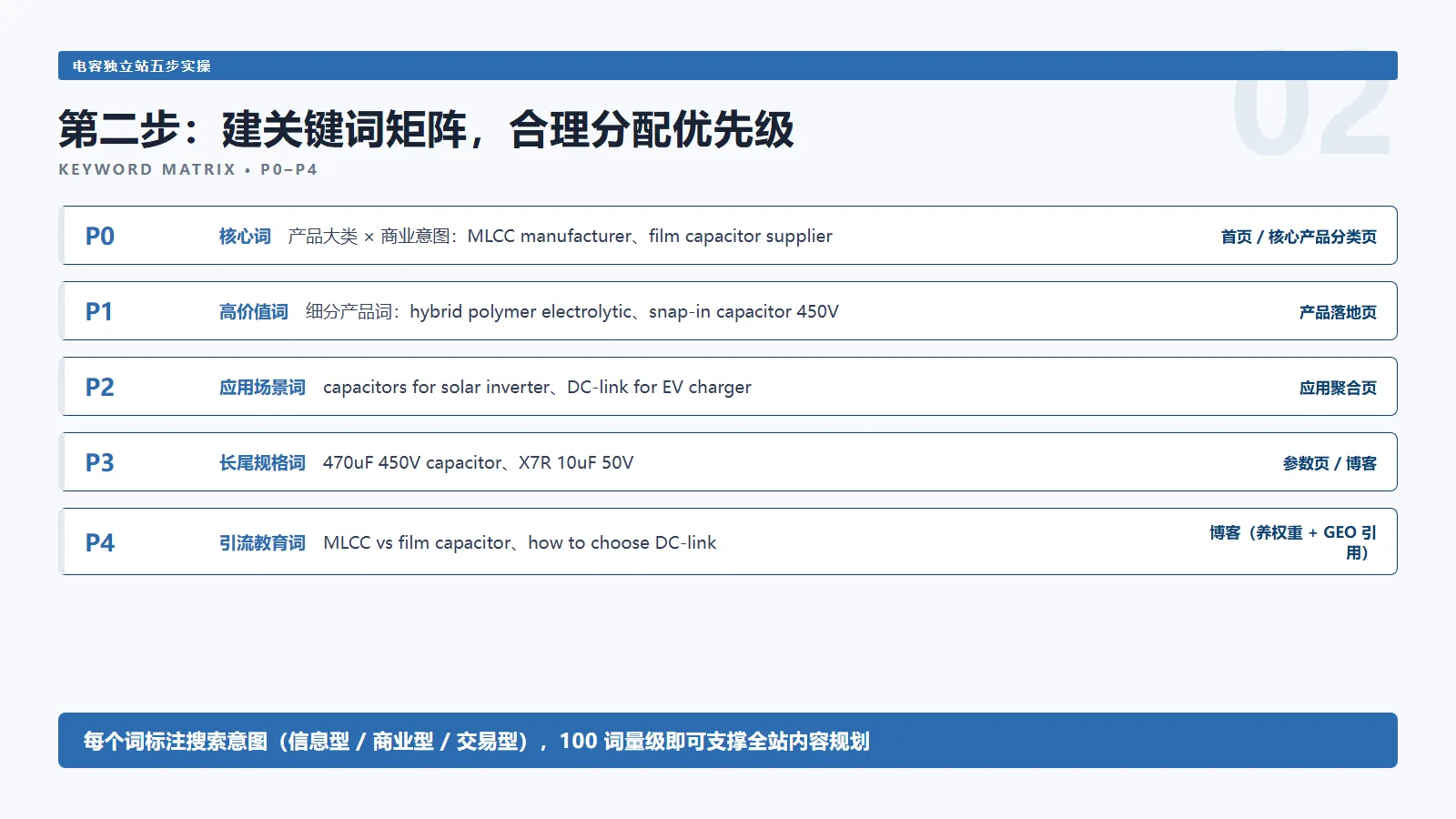
With the category tables in place, the next step is to transform them into a priority keyword matrix. We recommend using the P0–P4 five-level system:
P0 Core words
Product category × business intent, such as "MLCC manufacturer", "film capacitor supplier", "aluminum electrolytic capacitor factory". This doesn't necessarily mean the highest search volume, but rather that people coming with the intention to place orders. Place these on the homepage and core product category pages.
P1 High-value words
Use specific product keywords, such as "hybrid polymer aluminum electrolytic capacitor," "snap-in capacitor 450V," and "low ESR electrolytic capacitor." Searchers are almost exclusively engineers making product selections; place landing pages for the corresponding products.
P2 Application Scenario Keywords
Examples such as "capacitors for solar inverter" and "DC-link capacitor for EV charger" should be placed on the application aggregation page.
P3 Long-tail specification terms
Examples include "470uF 450V capacitor" and "X7R 10uF 50V". These have low search volume but extremely high conversion rates; utilize the parameter page or blog for this purpose.
P4 Lead Generation Education Keywords
For example, posts like "MLCC vs film capacitor" and "how to choose DC-link capacitor" can be published on blogs to improve website authority and GEO citations.
Each word is labeled with its search intent (informative/commercial/transactional), and a matrix of around 100 words can support the content planning of the entire website.
Step 3: Reverse-engineer the website's structure based on keywords
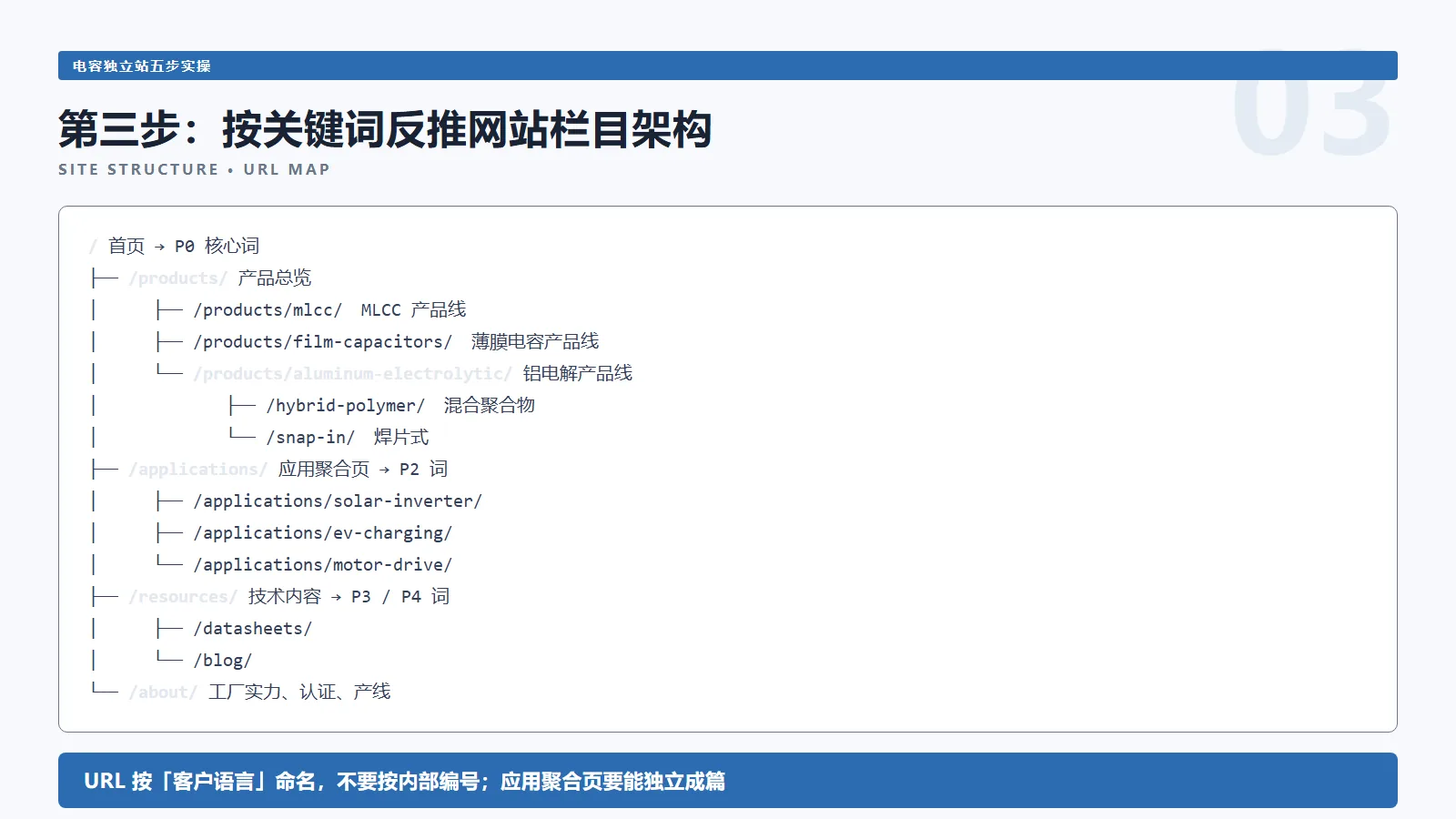
The keyword matrix priority is directly translated into URL structure:
```
/ (首页 → P0 核心词)
├── /products/ (产品总览)
│ ├── /products/mlcc/ (MLCC 产品线)
│ ├── /products/film-capacitors/ (薄膜电容产品线)
│ └── /products/aluminum-electrolytic/ (铝电解产品线)
│ ├── /hybrid-polymer/ (混合聚合物)
│ └── /snap-in/ (焊片式)
├── /applications/ (应用聚合页 → P2 词)
│ ├── /applications/solar-inverter/
│ ├── /applications/ev-charging/
│ └── /applications/motor-drive/
├── /resources/ (技术内容 → P3/P4 词)
│ ├── /datasheets/
│ └── /blog/
└── /about/ (工厂实力、认证、产线)
```
Three points to note:
- Product category pages must have their URLs named in the "customer's language," not using internal numbering.
- Each application aggregation page should be able to stand alone—clearly explaining what type of capacitor to use in this scenario, key selection points, and common problems;
- The "About Us" page needs to be truthful. B2B buyers will definitely check whether you are a factory or a trading company before placing an order.
Step 4: Write product page content according to the "engineer decision chain".
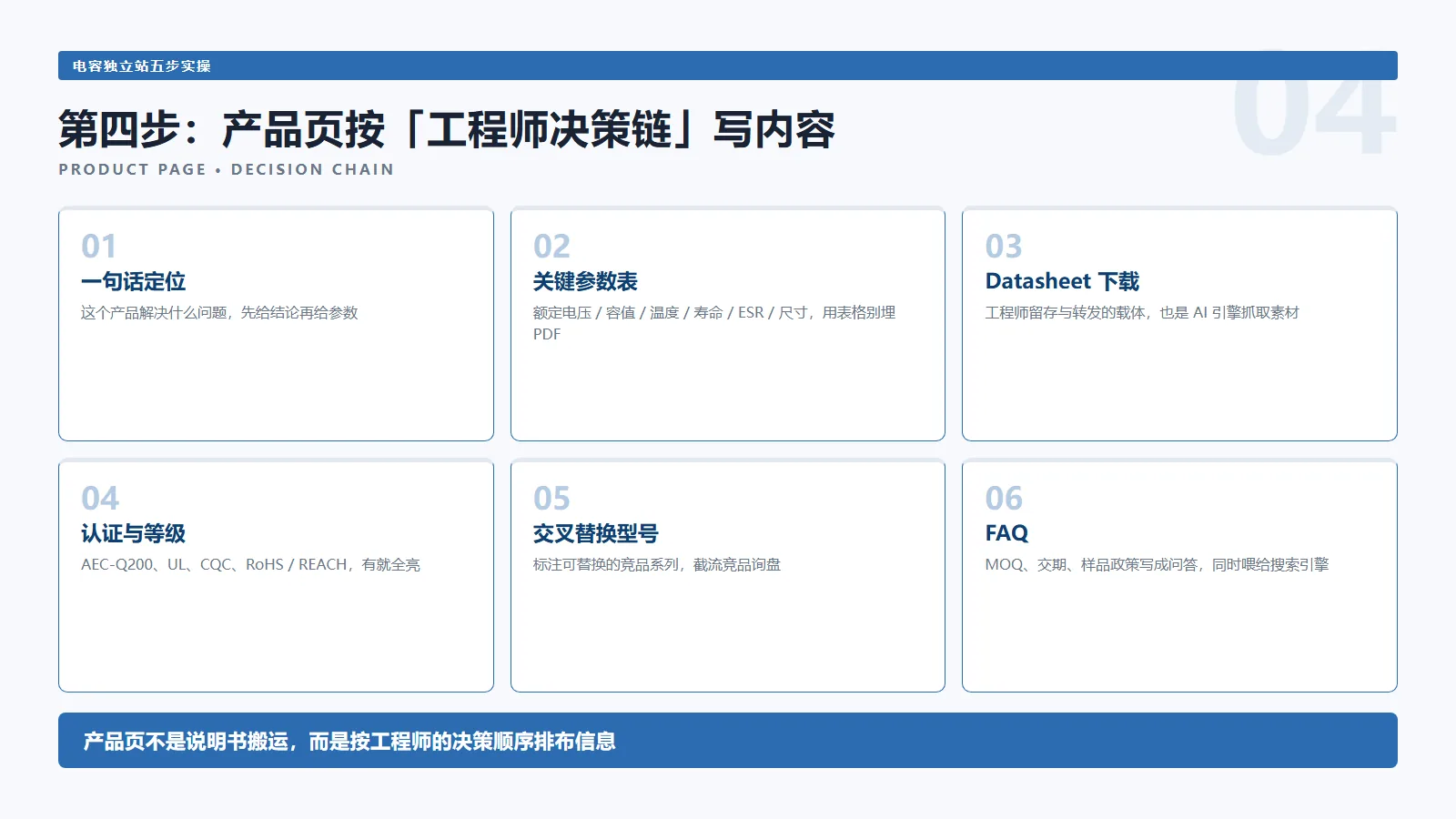
The capacitor product page is not a copy of the instruction manual; instead, the information is arranged according to the engineers' decision-making process.
- One-sentence positioning : What problem does this product solve (e.g., "Hybrid polymer electrolytic capacitors for high-ripple, space-constrained automotive power modules").
- Key parameters table : rated voltage, capacitance range, temperature range, lifespan (marked as 105°C 5000h), ESR, size code—use a table, don't bury it in the PDF.
- Datasheet Download : PDFs are a medium for engineers to save and forward, and also an important source of data for AI engines in the GEO era.
- Certifications and ratings : AEC-Q200, UL, CQC, RoHS/REACH – show them all if you have them.
- Cross-reference : Marking alternative competitor product series models is a classic tactic for intercepting competitor inquiries.
- FAQ : Write the questions and answers about MOQ, delivery time, and sample policies that are of most concern to procurement, so as to serve customers and feed the information into search engines.
Step 5: Content rhythm and inquiry conversion
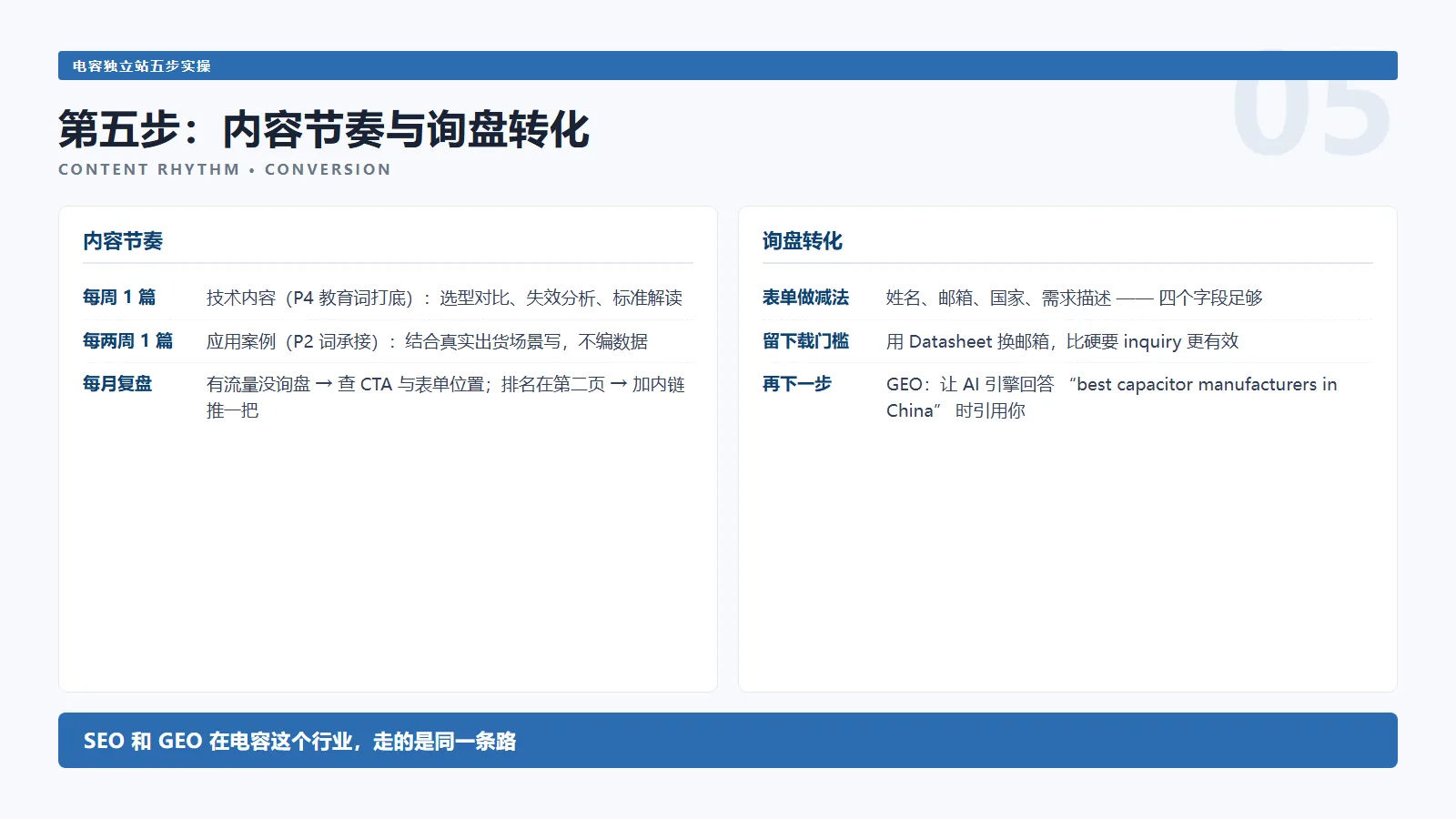
Once the section is set up, it will begin continuous operation.
- One technical article per week (with educational terms on page 4): Selection comparison, failure analysis, and standard interpretation.
- One application case study every two weeks (P2 keyword): written based on our own actual shipping application scenarios, without fabricating data.
- Monthly performance review : Which product pages have traffic but no inquiries (check CTA and form placement), which keywords rank on the second page (add internal links to boost them).
- Simplify the inquiries form : four fields—name, email, country, and description of requirements—are sufficient; leaving a download threshold in exchange for an email address is more effective than forcing an inquiry.
The next step is GEO—to get AI engines like ChatGPT and Perplexity to cite you when answering "best capacitor manufacturers in China." This requires the aforementioned actions: a clearly structured product page, crawlable parameter tables and FAQs, and continuously updated technical content. In the capacitor industry, SEO and GEO follow the same path.
In conclusion
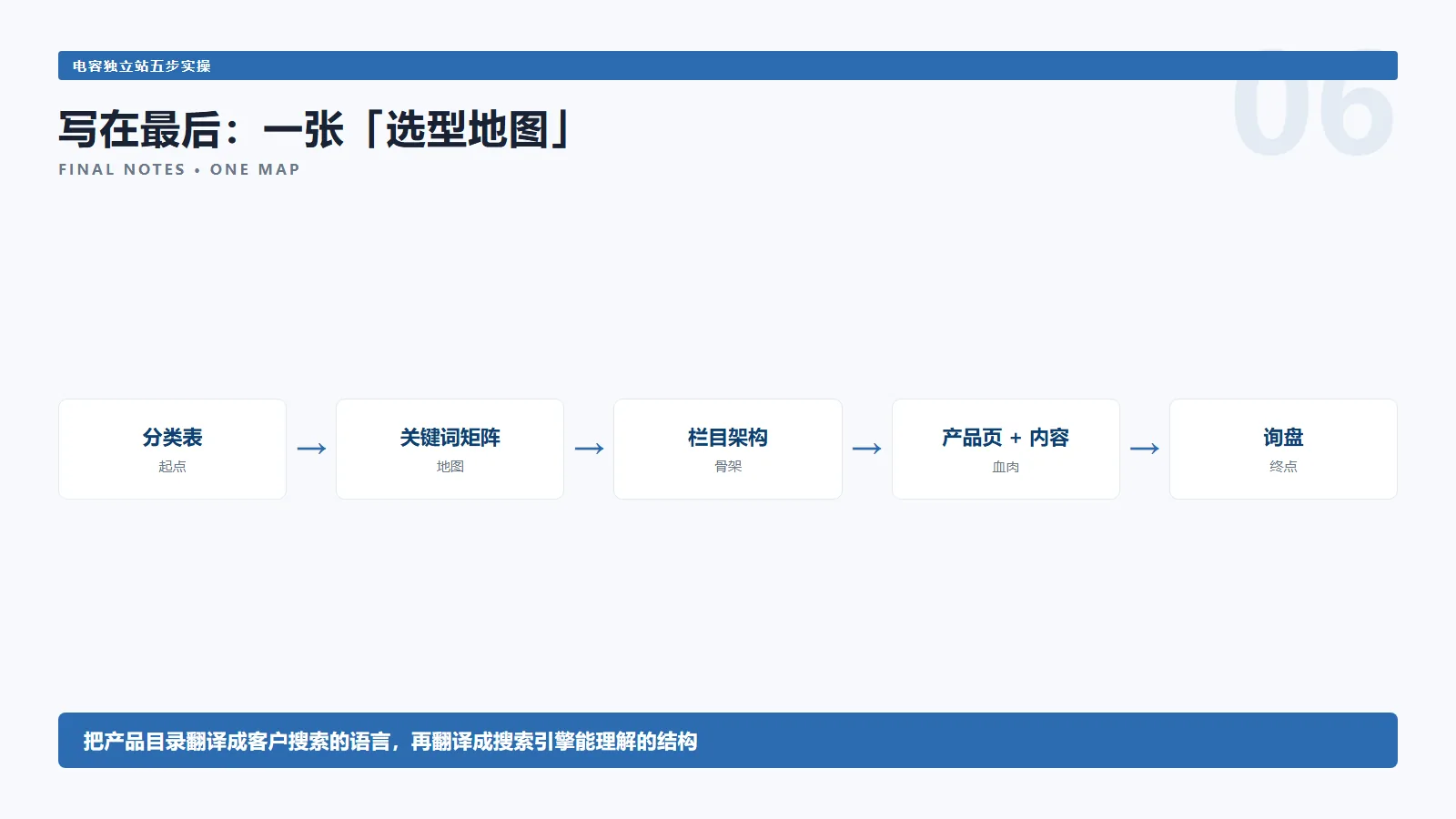
Translate your product catalog into the language customers search for, and then into a structure that search engines can understand.
The category table is the starting point, the keyword matrix is the map, the column structure is the skeleton, the product page and content are the flesh and blood, and inquiries are the end point.
This five-step checklist is ready to use. If your factory is building an international expansion business website, feel free to send us your product catalog so we can create this map together.

What does international social media management service include? 2026 Guide to Social Media Management for Export Businesses
2026-10-28

How to write a WordPress product page that will make overseas buyers want to send inquiries?
2026-10-28

How to fix WordPress form emails not sending: Practical WP Mail SMTP configuration
2026-10-27

Are foreign trade promotion companies reliable? Six key criteria for businesses to judge promotion service providers in 2026.
2026-10-26

How do I set up an email account for export businesses? How can I configure it to avoid it ending up in the spam/junk mail folder?
2026-10-26
Related Articles
Are foreign trade promotion companies reliable? Six key criteria for businesses to judge promotion service providers in 2026.
The 140th Canton Fair Opens: How can export businesses seize overseas sourcing opportunities through digital marketing?
How to Choose an Overseas Promotion Company for Foreign Trade? 2026 Service Provider Selection Criteria and Evaluation Guide
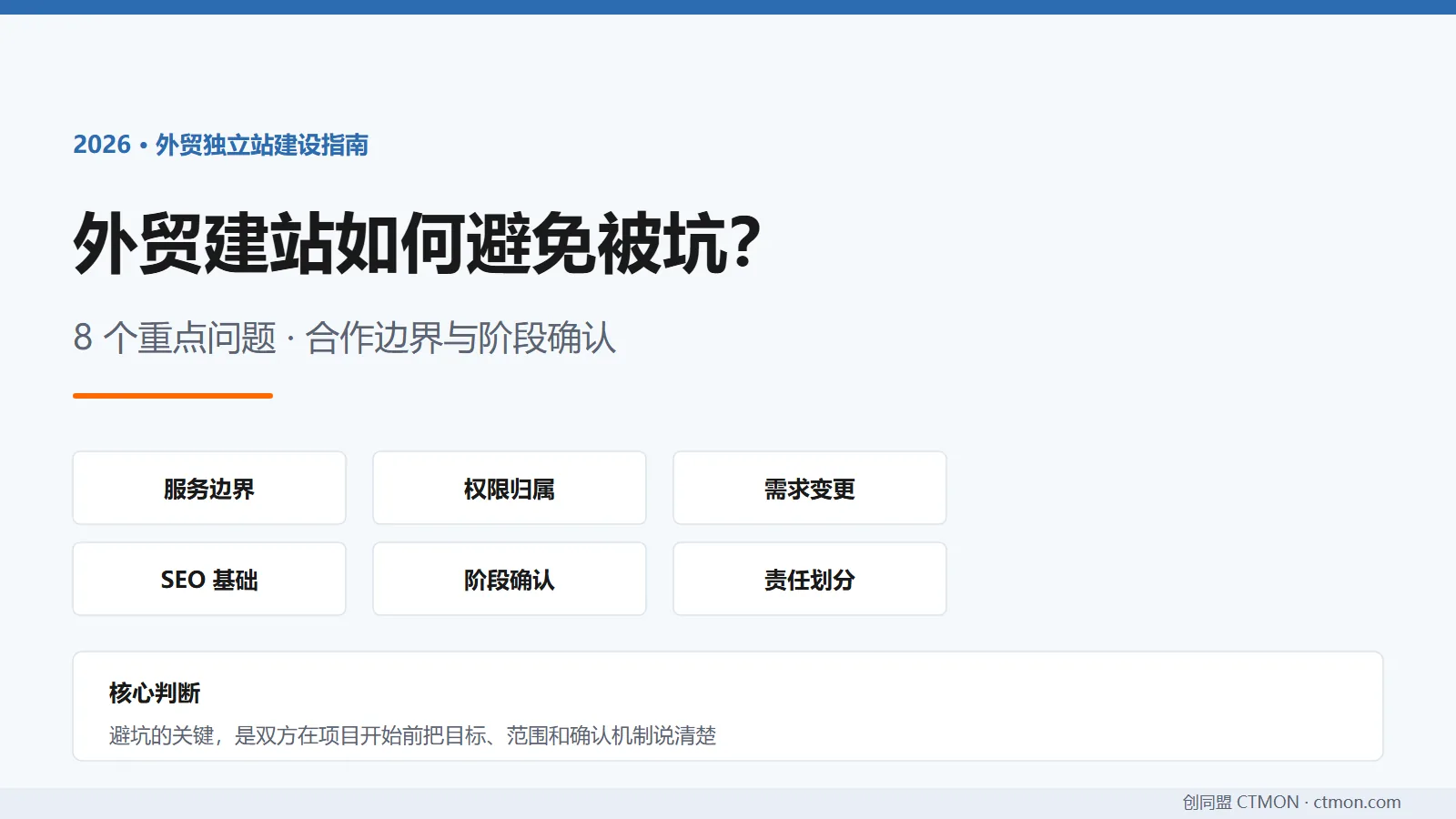
How to avoid pitfalls when building a B2B export website? A guide to avoiding common mistakes in B2B export website development in 2026.
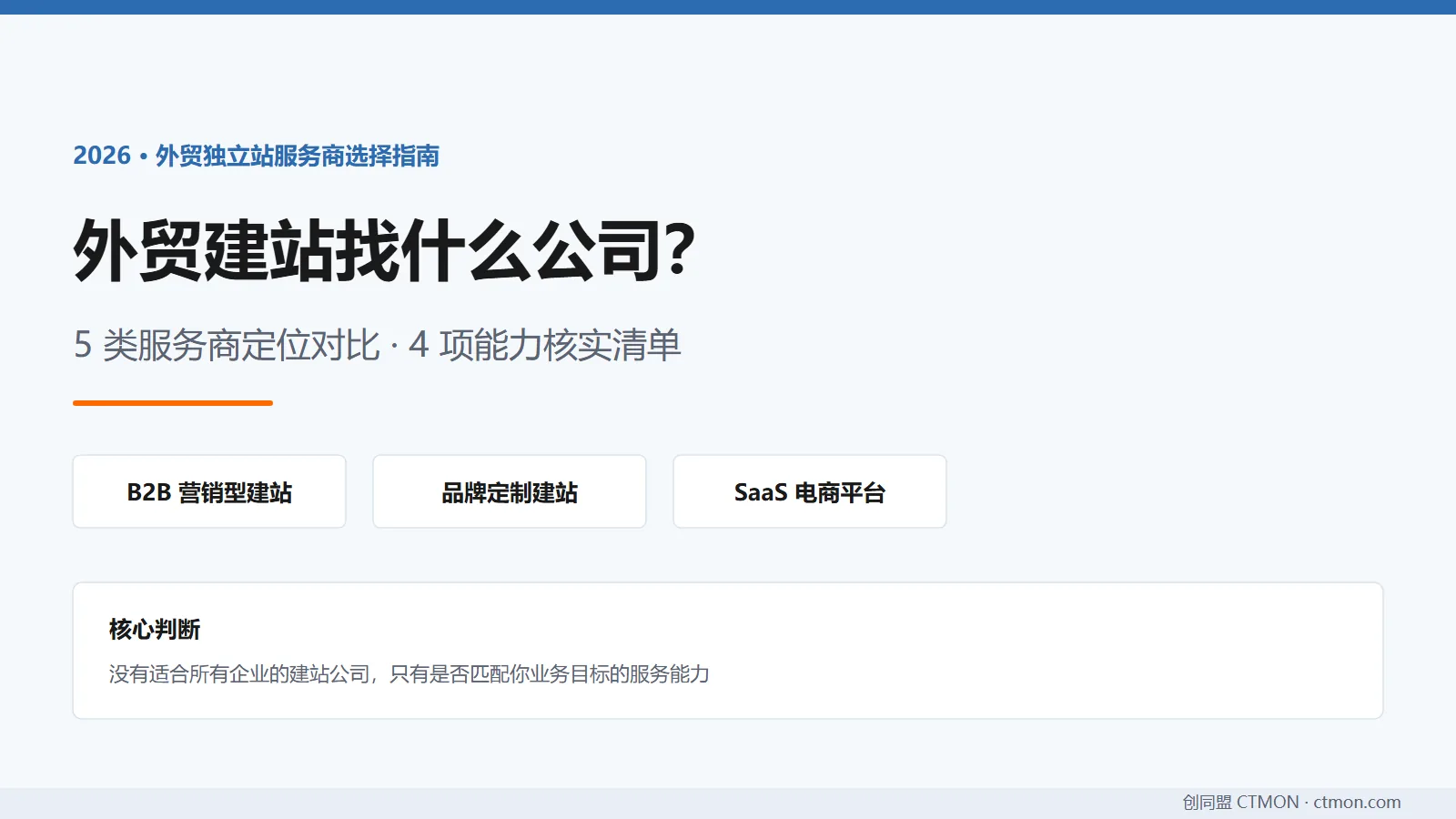
Which company should I choose for building a B2B export website? A comparison and recommendation of B2B export website service providers in 2026.

