Contents +
What exactly is a B2B export website? Many factories misunderstand it from the very beginning.
Source: 创同盟
Date: 2026-08-31
Views: 835
" Our company already has a Chinese website. If we create an English version, would that make us a B2B export website? "
This is the sentence we hear most often when we contact foreign trade factories, and it is also a misconception that most needs to be corrected.
Let's start with the conclusion: A B2B export website is not " the English version " your corporate website. The former represents your lead generation channels and digital assets for overseas markets, while the latter is simply a translated Chinese introduction. Confusing these two things is the starting point for most business websites " up being " after completion.
I. The most common misconception: mistaking it for the official website of " translation "
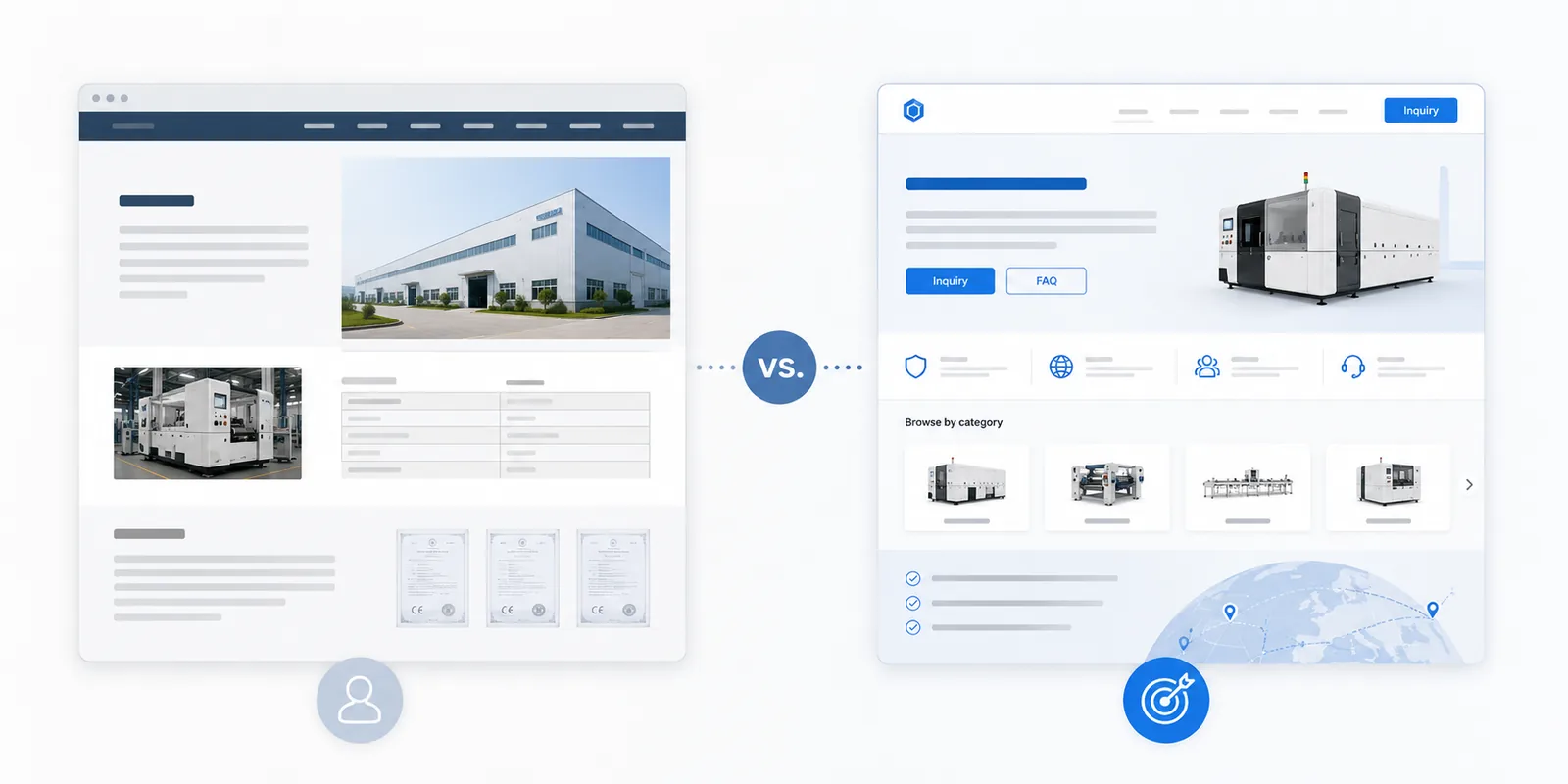
Many factories follow this path when creating a business website: they hand over their Chinese website to a translation company, add English descriptions to the product images, and copy the contact information and company profile over, then launch it.
The result is often like this:
- The homepage features the company's history, the chairman's address, and aerial photos of the factory.
- The product page only contains the model number, a few pictures, and a parameter table.
- After visiting the factory, the customer still didn't know what its main business was or what problems it could solve.
- Launched six months ago, it has only received single-digit visits and zero inquiries.
Where does the problem lie? This kind of website is built from the perspective of " I want to showcase " ," not from the perspective of " What customers need to assess." " overseas buyers open the website of an unfamiliar supplier, they are not concerned with your development history, but rather: Can you do what I need? Have you worked with similar clients? What are your delivery times and certifications? Who can I contact if there are problems?
Second, there is only one essential difference: you can be found by buyers without having to spend money each time.
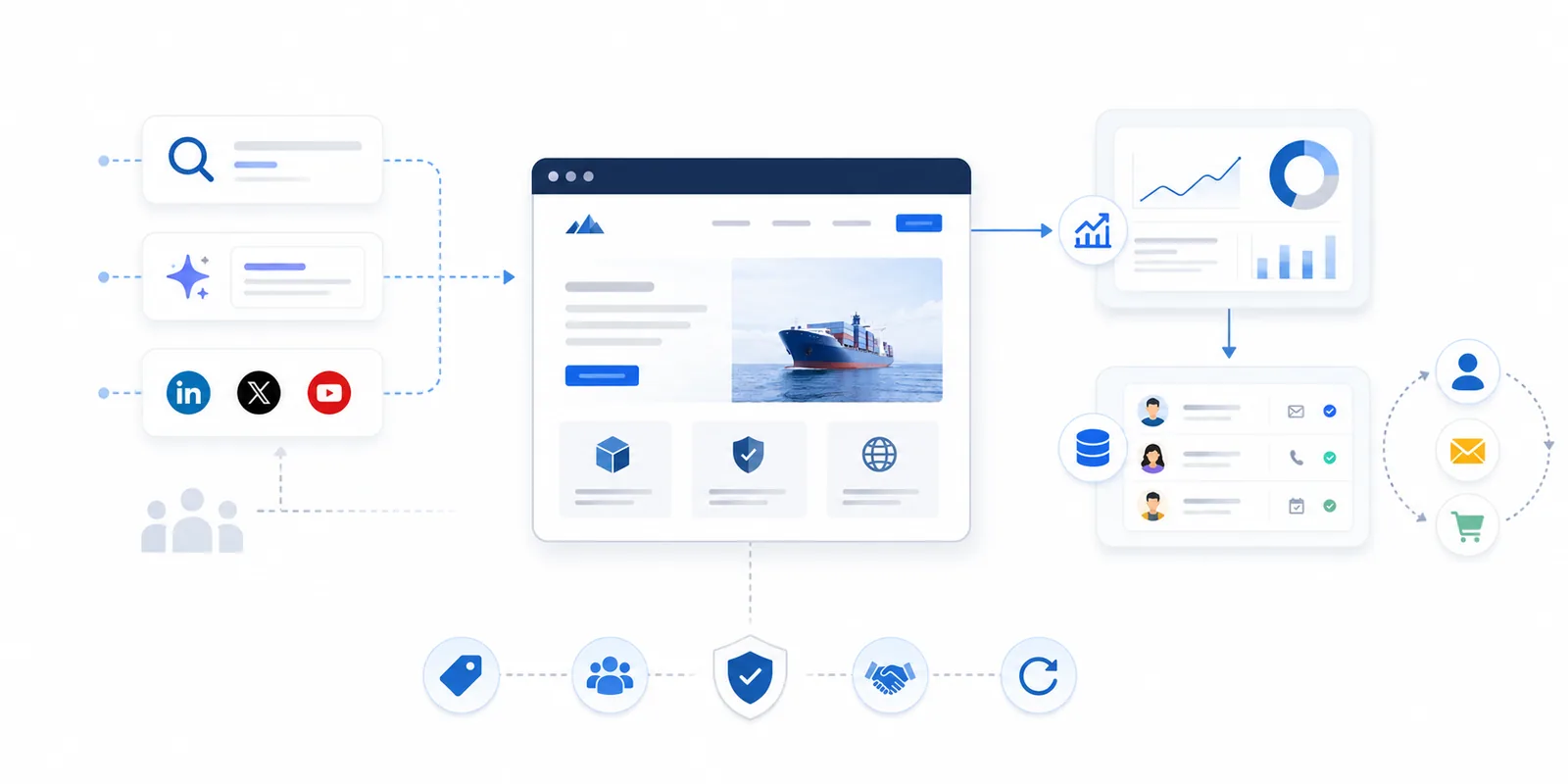
To determine if a website is a genuine business website, don't look at how many pages it has or how visually appealing it is. Just look at one thing:
Can it still be found by overseas buyers even if you stop advertising?
This is the only essential characteristic of a business website. If your site content, structure, and external references are done right, search engines and AI will continuously push you to buyers who need your site—this traffic doesn't require you to pay for it every time.
Following this line, we can deduce two other things that are often mistaken for " feature " :
① Visitor data is yours. You can see where visitors come from, which pages they view, and at which step they leave. Of course, analytics tools (such as GA4) provide sampled and de-identified data, not raw privacy data; but compared to the platform only giving you an order number, you can at least see the complete user behavior chain, which is the basis for all subsequent optimizations.
② Customers can be reached repeatedly. Customers who come through a business website can be followed up continuously using email lists, CRM, and remarketing audiences. On a platform, however, the customer essentially belongs to the platform; you are just one of the supplier options, and you have to buy exposure from the platform again next time.
In short: The core of a business website is not the page itself, but that you have your own traffic handling capacity and customer reach channels.
III. What are the differences between a business website, a corporate website, and a platform store?
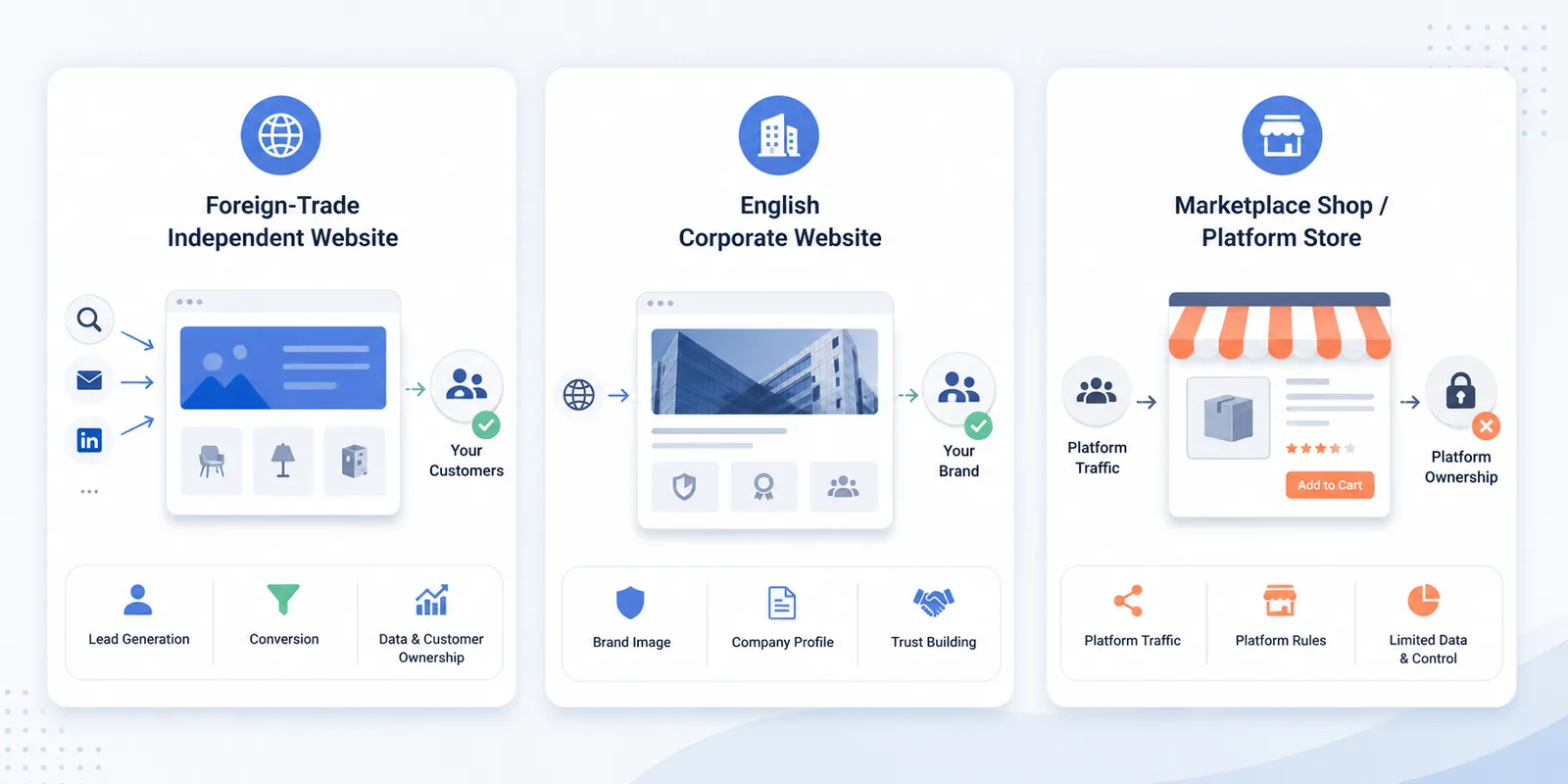
| B2B export website | Company website (English version) | Platform stores (such as the international site) | |
|---|---|---|---|
| Core objective | lead generation and transformation | Corporate Image Display | Obtaining orders within the platform |
| traffic source | Search, AI recommendation, social media, advertising | Basically relies on active access | Platform allocation |
| Data ownership | The company itself | The company itself, but without analysis. | All rights reserved by the platform |
| Customer outreach | Email/CRM/remarketing, can be repeated | Almost none | Difficult to retain customers; customers belong to the platform. |
| Regulatory risks | Independent and controllable | none | Subject to platform rules |
| Operation required | Only continuous operation can produce results. | Once built, it will be ready. | Requires continuous investment in promotion fees |
The most crucial row in this table is " representing traffic sources " : the official website is the display window for others to find you, and the business website is the channel that helps you find customers. However, note the reminder in the next section— " can generate traffic on its own, but " does not guarantee traffic after " is built, and the same applies to " .
Fourth, a word of caution: a business website doesn't automatically come with traffic.
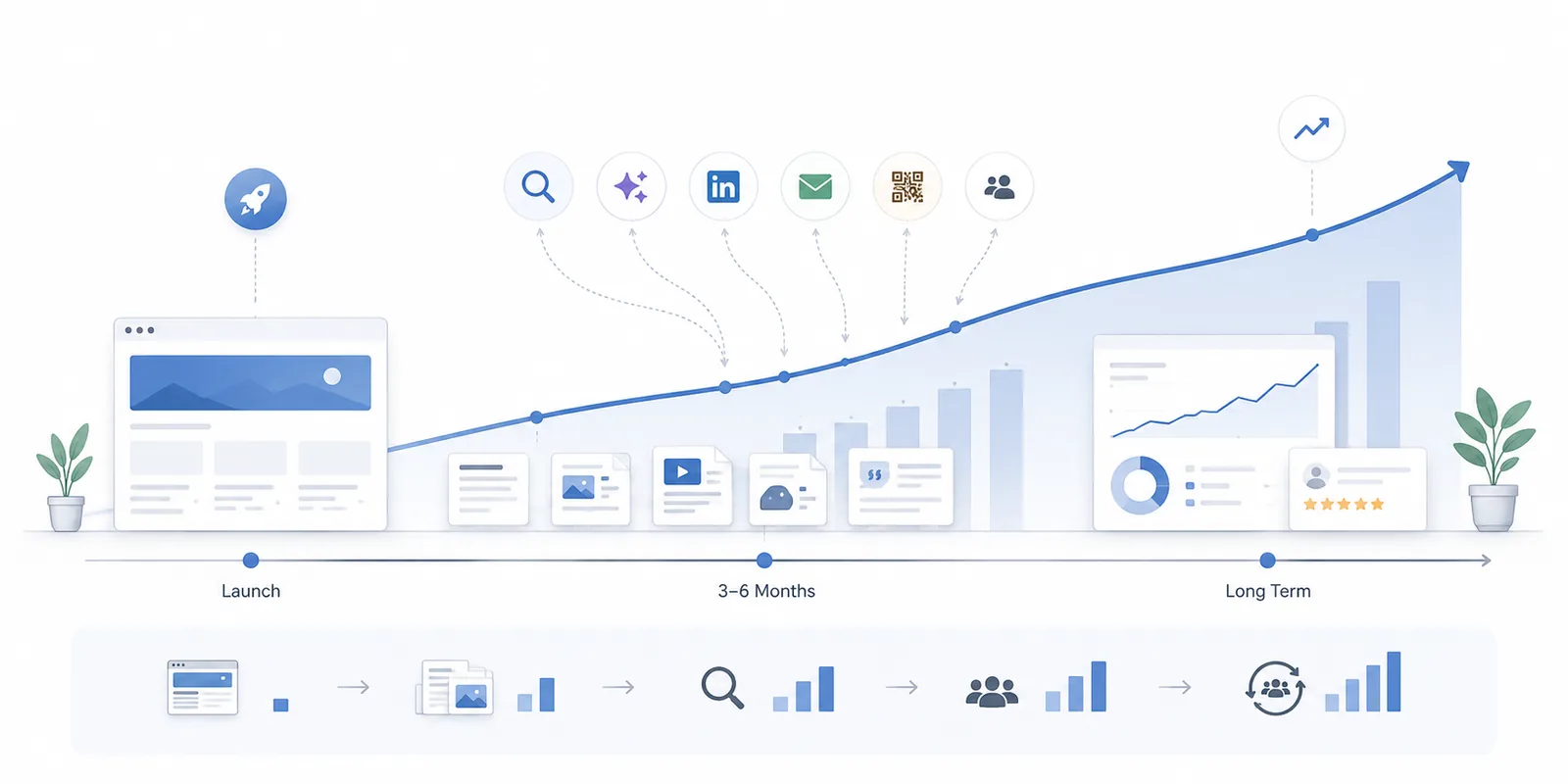
The easiest thing to be mythologized is that " business website itself includes the phrase "traffic " ".
The reality is that most business websites start with zero organic traffic in their initial stages. For the first six months, traffic relies primarily on referrals from other sources—QR codes on trade show business cards, links on social media pages, outreach emails and signatures, and referrals from existing clients. Content accumulation, SEO ranking, and AI adoption are all built up monthly, typically taking three to six months to see stable organic traffic, and over a year to establish a reliable traffic pool.
So don't expect inquiries to appear " after building " website. The value of a business website doesn't come from " customers " it's from every piece of content you " and every page that gets referenced. Every piece of content you publish adds to your assets—it becomes more valuable the more you use " .
Frequently Asked Questions
Q: I already have Alibaba.com, do I still need a business website?
A: Yes, they are needed, but their roles are different—the platform is responsible for current orders, while the business website is responsible for long-term asset accumulation and customer data. We will discuss the detailed division of labor in another article.
Q: How much does it cost to create a business website?
A: The differences are significant, ranging from SaaS solutions costing a few thousand yuan per year to custom development costing tens of thousands of yuan, mainly depending on the chosen solution and subsequent operational investment. We will break down the selection and cost in a separate article.
Q: Can a small factory without a content team still do this?
A: Yes. Start by writing answers to the 20 most frequently asked questions by " " , providing clear answers of 300-500 words for each question. Producing a few answers a month is enough to get started; there's no need to pursue high-frequency updates.
CTMON (CTMON) · Shenzhen · Over a decade of experience in B2B digital marketing · Official website ctmon.com
Series Navigation
- This article discusses "what a business website is/is not".
- The next article, "When to Build a Business Website," will continue: Which three types of factories are suitable for building one, and three self-checks to determine if you should start now.
- Other topics in the same series, such as selection, cost, content, SEO, and GEO, will be released successively.

What does international social media management service include? 2026 Guide to Social Media Management for Export Businesses
2026-10-28

How to write a WordPress product page that will make overseas buyers want to send inquiries?
2026-10-28

How to fix WordPress form emails not sending: Practical WP Mail SMTP configuration
2026-10-27

Are foreign trade promotion companies reliable? Six key criteria for businesses to judge promotion service providers in 2026.
2026-10-26

How do I set up an email account for export businesses? How can I configure it to avoid it ending up in the spam/junk mail folder?
2026-10-26
Related Articles
Are foreign trade promotion companies reliable? Six key criteria for businesses to judge promotion service providers in 2026.
The 140th Canton Fair Opens: How can export businesses seize overseas sourcing opportunities through digital marketing?
How to Choose an Overseas Promotion Company for Foreign Trade? 2026 Service Provider Selection Criteria and Evaluation Guide
How to avoid pitfalls when building a B2B export website? A guide to avoiding common mistakes in B2B export website development in 2026.
Which company should I choose for building a B2B export website? A comparison and recommendation of B2B export website service providers in 2026.

