Contents +
Why must a B2B export website adapt to AI search in 2026?
Source: 创同盟
Date: 2026-09-01
Views: 858
A business owner who makes industrial valves once said something that stuck with me: "In the past, foreigners would search for suppliers on Google using keywords; now they just ask AI—'Recommend a few industrial valve factories in Wenzhou, China, that have CE certification and can ship to the Middle East.'"
Let's start with the conclusion: overseas buyers are changing how they find suppliers, and most B2B export websites haven't kept up. More importantly, many factories believe that "optimizing keywords" is equivalent to doing well in AI search—in reality, AI's evaluation logic is completely different: it doesn't consider the size of your company, only whether your content is "verifiable."
I. AI assesses your four dimensions
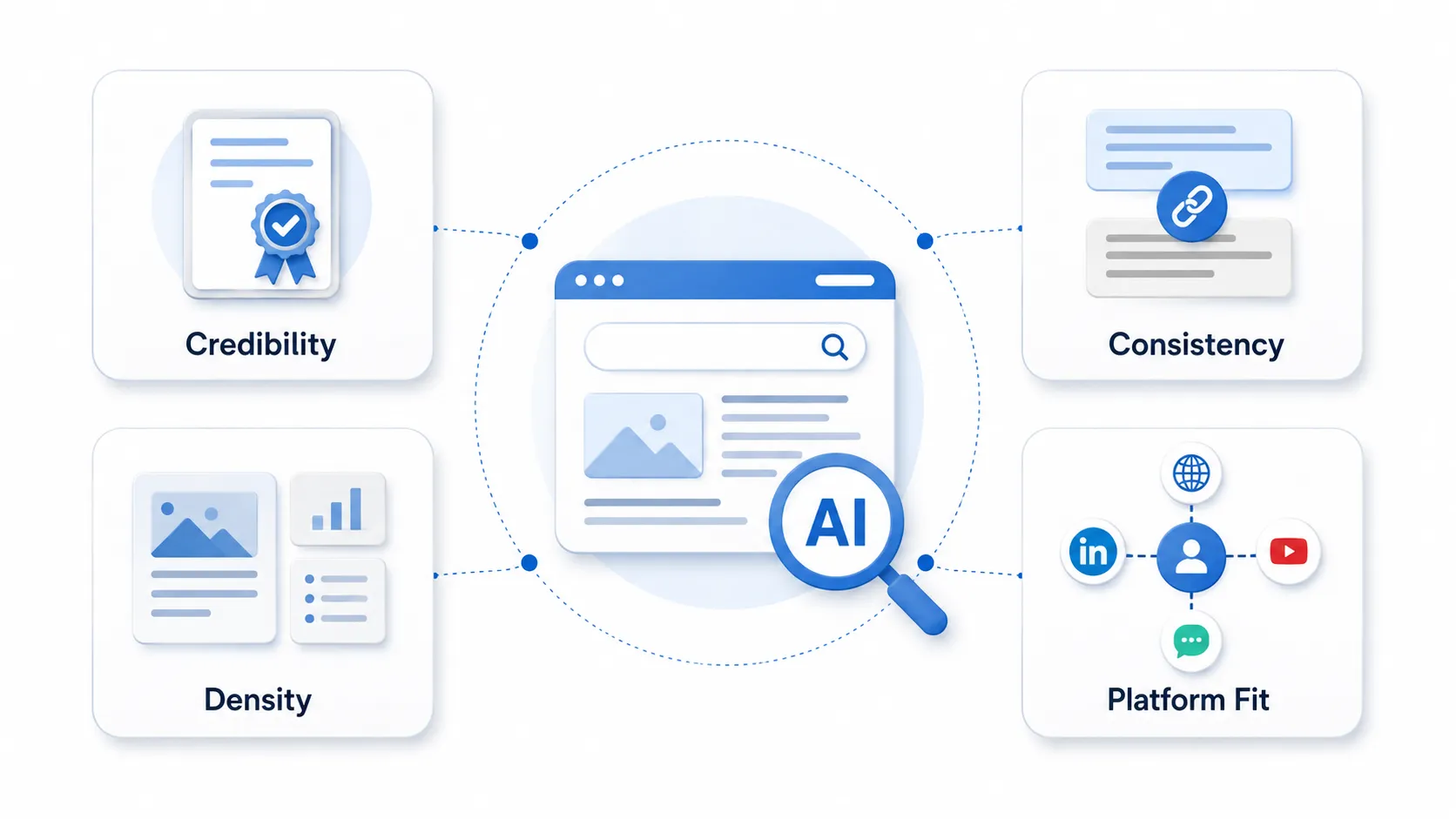
This is the starting point for understanding GEO. When AI decides whether to recommend a particular brand, it considers four dimensions:
| Dimension | meaning | What does this mean for the factory? |
|---|---|---|
| Data credibility | Can what you said be verified? | Parameters, certifications, and test reports must be authentic and verifiable; simply stating "reliable quality" is insufficient. |
| Semantic consistency | Are the various accounts consistent? | The statements on the official website, social media, and industry media should be consistent; avoid conflicting accounts. |
| Information density | Does the content contain any real information? | It's better to explain a specific issue clearly than to just state one empty sentence on a page. |
| Platform preferences | Different AI platforms have their own advantages | See Section 6; this requires specific adaptation. |
AI doesn't care who you are, it only cares about your "verifiability". This is a major benefit for small and medium-sized factories - it means that the basis of competition has changed from "who has the largest scale" to "who has the most complete chain of evidence".
II. An Era of Equal Evidence: A Cornering Opportunity for Small Factories
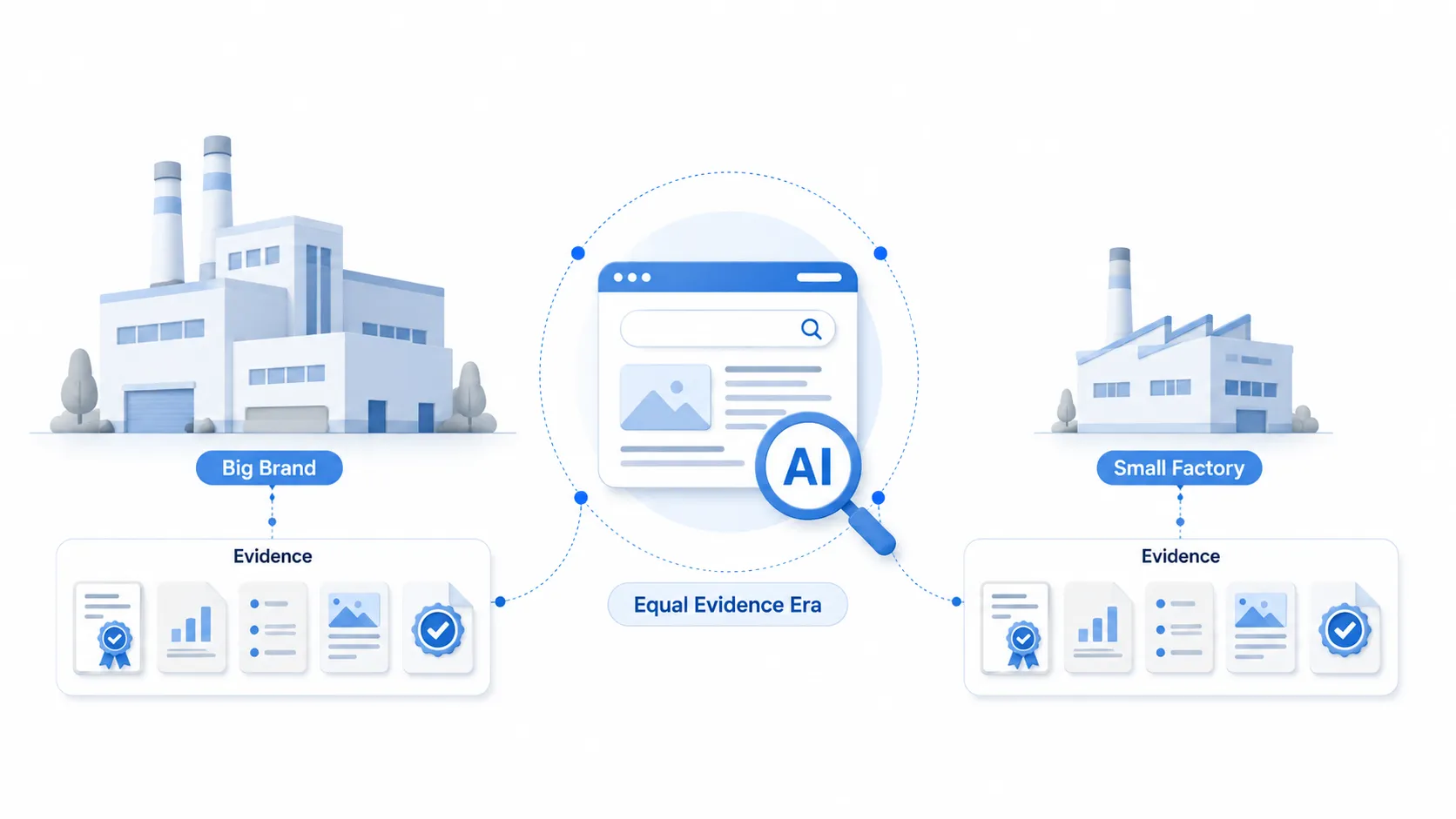
This change led to a very interesting result:
For major brands : those lacking AI-friendly content will also be penalized. The market has entered an era of "equal evidence," where whoever submits credible data first has priority in reallocating customer attention.
For smaller brands : A complete chain of evidence allows them to be seen by global buyers. GEO has become a lever for SMEs to leapfrog ahead – something almost impossible in the traditional search era, where competition relied on domain authority and backlink accumulation, both of which required time and money.
But the prerequisite is that you must first be "seen, understood, and remembered" (section 5).
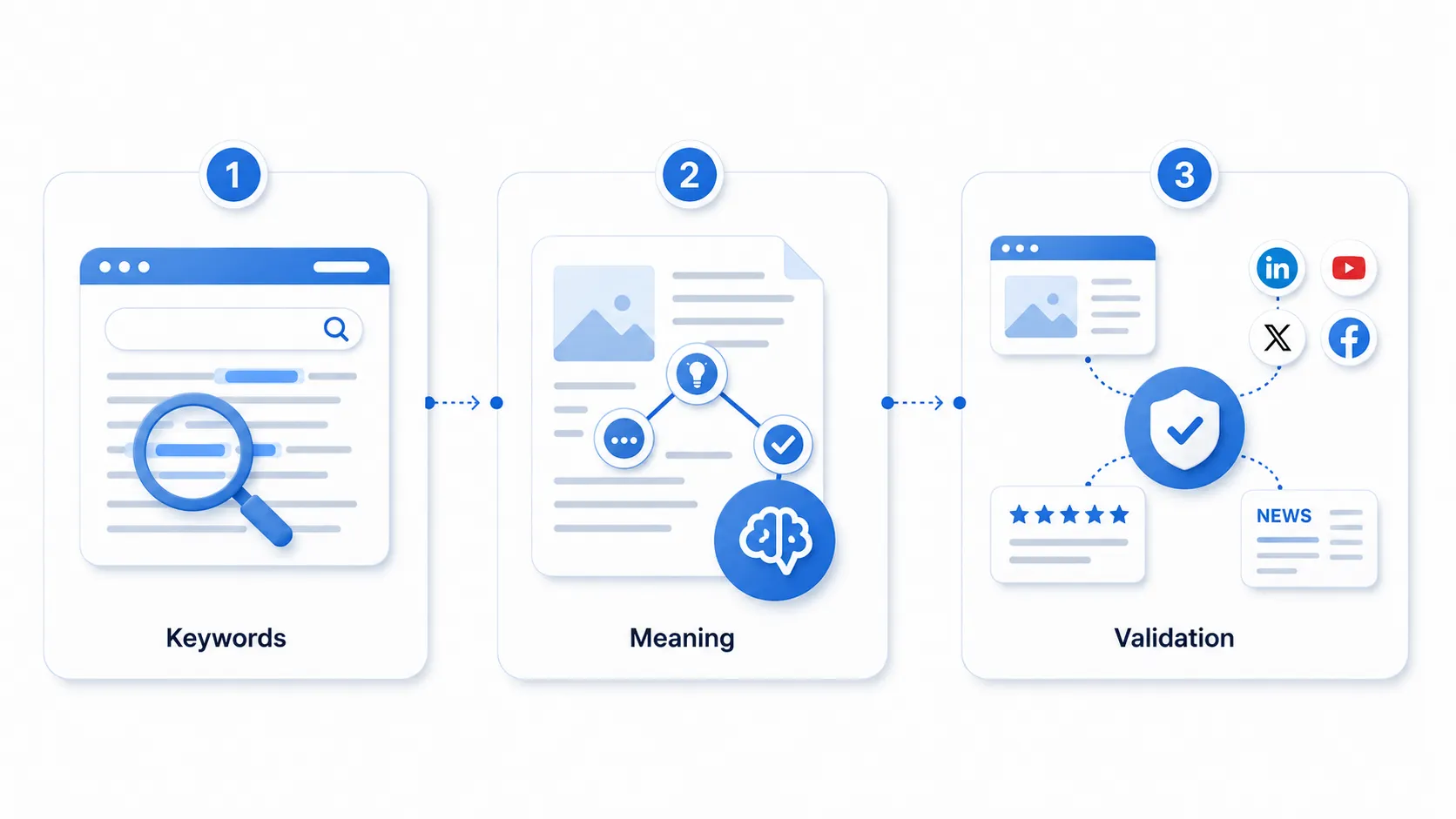
III. The Triple Evolution of AI Algorithms
To understand why old methods fail, we need to know how AI's evaluation criteria have evolved over the years:
The first step: from keyword matching to semantic understanding.
Early search engines looked for keywords on your page. Now, AI understands "what your content is about"—even if the buyer uses completely different words from those on your page, as long as the meaning matches, it will still be found. Keyword stuffing is no longer effective , but clearly explaining "what this is, why it is, and how it is done" makes it easier to be found.
The second level: from semantic understanding to knowledge authority assessment.
AI is starting to judge "whether this brand is authoritative enough in this field." The basis is not company size, but whether your content covers the complete levels of a field from basic to in-depth . AI can see websites with only product pages, but it can't see your achievements in the industry.
The third step (currently underway): cross-platform cross-validation.
AI will combine your official website, social media, industry media mentions, and customer reviews to determine whether you are a "local expert" or an "industry authority." Relying on only one channel is becoming increasingly difficult —AI needs cross-verification.
IV. Buyer intentions are divided into five layers, but most factories only completed one layer.
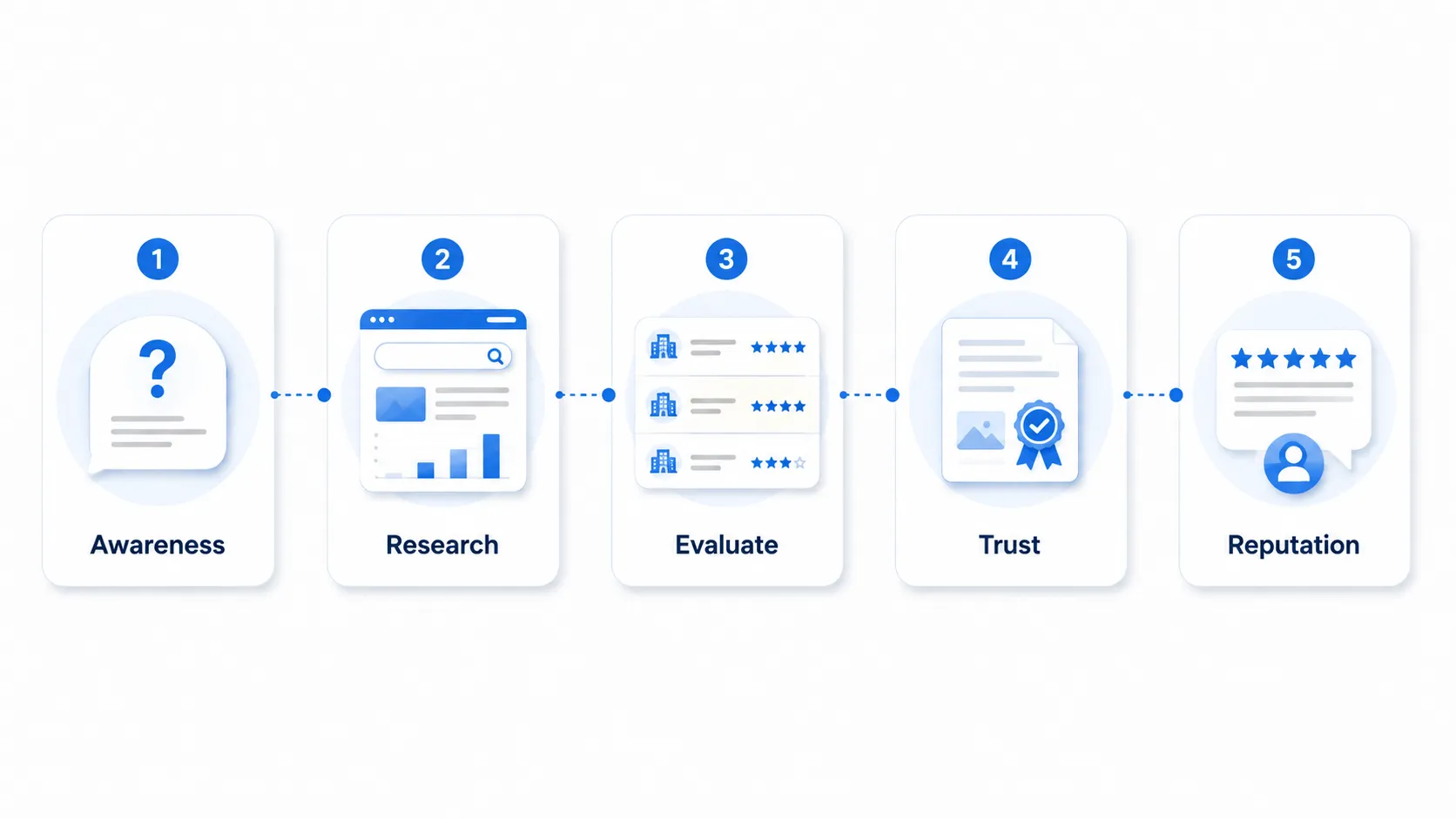
This is the most easily overlooked yet most significant difference. Overseas buyers go through five stages from "recognizing the problem" to "deciding to cooperate":
| stage | Buyer status | What would he ask? | What should you provide? |
|---|---|---|---|
| Awakening of Demand | I know there's a problem, but I don't have a solution. | What if we don't have enough warehouse space? | Explain the causes and costs of the problem |
| Cognitive establishment | In finding solutions and comparing options | How to choose between heavy-duty shelving and mezzanine shelving? | Solution Comparison and Selection Logic |
| Scheme Evaluation | Supplier screening | Which Chinese factories that manufacture warehouse racking are reliable? | Product capabilities, differentiation |
| Trust Decision | In nuclear strength | "Do you have ISO certification? Which countries have you worked on projects for?" | Case studies, qualifications, testing |
| Word-of-mouth marketing | Looking at the reviews | What's the reputation of this factory? | Customer reviews, third-party endorsements |
Most foreign trade websites only cover the third layer —product pages, company introduction, and contact information. Your website can't answer any of the questions buyers ask when they're looking for solutions at the beginning and verifying the company's capabilities later.
V. A Three-Tier Evidence System: Trusted, Understood, and Remembered
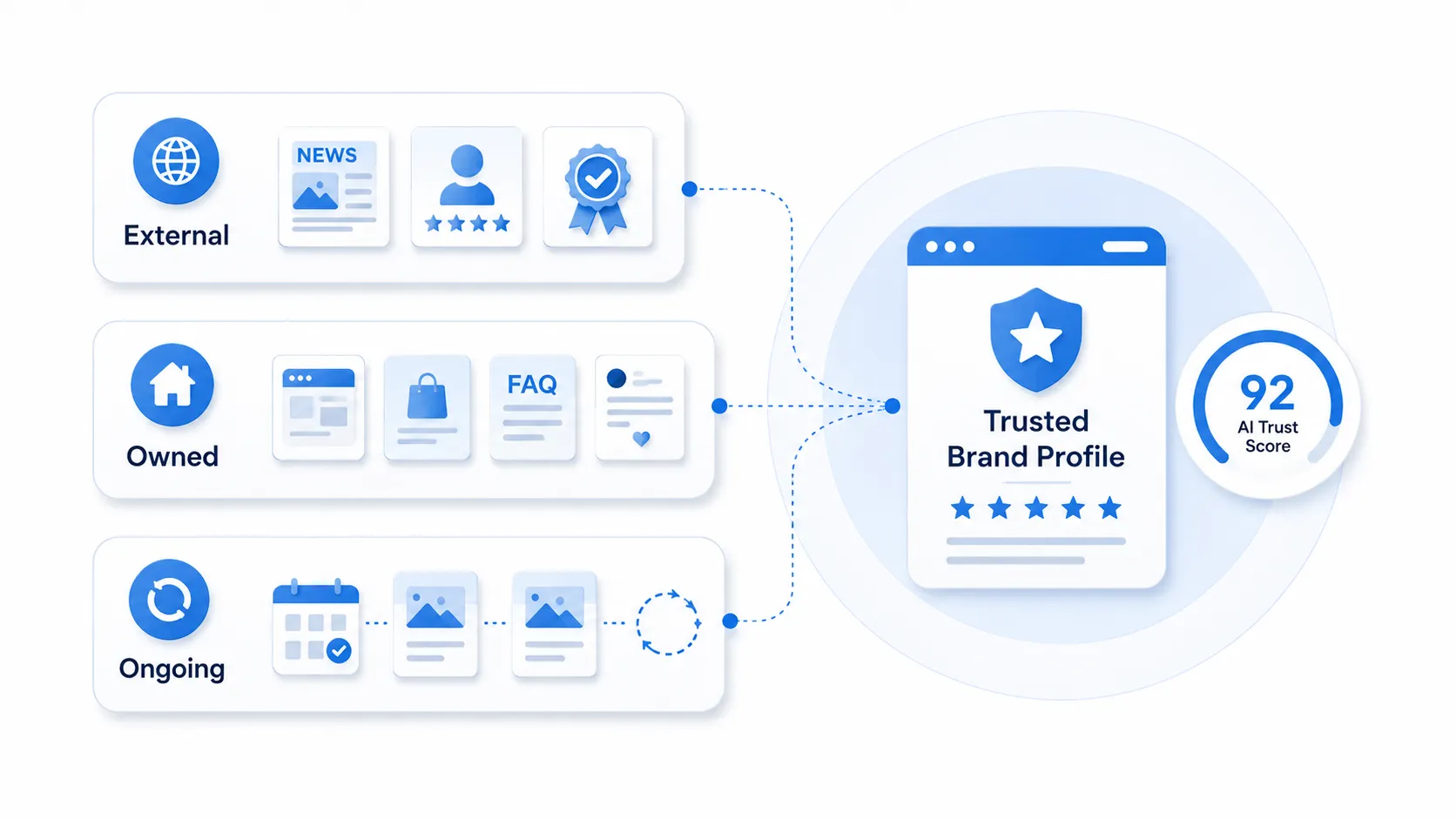
Now that we know how AI makes its judgments, the next question is: how do we get it to choose you? We break this process down into three steps:
The first layer: external verification – determines whether AI can trust you.
AI most trusts external sources of information such as official media, industry authorities, expert commentary, and public opinion. By distributing high-quality reports and evaluations through these channels, it transforms corporate facts into independent, citationable evidence, forming a high-weighted layer of "external evidence." This is the part where, in addition to your own self-praise, others also speak highly of you.
The second layer: self-verification – determines whether AI can understand you.
Official website news, product updates, technical white papers, and social media content constitute a company's self-narrative matrix, providing structured and parsable metadata to AI. The key is to maintain a high degree of consistency —if the official website tells one thing and social media tells another, AI will deduct points during cross-validation.
The third layer: Continuous content – determines whether AI will remember you.
AI models are constantly iterating and training, continuously outputting fresh content, allowing your data to be repeatedly captured and forming a long-term, stable presence. This is why the approach of "doing it once and waiting for the result" doesn't work.
Cross-referencing self-evidence and other-evidence will further enhance the AI's overall assessment of your professionalism.
VI. Five major overseas AI platforms have different preferences.
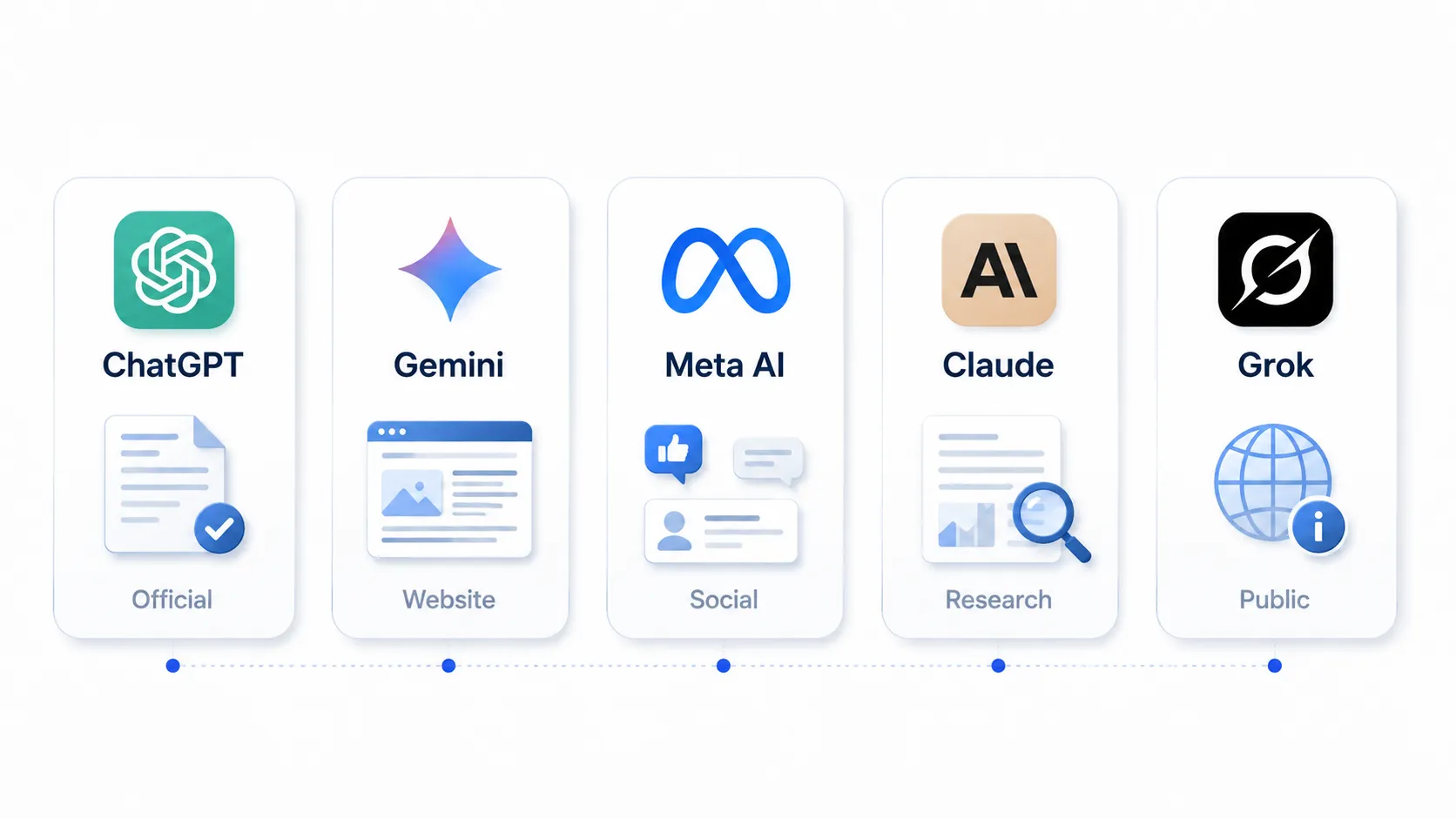
This is especially important for international expansion in foreign trade— different AI platforms capture and prefer very different types of content :
| platform | Content preferences | Semantic preferences |
|---|---|---|
| ChatGPT | Comprehensive data | Official objective statements, argumentative type |
| Gemini | Website data | Corporate Statement |
| Meta AI | social media | Comprehensive information + expert information |
| Claude | Vertical industry information | Scientific research nature |
| Grok | Administrative Information | Official Information |
This means that the same content cannot be effective across all platforms . For example, if your content has in-depth coverage in industry media (authoritative and evidence-based), ChatGPT is more likely to cite it; and if your social media page is active and has a lot of discussion among influencers, Meta AI will give it a higher priority.
One of the solar inverter companies we serve operates on this logic: when buyers ask questions like "What solar inverter should I use for my RV?", "How do I choose an off-grid inverter?", and "How do I price an energy storage system?", their brand appears in the answers on different platforms like AI Mode and Gemini—because different platforms consume different types of evidence.
VII. Six Steps to Implementation: From Zero to AI Adoption
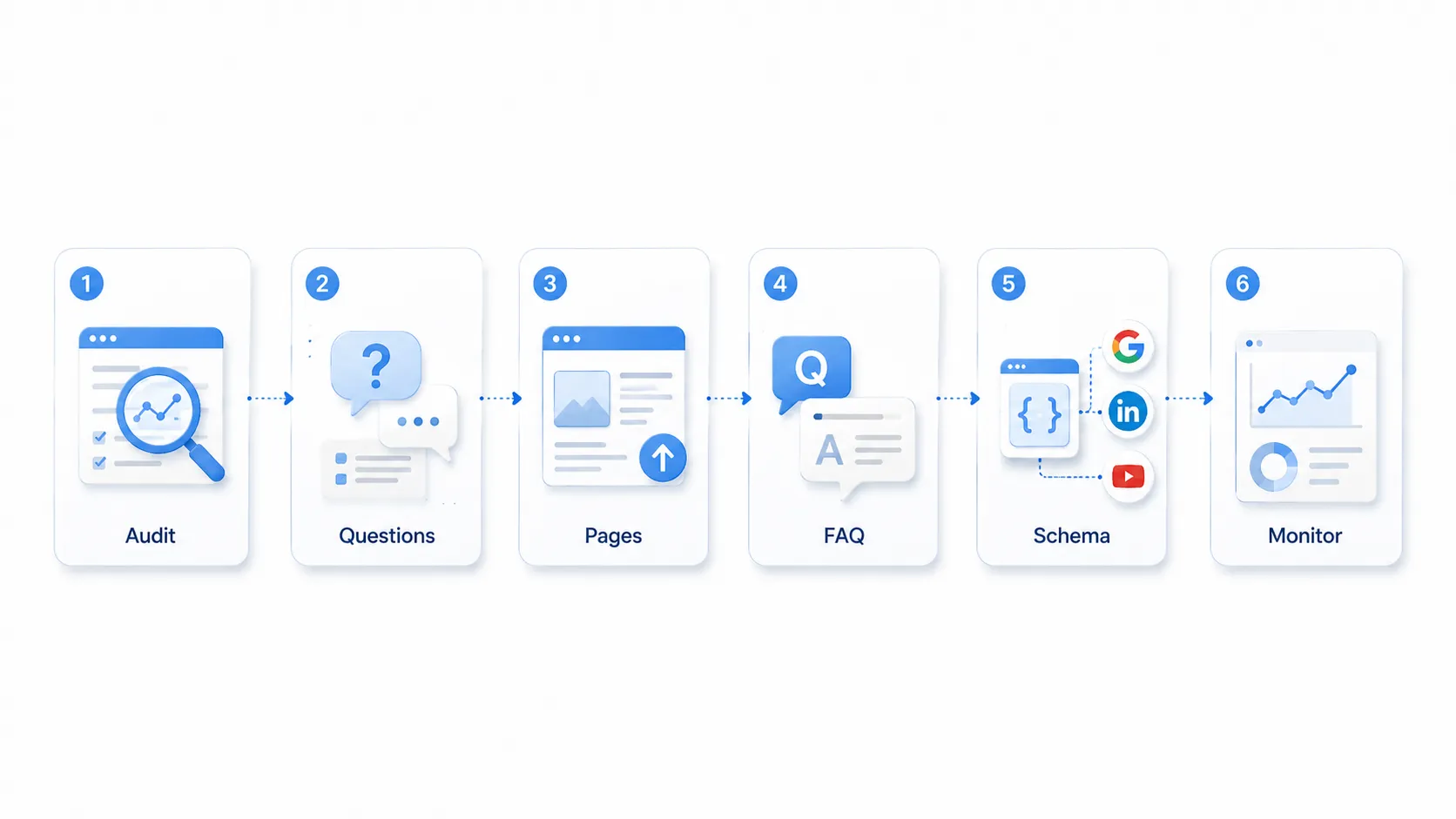
Having explained the principles, let's move on to the specific steps. The checklist we provide to export-oriented factories consists of these six steps:
Step 1: First, check the official website for basic information.
Check four things: Is the page properly indexed ( robots.txt and sitemap should not conflict), is the speed and mobile performance normal, is HTTPS enabled, and is there basic structured data? AI cannot crawl your page, so it cannot reference it. This is the foundation; skipping it will render everything else useless.
Step 2: Create a "buyer question terminology database".
Don't start with "product keywords," start with "question keywords." Translate your core products into questions that buyers would actually ask in an AI environment—not "warehouse racking supplier," but rather "how to choose between heavy-duty shelving and mezzanine shelving" or "how many shelves can be placed in a 3-meter-high warehouse." Aggregate long-tail queries from mainstream AI platforms to build a dynamic database of buyer questions, and then generate content themes around these questions to ensure that each article corresponds to a real purchasing scenario.
Step 3: Shift the product page from "Parameters" to "Questions and Answers".
Each key product is supplemented with three sections: product section (what it does, specifications, certifications), technology section (principles, selection, industry know-how), and application section (how to use it in different scenarios, what pitfalls were encountered). These three sections together perfectly cover the structure that both buyers and AI will ask.
Step 4: Write 20 FAQ answer pages.
The most cost-effective starting point, even without a content team. Select "20 frequently asked questions by buyers," each 300-500 words long, and write a page with built-in answers: clear definitions, real data, and use cases, without beating around the bush. These 20 articles are the "minimum viable content set" for most GEOs in small and medium-sized factories.
Step 5: Add structured data and distribute it across multiple platforms.
Add structured data such as Organization, Product, and FAQ to the homepage, product pages, and FAQs to make it easier for AI to extract and label sources. At the same time, synchronize core content to the official website, social media, and industry media— ensuring that you are mentioned in multiple places . This is the foundation of the third layer of "cross-platform cross-validation".
Step 6: Monthly monitoring, using data to drive iteration.
We check the citation metrics monthly to see which issues haven't been covered and which content isn't "like an answer" enough, and then add it to the next round of supplementation.
> Reminder: GEO is an "amplifier of content quality," not a "cover-up for poor-quality content." If your foundation is weak, first strengthen the groundwork in step 1; don't expect to bypass it with tricks.
8. Look at these four metrics, don't use SEO standards to measure GEO.
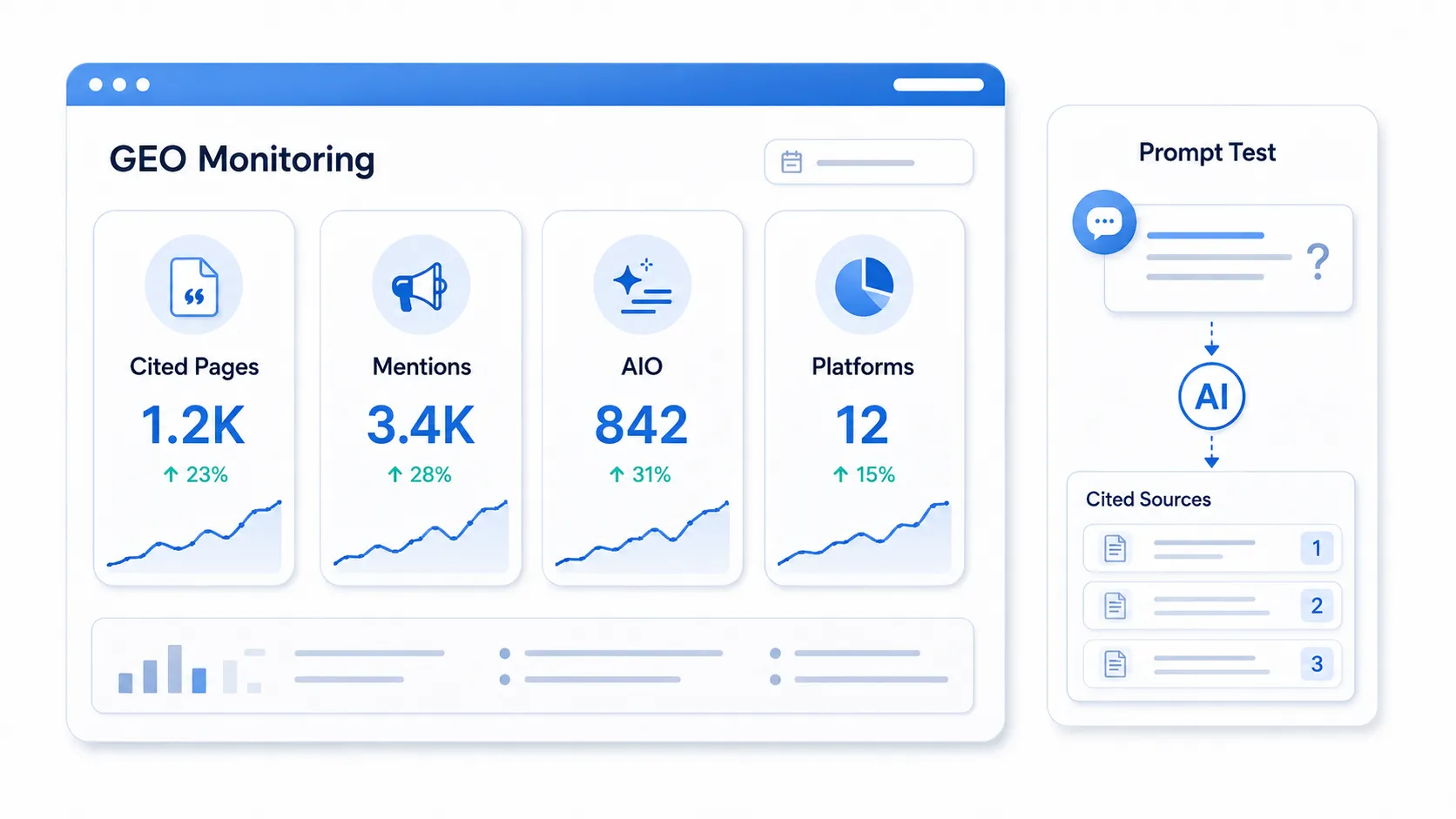
Many factories ask, "Is AI search actually useful?" after creating their content— the answer isn't in page views, but in another set of metrics. GEO's core metric is "citations":
- The number of unique pages cited by AI – the hardest measure: how many of your pages appear in the "source" of AI answers.
- The number of times your brand is mentioned in AI answers —Did the AI include your brand name in the body of the text?
- AI Overview Page Count – How many pages does the largest entry point, Google AI Overview, reference?
- Citation distribution across AI platforms— how many citations were made by ChatGPT, Gemini, Perplexity, etc., and which platform had the most?
How to check? The Prompt test method, zero cost:
- The problems in the "word-to-text conversion" database were then distributed to various AI platforms one by one.
- Check if your page is in the "Source/Citation" section of the answer.
- Does the text mention your brand name?
- Note down: which question was cited, which platform cited it, and which article was cited.
If you run the survey once a month and make a horizontal comparison, the trend will become clear.
9. Three common misconceptions
Myth 1: Only looking at organic traffic and rankings.
That's an SEO metric. The benefits of GEO (Geographic Optimization) are often first reflected in "citations," and not necessarily immediately in traffic numbers. Looking only at traffic can easily lead to the misconception that GEO is useless.
Myth 2: Believing in the claim of "guaranteed placement on the AI homepage".
Promises like "Get recommended by ChatGPT in 7 days" are either misleading; they'll either relegate you to low-quality aggregation pages (and quickly demote you) or are just empty sales pitches. Service providers that can provide verifiable data like the number of pages referenced are reliable.
Myth 3: Do it once and wait for the result.
GEO is about continuous iteration, not a one-off deal. Without monthly monitoring and retrospective content updates, initial investments will quickly evaporate.
10. Three-step self-test: You can start today.
- Ask questions like a buyer would. Open ChatGPT or Perplexity, don't search for keywords, just ask a question a buyer would say.
- See who the answers cite. Click on the websites that are cited and see what their content looks like—they usually have a clear question-and-answer structure, specific data, and application scenarios.
- Ask the same question again. A stable answer indicates that the AI has formed a fixed pool of information sources; if it cannot enter this pool, it is as if it does not exist at this entry point.
Frequently Asked Questions
Q: With AI search now in operation, is Google SEO still necessary?
A: Absolutely. Google remains the primary traffic source for B2B foreign trade, and a strong SEO foundation is a prerequisite for GEO. My suggestion is to "build a foundation with SEO, then add incremental growth with GEO."
Q: How long will it take to see changes in the data?
A: Those with a strong foundation will see changes in the number of cited pages within 1-2 months; those with a weak foundation should spend 3-6 months building their content base. The criterion is to look at the number of citations, not the traffic.
Q: Can a small factory without a content team still do this?
A: Yes. Start with step 4, "20 FAQs," each 300-500 words long. A few per month is enough. Focusing on "intent" is more effective than creating many shallow pages.
Q: If my application is cited by AI but there are no inquiries, does that count as a success?
A: Being "seen" is a success—you've made it onto the buyer shortlist. But to truly convert, you need to coordinate with the official website conversion page, social media, and SEM; relying on just one approach is risky.
Q: Do we need to rebuild the website first?
A: Most don't need it. First, conduct a technical check-up, then supplement the structured data, and then gradually improve the content layout. Among the export businesses we serve, about 90% don't need to rebuild their official websites.
Q: We're not a large company, can we compete with the big ones?
A: Sure. AI doesn't consider brand size; it only looks at verifiability—whoever has a complete chain of evidence, semantic consistency, and high information density is more likely to be recommended. This is precisely the window of opportunity for small and medium-sized factories.
CTMON (CTMON) · Shenzhen · Over a decade of experience in B2B digital marketing · Official website ctmon.com

What does international social media management service include? 2026 Guide to Social Media Management for Export Businesses
2026-10-28

How to write a WordPress product page that will make overseas buyers want to send inquiries?
2026-10-28

How to fix WordPress form emails not sending: Practical WP Mail SMTP configuration
2026-10-27

Are foreign trade promotion companies reliable? Six key criteria for businesses to judge promotion service providers in 2026.
2026-10-26

How do I set up an email account for export businesses? How can I configure it to avoid it ending up in the spam/junk mail folder?
2026-10-26
Related Articles
Are foreign trade promotion companies reliable? Six key criteria for businesses to judge promotion service providers in 2026.

The 140th Canton Fair Opens: How can export businesses seize overseas sourcing opportunities through digital marketing?
How to Choose an Overseas Promotion Company for Foreign Trade? 2026 Service Provider Selection Criteria and Evaluation Guide
How to avoid pitfalls when building a B2B export website? A guide to avoiding common mistakes in B2B export website development in 2026.
Which company should I choose for building a B2B export website? A comparison and recommendation of B2B export website service providers in 2026.

