Contents +
SEO and PPC click-through rates are at historic lows; AI technology is reshaping the search engine ecosystem.
Source: 创同盟
Date: 2025-03-07
Views: 1234
This article contains 3745 words and is estimated to take 10 minutes to read.
After the emergence of large AI models such as "chatGPT", they took away a portion of the user information-based search traffic from search engines.
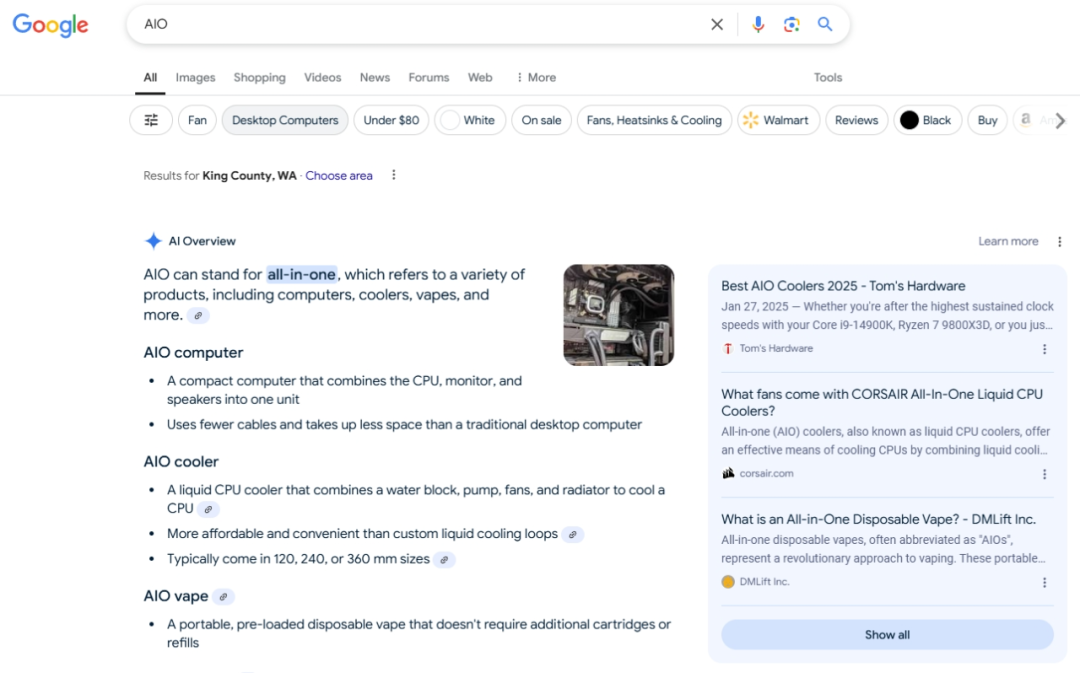
Search engine service providers like Google certainly wouldn't sit idly by. As early as May 14, 2024, Google released a beta version of AI Overviews (AIO) in the US market, and it has since developed rapidly.
By October of that year, AIO had been launched in more than 100 countries and regions around the world, reaching more than 1 billion global users every month and supporting multiple languages, including English, Hindi, Indonesian, Japanese, Portuguese and Spanish.
Recently, foreign media reported that Google is internally testing a completely redesigned search page.
The biggest difference from the current version is that the first page of search results is completely dominated by AI-generated sections similar to "intelligent summaries," while traditional web search results are placed on the second page, requiring manual switching to view them.
Sources say this redesign could be a significant signal of the full AI-driven transformation of search products.
In fact, Google CEO Sundar Pichai had previously revealed that the search function is undergoing a transformation "from tool to assistant".
Future searches will not only list links, but will also act as an intelligent manager that proactively analyzes information across the entire internet—it can browse dozens of web pages, compare different information sources, and finally directly integrate concise answers.
This major interface overhaul is clearly paving the way for a new era of AI-driven search.
This means that the underlying logic of SEO and SEM is being disrupted.
If marketing professionals remain stuck in the traditional mindset of keyword stuffing, long-tail keyword coverage, and solely relying on CTR (click-through rate), they may find it difficult to make any progress in the future search battlefield.
So how much impact does AIO actually have on SEO and SEM?
A senior digital marketing expert from abroad, Tracy, conducted a rigorous and detailed study on this topic and shared her research report.
I. The New Era of AI Search Has Arrived
Author: Tracy McDonald
Date: February 4, 2025
I believe Google's AI Overview (AIO) will significantly impact click-through rates (CTR) for both organic search and paid advertising, but the impact will vary depending on query type and AIO attribution. Therefore, I've conducted a more in-depth analysis based on our initial CTR report.
Research Methods
Keyword selection:
- We selected the top 20 keywords from approximately 10,000 keywords that demonstrated information search intent, ensuring that the keywords we tracked were most susceptible to AIO.
- Sort by estimated traffic to measure the keywords with the greatest potential impact.
Data integration:
- Merge the following data sources:
- Google Ads (Paid CTR Data)
- Google Search Console (Natural CTR Data)
- ZipTie AIO Data (AIO Occurrence Situation)
Search Categories:
- Divide the query into two groups:
- The final query that results in AIO
- AIO queries never appeared
Trend Analysis:
- Analyze the CTR trends of two sets of queries from January 2024 to January 2025.
- Differentiate between organic CTR and paid CTR to identify patterns of change.
- The study investigated the CTR differences between queries from customers who had AIO and those who did not.
Key findings
AIO queries have a lower starting point for CTR (zero-click search effect).
- Even before AIO was implemented, it was eventually shown that AIO query types had lower click-through rates from the start (data can be found in the SparkToro research graph). This finding challenges the assumption that "AIO is the sole cause of the click-through rate decline."
- Similar to the pattern when Featured Snippets were first launched: AIO may appear more often in queries with fewer clicks in the user's history (such as low-click queries in education/information categories).
The natural CTR of non-AIO queries is rising.
- The year-over-year increase in organic CTR for queries without AIO indicates that organic traffic opportunities remain strong even when AIO is absent (possibly due to reduced competition from SERPs).
- "For query types that did not exhibit AIO... the organic click-through rate is actually increasing."
AIO query organic CTR plummeted
- The natural CTR of queries with AIO dropped sharply from 1.41% to 0.64%, highlighting the monopolistic effect of AIO on user attention.
Paid CTR declined across the board
- Regardless of the presence of AIO, paid CTR decreased significantly year-over-year.
- Potential reasons:
1. User fatigue with SERP ads (e.g., leaked emails show that Google sacrificed user experience for increased revenue).
2. Users turn to other platforms to ask questions (such as AI search, private communities, TikTok) instead of clicking on Google Ads.
Occupy the brand effect of AIO
- If brand content appears in AIO:
The organic CTR rose from 0.74% to 1.02%, while the paid CTR jumped from 7.89% to 11%. - Interpretation:
- These types of queries are mostly brand keywords (with relatively high base CTR), and AIO displays enhance user trust in the ads.
- The social proof effect increases click intent, indicating that having AIO still provides a competitive advantage in a low CTR environment.
From this research report based on data from frontline work, we can glean three key conclusions that are crucial for those working in foreign trade promotion:
- AIO is reshaping the search ecosystem:
Information queries are rapidly evolving towards "zero clicks," making brand keywords a scarce battleground. - Advertisers should be wary:
The effectiveness of traditional paid search is declining, necessitating the exploration of AIO integration strategies and multiple traffic entry points. - New Opportunities in SEO:
There is a traffic bonus in areas outside of AIO coverage, but we need to be wary of Google's algorithm increasing the requirements for content quality.
II. Comprehensive Upgrade of Google SEO and Advertising Strategies
Google SEO Strategy Upgrade Guide:
Trend 1: Information queries are rapidly evolving towards "zero-click" processing.
Report conclusion: AIO directly providing answers led to a 50% drop in the organic click-through rate of information-related keywords (1.41% → 0.64%).
Key points of operation:
Targeting AIO content coverage scenarios: For high-traffic information queries (such as "How to", "What is"), organize content using FAQs, step lists, data tables, etc., to increase the probability of being crawled by AIO. Example: Use the FAQ module and structured data to mark key information points.
Shift from information provision to in-depth value: Develop extended content (such as comparative evaluations and case studies) for the query types covered by AIO to guide users to click and view more details.
Monitor AIO trigger terminology: Use tools (ZipTie, STAT) to identify high-frequency AIO terms in your own domain and optimize accordingly.
Trend 2: Non-AIO queries become a new blue ocean for traffic, but the window of opportunity is limited.
Opportunity: The natural CTR of queries without AIO has increased year-over-year, and the competition density may be low.
Action strategy:
Seize the long-tail niche market: Use semantic analysis tools (MarketMuse, Clearscope) to discover vertical fields with low AIO coverage and quickly produce authoritative content.
Strengthen the EEAT signal: For high-risk industries such as education and healthcare, highlight author qualifications and cite academic sources to reduce the risk of being replaced by AIO.
Anticipate AIO expansion path: Analyze historical data (such as the evolution pattern of featured summaries) and plan ahead for query types that may be consumed by AIO.
Trend 3: Brand keywords become a scarce battleground, leveraging the AIO trust effect
Data support: When brand keywords appear in AIO, the organic CTR increases by 38% (0.74% → 1.02%).
Action strategy:
Optimize the brand knowledge graph: Improve third-party resources such as Wikipedia and Crunchbase to enhance Google's recognition of the brand's authority.
Create AIO-friendly content: Set up a "Brand Q&A Center" on the official website and use a concise Q&A format to increase the probability of being crawled by AIO.
Monitor brand-related AIO displays: Use Moz Pro to monitor whether brand keywords trigger AIO and correct negative interpretations in a timely manner.
Google Ads Campaign Strategy Upgrade Guide
Trend 1: The effectiveness of traditional keyword bidding models is declining.
Data alert: Regardless of whether AIO exists, paid CTR has decreased significantly year-over-year.
Key points of action:
Reconstruct keyword value assessment: Reduce CPC bids for keywords with high AIO coverage and shift to "AIO + ad" combination keywords (such as "brand name + discount").
Developing an AIO collaborative advertising strategy:
For example, when AIO displays competitor information, it runs "comparative" ads ("Why [brand] beats [competitor]").
Combating distraction with PMax automation: Compete for ad space below shopping category AI by optimizing creatives through product feed and AI.
Trend 2: AIO Displays Add a Trust Premium to Brand Advertising
Opportunity: When the brand keyword AIO appeared, the paid CTR surged from 7.89% to 11%.
Key points of operation:
Designing a continuous "AIO-Advertising" scenario:
Example: The AIO displays "How to use [product]", and below it is an ad that says "Get 30% off [product] starter kit".
Strengthen the social acceptance of brand advertising: reference AIO content ("As featured in Google's AI Overview") in advertising copy.
Prioritize brand defense advertising: Set high bids for brand keywords that have already occupied AIO display positions to prevent competitors from intercepting traffic.
Trend 3: User behavior shifts are driving channel diversification
Background: Users are turning to TikTok, private social media groups, and other channels for searching.
Action recommendations:
Layout Search - Social Collaboration Strategy:
Example: Embed brand keywords in a Reddit Q&A post to drive back to Google search and trigger AIO (Action, Inquiry, and Impression) displays.
Develop "anti-AIO" advertising ideas:
Addressing the limitations of AIO (such as poor timeliness), highlight the unique value of advertising ("Updated 2025 data").
Expand advertising on other overseas platforms: for example, advertising on platforms such as Facebook and YouTube.
III. CTMON Embraces New Changes in Foreign Trade Promotion in the AI Era
In response to the transformation brought about by Google AI search, CTMON actively embraces change and focuses on providing practical solutions for export businesses:
In terms of SEO content upgrades, we focus on in-depth content that AI cannot easily replace: product application guides, industry case studies, technical tutorial videos, etc., to build professional trust.
At the same time, product documents are converted into a "problem-solution" format to adapt to AI summary extraction rules.
In terms of advertising, we are actively expanding from the single channel of Google to diversified performance advertising channels, creating "search term derivative ads" on platforms such as Facebook/LinkedIn to capture traffic from Google to social search.
We believe that true digital marketing is not about fighting change, but about understanding the rules and cultivating value.
Epilogue: Little Creator Has Something to Say
In the search ecosystem reshaped by AIO, the winners will be those brands that can both become a source of knowledge for AI and create a "must-click" motivation.
This battle is no longer about rankings, but about controlling the entire chain from AI cognition to user decision-making.
Are you fully prepared if you aspire to operate in the global market?
CTMON has been focusing on overseas digital marketing for B2B companies for 10 years, dedicating itself to researching how to help clients obtain accurate qualified inquiries, and has served more than 2,000 clients.
We help companies increase their inquiry conversion rate by 103.75%-387.30% , and achieve a return on investment (ROI) of 39.55%-216.02% .
What does international social media management service include? 2026 Guide to Social Media Management for Export Businesses
2026-10-28
How to write a WordPress product page that will make overseas buyers want to send inquiries?
2026-10-28

How to fix WordPress form emails not sending: Practical WP Mail SMTP configuration
2026-10-27
Are foreign trade promotion companies reliable? Six key criteria for businesses to judge promotion service providers in 2026.
2026-10-26
How do I set up an email account for export businesses? How can I configure it to avoid it ending up in the spam/junk mail folder?
2026-10-26
Related Articles
Are foreign trade promotion companies reliable? Six key criteria for businesses to judge promotion service providers in 2026.

The 140th Canton Fair Opens: How can export businesses seize overseas sourcing opportunities through digital marketing?
How to Choose an Overseas Promotion Company for Foreign Trade? 2026 Service Provider Selection Criteria and Evaluation Guide
How to avoid pitfalls when building a B2B export website? A guide to avoiding common mistakes in B2B export website development in 2026.
Which company should I choose for building a B2B export website? A comparison and recommendation of B2B export website service providers in 2026.

