Contents +
In the AI era, the new direction of SEO optimization is undoubtedly...
Source: 创同盟
Date: 2025-03-14
Views: 1199
Due to the rapid development of large-scale AI models in recent years, search engines such as Google have launched their own AI overviews in SEEP. There are even rumors that Google's new search homepage, to be launched in 2025, will be entirely composed of AI-generated content similar to AI Overviews, and users will only be able to see the web page URL presented in the traditional search by scrolling to the bottom and switching to the next page.
In February 2025, Tracy McDonald, a senior digital marketing expert in the United States, published a research report on the impact of AI Overviews on Google organic search clicks and paid search clicks, which concluded that:
The presence of AIO significantly reduces natural CTR, while its absence increases it.
This means that Google SEO's focus will shift entirely to creating content that is favored by AIO. Websites that build their content framework around semantics will gain more traffic and authority.
In fact, as early as 2023, Google EEAT updated its guidelines, emphasizing that content naturalness takes precedence over keyword density.
Traditional SEO strategies that rely on "long-tail keyword categorization" and "backlink stuffing" are about to be thrown into the dustbin of history.
LSI (Latent Semantic Indexing) keywords are related terms that help search engines understand the semantics of a page's topic . They are not simple synonyms, but rather terms that have semantic relevance and contextual co-occurrence with the core keywords. The role of these keywords in SEO has evolved from an early content optimization tool to a key element for modern search engines to understand user intent.
Four core characteristics of LSI keywords
- Semantic Network Construction
- Example: Keyword "glass preform manufacturing"
- LSI keywords: fiber draw process / dopant deposition / silica consolidation
User Intent Mapping
- Example: Keyword "optical fiber production"
- LSI keywords: transmission loss rates / ITU-T standards / cabling applications
Content Depth Marker
- Example: Keyword "preform suppliers"
- LSI keywords: lead time optimization / MOQ requirements / vendor audit checklist
Multimodal correlation
- Example: Keyword "preform defects"
- LSI keywords: stress distribution modeling / HIP treatment / bubble formation
The essential difference from traditional keywords
| Dimension | Traditional keywords | LSI keywords |
|---|---|---|
| Matching method | Exact match / Phrase match | Semantic association matching |
| Optimization Objective | Keyword density control | Building the Authority of the Topic |
| Tool testing | Obtained through Keyword Planner | TF-IDF algorithm analysis is required. |
| Algorithm impact | Basic factors affecting ranking | Quality signals that determine content depth |
| Typical example | "buy glass preform" | "vapor deposition parameters" |
Real-world application scenarios
Case Study: Optimization of Glass Preform Product Page
- Core keywords
glass preform manufacturing - LSI keywords that must be covered
MARKDOWN- 工艺相关:MCVD process / OVD technology / sintering stages - 材料相关:ultra-pure silica / germanium doping / chlorine content - 设备相关:lathe rotation speed / deposition burners / glass handling robots - 检测相关:refractive index profiling / bubble inspection / diameter tolerance - Content integration techniques
HTML<!-- 错误示范 -->"Our glass preform manufacturing uses advanced manufacturing processes..." <!-- 正确示范 -->"Utilizing modified chemical vapor deposition (MCVD) technology, our preforms achieve <2×10⁻⁴ dB/km attenuation through precise germanium doping control, verified by inline refractive index profiling systems."
LSI Keyword Mining Tool
- Google Natural Results Analysis
- Search command:
related:[竞争对手URL] - See the "People also ask" section
- Search command:
- Professional tools
- SEMrush → Topic Research tool
- LSI Graph → Automatically generate semantic networks
- TextOptimizer → Based on search engine results analysis
- Technical methods
PYTHON# 使用Python的gensim库提取LSI关键词from gensim import corpora, modelsdocuments =["text corpus with industry content..."]texts =[[word for word in doc.lower().split()]for doc in documents]dictionary = corpora.Dictionary(texts)corpus =[dictionary.doc2bow(text)for text in texts]lsi = models.LsiModel(corpus, id2word=dictionary, num_topics=2)print(lsi.print_topics(num_words=5))
New rules influenced by algorithms in 2024
- EEAT Enhancement
LSI keywords must include:
- Industry standard terminology (such as IEC 60793-2-50)
- Commonly used vocabulary in academic papers
- Technical description in patent documents
- BERT processing
There should be 3-5 relevant LSI terms that appear naturally within a range of 200 words, for example:
TEXT"从气相沉积(Vapor Deposition)到玻璃化(Vitrification)的完整工艺链, 每个阶段都通过实时直径监测(Real-time Diameter Monitoring)确保几何精度, 最终预制棒的芯包比(Core-to-Cladding Ratio)误差控制在±0.5%以内" - Multilingual adaptation
Note for non-English websites:
- Chinese: Must include the English abbreviations of technical terms (e.g., OVD → cladding deposition)
- German: Compound words need to be broken down (e.g., Faserglasrohlingherstellung → Faser Glas Rohling Herstellung).
Common Misconceptions Warning
- ≠ Long-tail keywords
❌ Misconception: Treating "cheap glass preform suppliers" as an LSI term
✅ Correct practice: Use "supplier qualification criteria" - ≠ Keyword stuffing
❌ Incorrect example: Repeatedly inserting "process," "technology," or "method" in a paragraph.
✅ Correct approach: Describe the specific process parameters (e.g., deposition rate: 1.2 g/min) - ≠ Fixed vocabulary
❌ Incorrect practice: Repeated use of the same set of LSI terms
✅ Correct practice: Update the semantic model every 6 months using the Google NLP API.
Mastering the essence of LSI keywords is building a professional semantic network of content , which requires:
① Thorough understanding of product technical details
② Continuously track academic/industry literature
③ Organize content from a search engine perspective
This is more effective than simply controlling keyword density in enhancing the page's thematic authority.
CTMON has been focusing on overseas digital marketing for B2B companies for 10 years, dedicating itself to researching how to help clients obtain accurate qualified inquiries, and has served more than 2,000 clients.
We help companies increase their inquiry conversion rate by 103.75%-387.30% , and achieve a return on investment (ROI) of 39.55%-216.02% .
What does international social media management service include? 2026 Guide to Social Media Management for Export Businesses
2026-10-28
How to write a WordPress product page that will make overseas buyers want to send inquiries?
2026-10-28

How to fix WordPress form emails not sending: Practical WP Mail SMTP configuration
2026-10-27
Are foreign trade promotion companies reliable? Six key criteria for businesses to judge promotion service providers in 2026.
2026-10-26
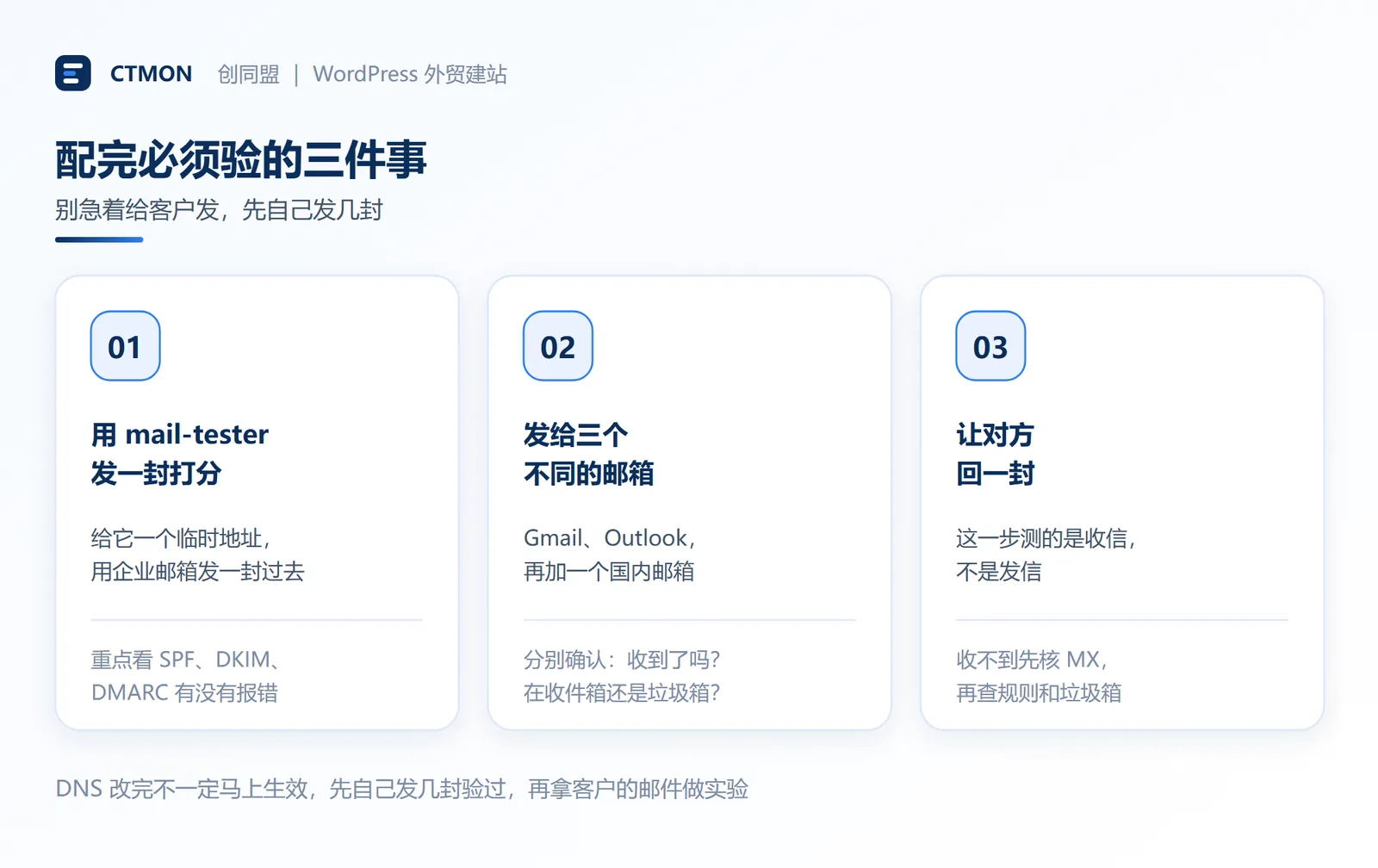
How do I set up an email account for export businesses? How can I configure it to avoid it ending up in the spam/junk mail folder?
2026-10-26
Related Articles
Are foreign trade promotion companies reliable? Six key criteria for businesses to judge promotion service providers in 2026.

The 140th Canton Fair Opens: How can export businesses seize overseas sourcing opportunities through digital marketing?
How to Choose an Overseas Promotion Company for Foreign Trade? 2026 Service Provider Selection Criteria and Evaluation Guide
How to avoid pitfalls when building a B2B export website? A guide to avoiding common mistakes in B2B export website development in 2026.
Which company should I choose for building a B2B export website? A comparison and recommendation of B2B export website service providers in 2026.

