Contents +
How to use AI tools to write a popular SEO blog post
Source: 创同盟
Date: 2026-06-24
Views: 662
Recently, many people have asked: Since AI can already write articles, can we simply give it keywords and it automatically generate an SEO article that has traffic, rankings, and popularity? Actually, the answer is not that simple.
AI can indeed significantly improve writing efficiency, but what truly determines the effectiveness of an article is never "how fast it's written," but rather "how accurate the topic is, how correct the structure is, and whether the content adds new value." In other words, AI is just a tool; what truly makes an article popular and searchable is your ability to judge topics, plan content, and polish it later. Therefore, to use AI to write a truly traffic-driving SEO article, the most important thing is not to let the AI write the entire article in one go, but to learn how to place it in the right position. The following method is suitable for beginners using AI to improve content production.

First, let's understand what constitutes a "popular" SEO article.
Many people misunderstand "being trending," believing that simply writing about a popular keyword will automatically make an article go viral. However, from an SEO perspective, a trending article must meet at least three conditions simultaneously:
a) People are searching for it; b) This search demand is growing or stable enough; c) The article solves the problem better than existing results. In other words, popularity isn't just about "this topic is trending," but rather "this topic is being searched, and you have an opportunity to get involved." For example, "high heels that girls like" is a broad term, but the competition is fierce. If you just ask AI to write a general introductory article, it's unlikely to succeed. However, if you refine the title to "Recommendations for 10cm red high heels suitable for girls' parties" or "Summer parties: how to choose the right red high heels for fashionable outfits," it's much easier to find precise traffic.
Therefore, the first step in using AI for SEO is not writing, but choosing a topic.

Second, find the trending topics first, then let AI write.
Whether an article generates search traffic depends 80% on its topic. Many people immediately type in, "Write me an article about red high heels." The biggest problem with this approach is that you skip the most crucial "demand assessment." AI can generate content for you, but it can't decide for you whether the topic is worth writing about right now. The correct approach is to first find these three types of keywords and their corresponding trending topics:
a) These are trending keywords that are currently gaining popularity. These keywords are suitable for timely articles, aiming to leverage their popularity to generate short-term traffic.
b) are extended terms related to trending topics. For example, if a pair of shoes becomes popular, users will then search for how much it costs and whether it's worth buying.
c) These are long-tail keywords. Although their search volume may not be as high as that of broad keywords, they have less competition, more accurate conversion rates, and are more suitable for blog post layouts.
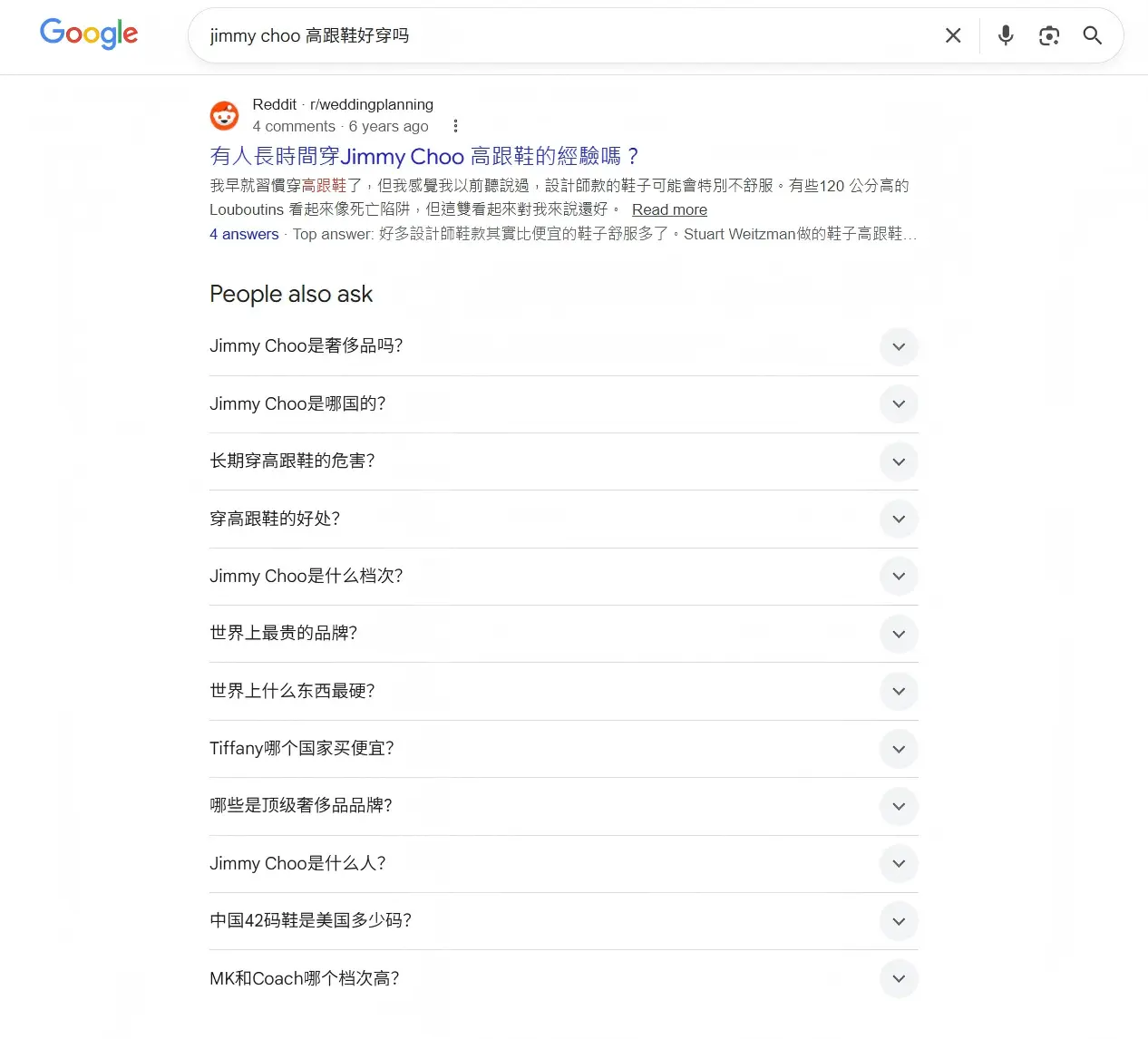
For a simple example, if "Jimmy Choo high heels" are currently trending, don't just write "What are Jimmy Choo high heels?" Instead, break it down into: ① How comfortable are Jimmy Choo high heels compared to other brands? ② Are Jimmy Choo high heels suitable for dancing?
③ Does Jimmy Choo, a high-heeled shoe brand, make wedding shoes? The advantage of doing this is that you're not chasing a vague trend, but rather building a content framework around that trend that's easier to leverage search traffic. You can refer to Google's "People also ask" or social media platforms for inspiration.
Third, let AI perform "search intent analysis" first, and don't rush to release the full text.
When a user searches for a keyword, there's usually a clear intent behind it. Some want to understand a concept (information), some want to see recommendations (business), some want to buy something (transaction), and others simply want to quickly find solutions (information, business). If an article doesn't match the content the user truly wants to see, even if it's long, it's unlikely to get clicks or stay on the page. In this situation, the best thing AI can do isn't to directly write the main text, but rather to first help you determine the search intent.
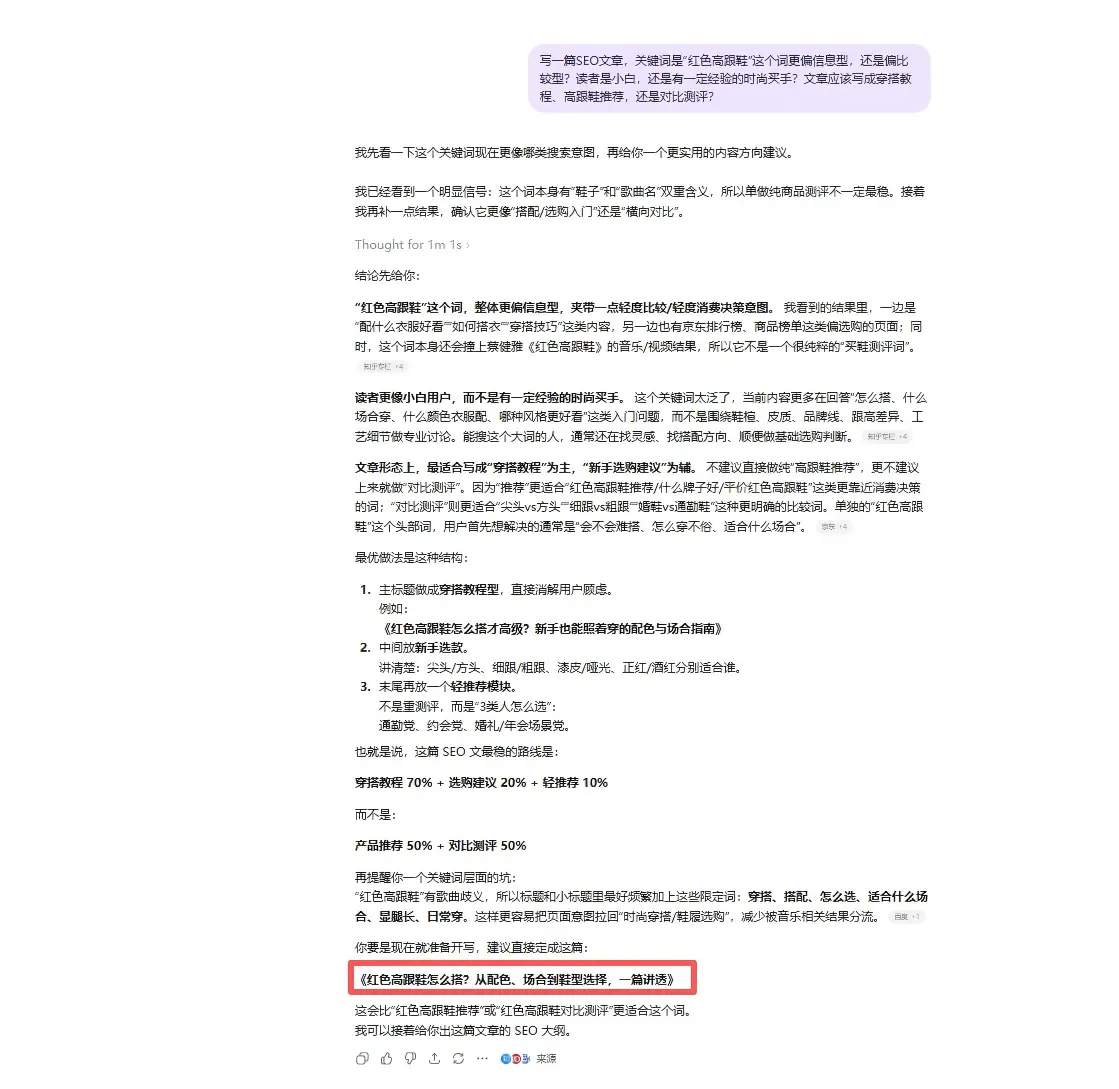
For example, if the keyword is "red high heels," the AI should first analyze whether the term is more informational or comparative. Are the readers beginners or experienced fashion buyers? Should the article be a styling tutorial, a high heel recommendation, or a comparative review? Only by clarifying this step can the subsequent outline, title, and structure stay on track. Treat the AI as a content planning assistant, not a writing machine. Let it help you break down user questions, organize reader needs, and summarize the article structure before letting it enter the writing stage; the results will usually be much better.
Fourth, creating an outline first, then writing the article, is more efficient and reliable.
The biggest problem with AI writing the entire text is that it easily "seems to say everything, but actually says nothing clearly." This is because it tends to output safe, generic, and smooth content that lacks sharpness. Therefore, a more recommended process is: first, give the AI keywords and target audience to generate an outline; then optimize the article structure based on the outline; and finally, let the AI generate the content in segments.
A good SEO article outline should include at least the following:
a. A title that clearly includes the core keywords; b. An introduction that quickly conveys the value of the article.
c. Each H2 addresses a specific problem; d. Each H3 addresses frequently asked questions from users.
d. Include an FAQ or action suggestions at the end;

Fifth, AI is responsible for accelerating the process, while humans are responsible for creating "added value."
Why do many AI-generated articles fail to generate traffic, rankings, or conversions? The answer is that "articles that truly succeed usually have these 'human' components." AI is responsible for building the "skeleton" and the "initial draft," while you are responsible for transforming the article into content that is "warm, insightful, and credible." This part is the key to truly determining the quality of the article.
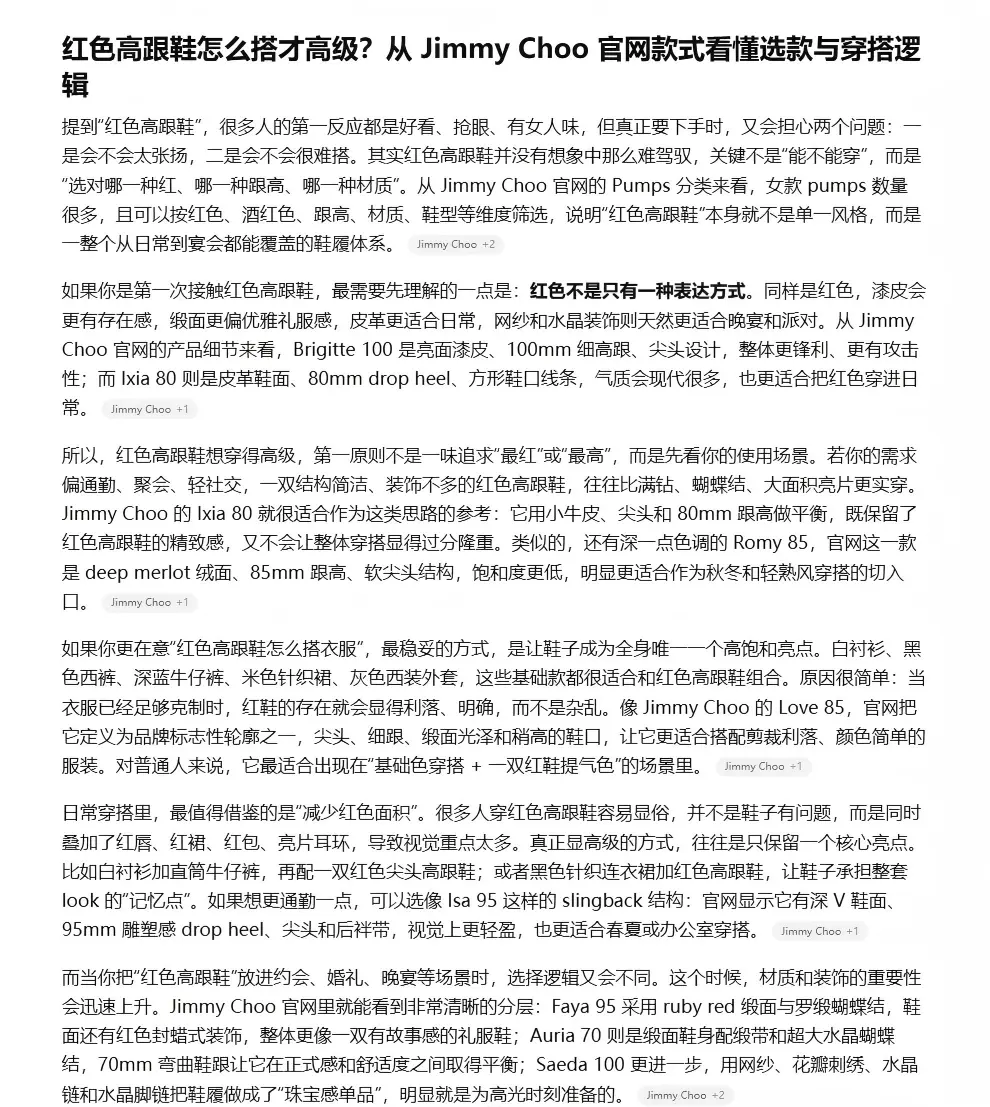
① Real experience: which brands of shoes I tried, what pitfalls I encountered, and what methods I finally found to be the most effective.
② Clearly determine which brand and type of shoes are suitable for which scenario, where to start, and which features seem advanced but are actually unimportant.
③ Specific information, such as shoe style, fashion matching, comfort, and durability of materials, can significantly improve the usability of the article.
④ Unique materials, such as your case studies, test results, customer feedback, team experience, or even a comparison table you created yourself.
Conclusion
When AI is used in key stages such as topic analysis, structure design, draft generation, and post-optimization, it becomes a very powerful content assistant. However, if you simply throw keywords at it and expect it to automatically generate viral articles, the result will most likely be a mediocre, homogenous, and difficult-to-rank article. Truly popular SEO articles are not about "how fast AI writes," but rather "whether you've used AI to write more accurate, in-depth, and useful content that users really want to see."

What does international social media management service include? 2026 Guide to Social Media Management for Export Businesses
2026-10-28

How to write a WordPress product page that will make overseas buyers want to send inquiries?
2026-10-28

How to fix WordPress form emails not sending: Practical WP Mail SMTP configuration
2026-10-27

Are foreign trade promotion companies reliable? Six key criteria for businesses to judge promotion service providers in 2026.
2026-10-26

How do I set up an email account for export businesses? How can I configure it to avoid it ending up in the spam/junk mail folder?
2026-10-26
Related Articles
What are the differences between Google SEO and Google Ads? Which should B2B export businesses do first?

2026 Shenzhen Google SEO Optimization Company Recommendations: Service Provider Comparison and Selection Guide
How to improve Google rankings through SEO optimization for international trade? 7 practical methods and steps.

Recommended Shenzhen B2B export website operation company: How to choose a suitable international lead generation service provider for your enterprise?

Why is the Google ranking of Shenzhen export businesses' business websites not improving?

