Contents +
Improve your efficiency and quality of SEO for your B2B export website with AI Assistant!
Source: 创同盟
Date: 2026-06-25
Views: 860
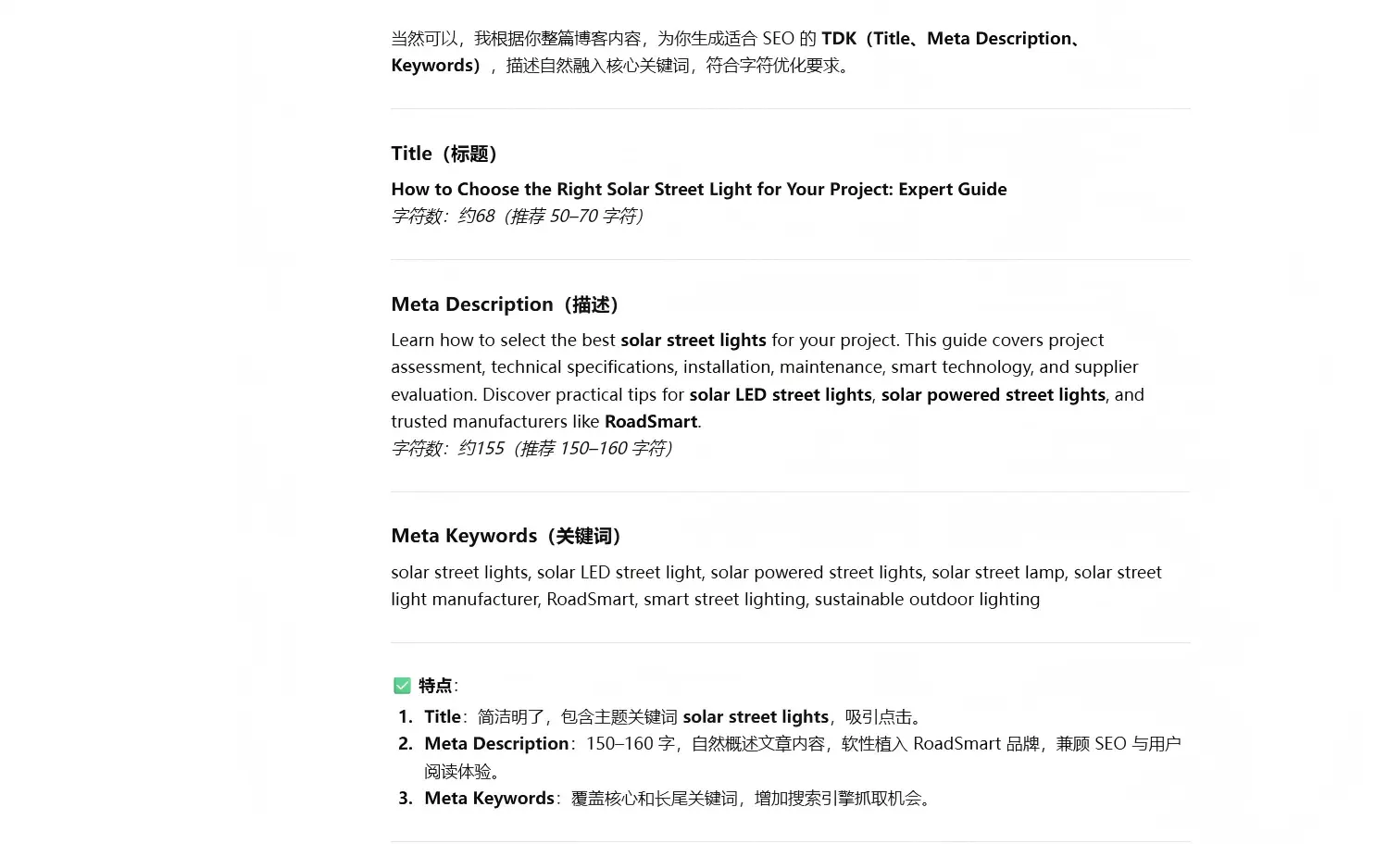
In SEO work, a significant amount of time is spent on data collection, information organization, initial content drafting, and basic analysis. For example, when researching competitor websites, one must examine their sections, titles, and keyword layout page by page; when conducting keyword research, one must categorize, filter, and combine a large number of words; and when writing content, one must consider search intent, readability, and conversion expression. These tasks are highly repetitive and time-consuming, while AI excels at "rapid organization" and "structured output."
The biggest role of AI is to help teams build a more efficient SEO workflow: first, conduct rapid research, then formulate strategies, then assist in batch execution, and finally combine data for continuous optimization.

I. AI Tools Competitive Background Checks
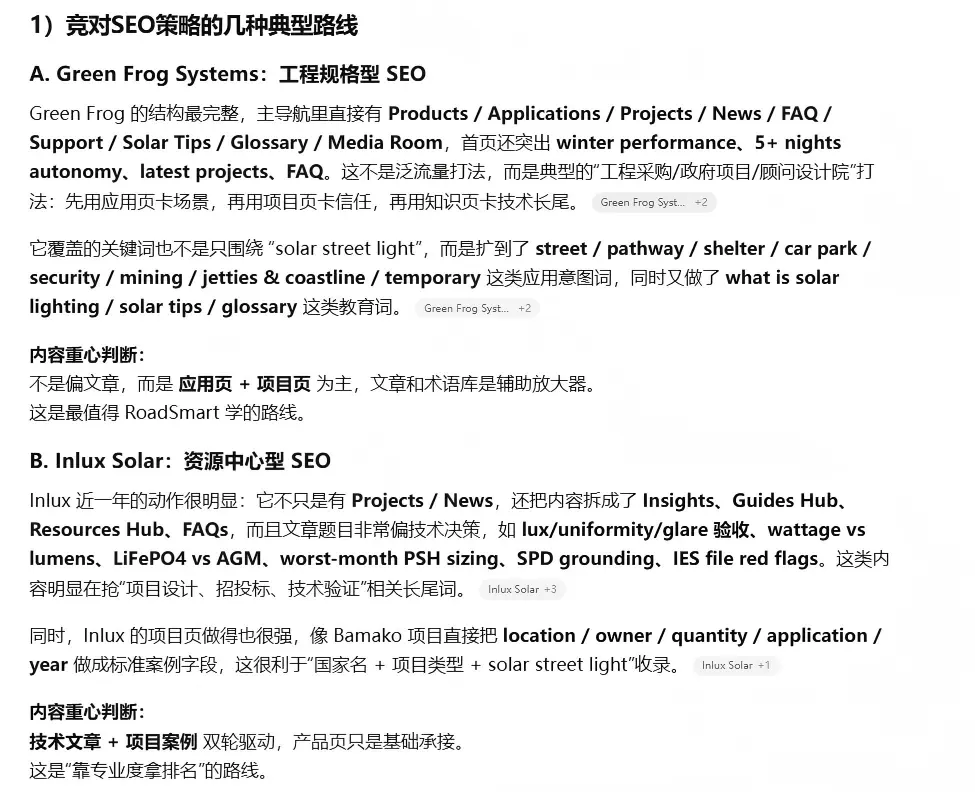
Many people focus solely on their own website when doing SEO, neglecting to consider what keywords their competitors are searching for, what content they're writing, and how they're laying out their pages. AI assistants can act as background investigators during the competitor analysis phase. For example, you can provide the AI with the URLs, page titles, product categories, and blog themes of several competitors, allowing it to help you analyze them.
① Which sections are key traffic entry points? ② Which pages are more lead generation oriented? ③ What keyword types does the other party primarily cover, such as product terms, solution terms, industry terms, and FAQ terms? ④ Does the content strategy emphasize articles, product pages, or case study pages?
II. AI in Keyword Research
Keywords for B2B export websites are often more complex, including not only core product terms but also long-tail keywords, geographic terms, industry terms, usage terms, and purchasing intent terms. The most painful part of manually doing this is often not finding the keywords, but rather the subsequent organization and grouping.
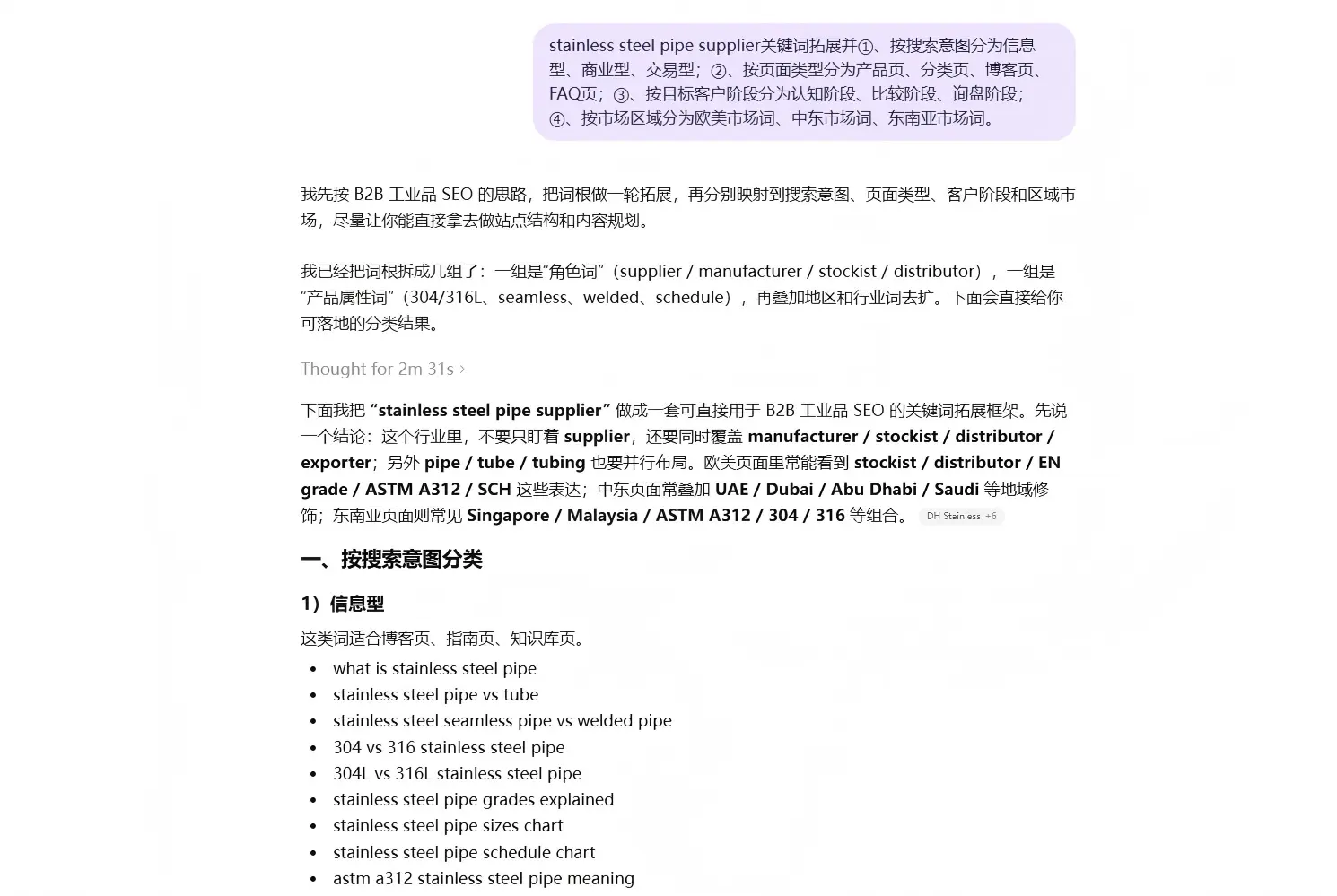
You can feed a batch of keywords into an AI tool and have it categorize them according to different dimensions:
① By search intent: informational, commercial, and transactional; ② By page type: product pages, category pages, blog pages, and FAQ pages; ③ By target customer stage: awareness stage, comparison stage, and inquiry stage; ④ By market region: keywords for the European and American markets, keywords for the Middle East, and keywords for the Southeast Asian markets. ...
AI can help discover logical relationships between keywords. For example, "stainless steel pipe supplier," "stainless steel pipe manufacturer," and "industrial stainless steel tubing" may seem different, but they can actually be categorized into the same theme cluster, thus avoiding duplicate page creation and content waste on the website.
III. AI in Business Website SEO Strategy Development
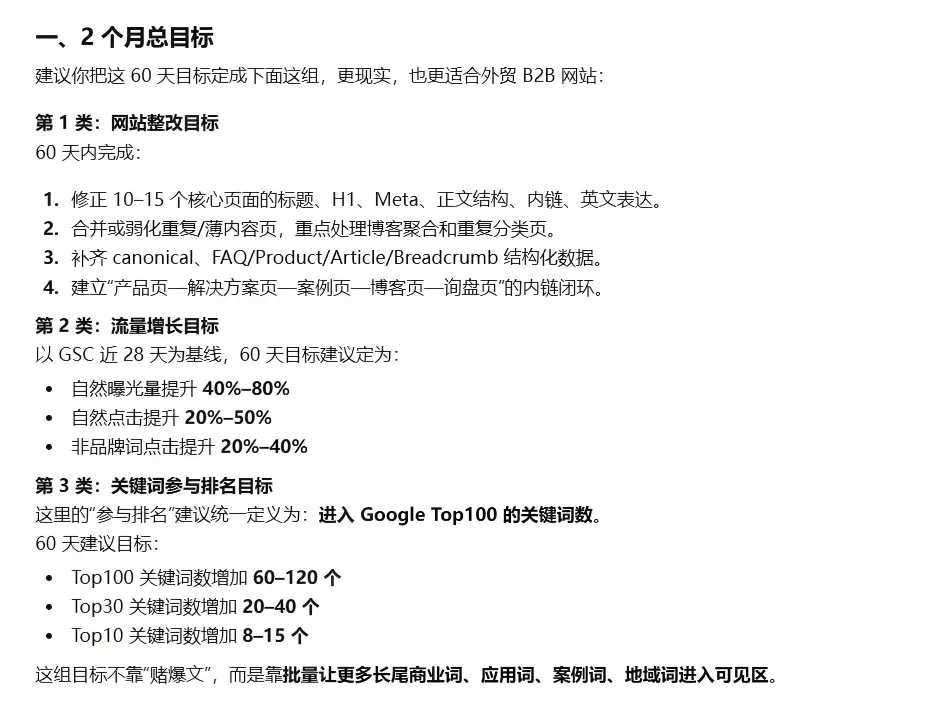
What should be done on a page first, which keywords should be prioritized, and how should product pages and blog pages be coordinated? Often, there's a lack of clear planning. AI can help you transform fragmented ideas into a more complete SEO strategy framework. For example, you can have AI generate a phased SEO plan based on your industry, product line, target market, and customer type.
In the first phase, priority will be given to optimizing core product category pages and key product pages;
The second phase will expand the blog content around procurement issues, application scenarios, and material selection.
The third phase involves adding case study pages, FAQ pages, and regional pages to expand long-tail coverage.
In the fourth stage, the inquiry path is optimized through internal links and conversion buttons.
The role of AI here is not to make decisions for you, but to help you structure your thinking more quickly. It can help you shift from a "do whatever comes to mind" approach to a "break down tasks according to goals" work style.
IV. Writing content using AI
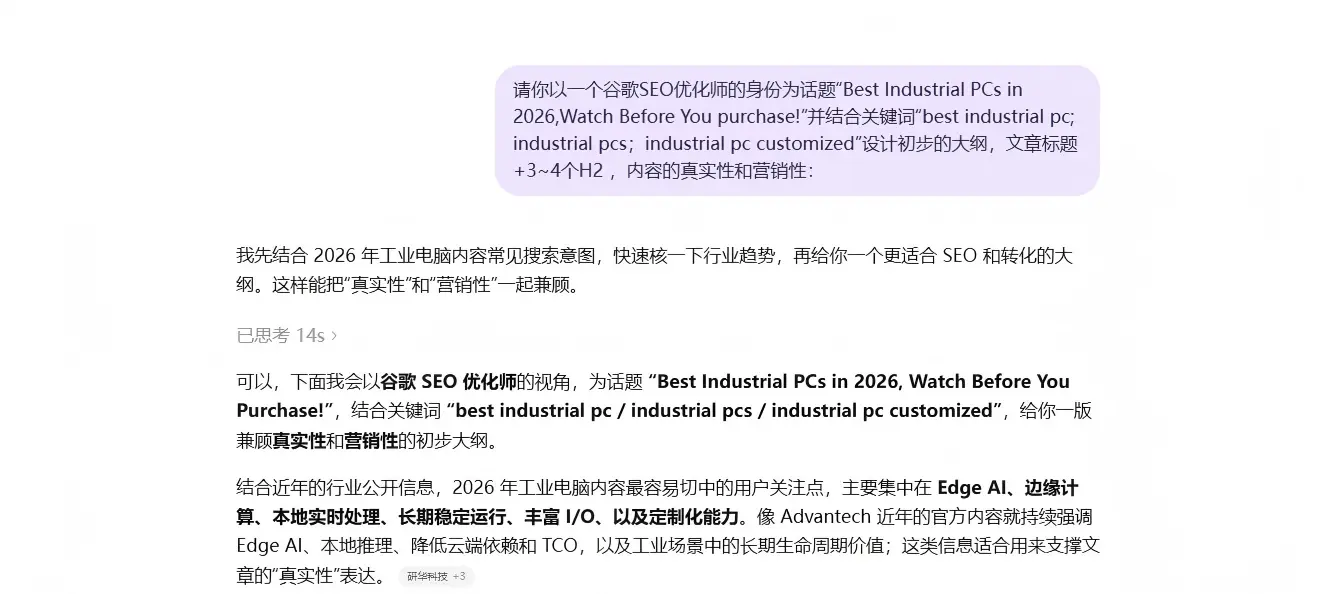
Truly high-quality SEO content for foreign trade isn't about piling on words; it's about simultaneously meeting search demands, employing professional expression, and driving commercial conversion. AI is best suited for three tasks in content creation: first, generating outlines; second, completing initial drafts; and third, polishing and expanding upon them.
For example, when writing an article on "how to choose industrial valves for chemical plants," AI can first output the article structure: application scenarios, material selection, corrosion resistance requirements, common mistakes, purchasing suggestions, and FAQs. Then, a draft is generated based on this structure. Finally, human editors supplement the draft with real-world company examples, product parameters, certification information, delivery timelines, and other details. Articles written in this way have both search value and higher conversion rates.
The same applies to product pages. AI can help write product introductions, technical parameter descriptions, application industry descriptions, FAQs, meta titles, and meta descriptions, but when it comes to information such as actual performance, export qualifications, packaging methods, and minimum order quantities, human verification is still required. Only in this way can the content avoid being "presentable but unbelievable."
V. AI-powered page and on-site optimization assistance
SEO is not just about writing content; it also includes a lot of details such as page title optimization, description writing, H tag structure, image alt text, and internal link suggestions.
For example, when you have dozens of product pages to optimize, AI can quickly generate more standardized titles and descriptions, avoiding issues such as overly long titles, repetitive keywords, and vague descriptions. For blog content, AI can also recommend suitable internal link placements based on context, helping to direct article traffic to key product pages or inquiry pages.
VI. Applications of AI in Data Analysis and Performance Review
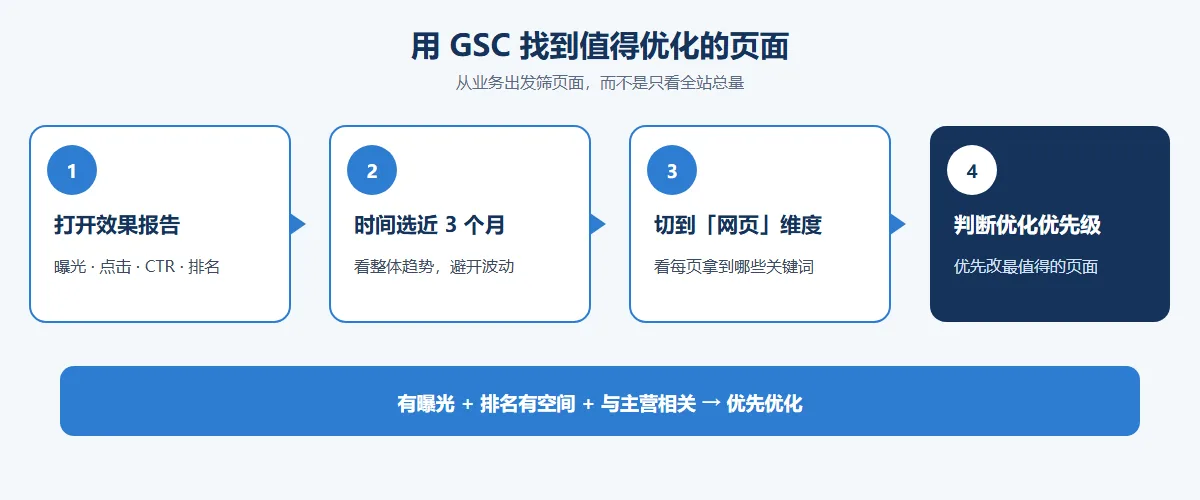
After you export the data from Search Console or GA, AI can help you identify: which pages have high exposure but low click-through rates; which keywords are close to the first page and deserve focused optimization; which content generates traffic but does not generate inquiries; and which topics are worth expanding into special pages or series of articles.
summary
The core value of AI assistants is not to replace humans, but to help people spend more time on judgment, planning, and quality control, while letting tools handle repetitive, tedious, and time-consuming tasks. Whether it's competitor background research, keyword analysis, business website SEO strategy development, content writing, page optimization, or performance analysis, AI can be a highly efficient assistant.

What does international social media management service include? 2026 Guide to Social Media Management for Export Businesses
2026-10-28

How to write a WordPress product page that will make overseas buyers want to send inquiries?
2026-10-28

How to fix WordPress form emails not sending: Practical WP Mail SMTP configuration
2026-10-27

Are foreign trade promotion companies reliable? Six key criteria for businesses to judge promotion service providers in 2026.
2026-10-26

How do I set up an email account for export businesses? How can I configure it to avoid it ending up in the spam/junk mail folder?
2026-10-26
Related Articles
What are the differences between Google SEO and Google Ads? Which should B2B export businesses do first?
2026 Shenzhen Google SEO Optimization Company Recommendations: Service Provider Comparison and Selection Guide
How to improve Google rankings through SEO optimization for international trade? 7 practical methods and steps.

Recommended Shenzhen B2B export website operation company: How to choose a suitable international lead generation service provider for your enterprise?

Why is the Google ranking of Shenzhen export businesses' business websites not improving?

