Contents +
Essential Pages for a WordPress B2B Export Website: Besides Product Pages, These 11 Page Types Should Also Be Considered
Source: 创同盟
Date: 2026-10-22
Views: 78
From local testing to official launch, the next question a website often faces is: which pages should be created? In our article on WordPress website configuration, launch, and maintenance , we discussed how to build a website; this article will fill in the gap in the "page planning" aspect.
I've seen many factories create B2B export websites, put a few carousel images on the homepage, and then display a product list, thinking that the website is already done.
After a few months of operation, the website received few inquiries, leading to concerns that Google SEO might not be working properly or that the website design was not attractive enough.
However, a closer look at the website reveals many fundamental issues:
The contact page only has one form, no company email address, and no other contact methods; the "About Us" page only has a company profile, without even a real photo of the factory; the product page only has pictures and model numbers, without parameters or any actual application information.
Overseas customers may spend a long time looking at the company and still not understand whether it is a manufacturer or a trading company, what products it can provide, or how to contact it.
The problem may not necessarily be with traffic; it could also be that the website itself lacks necessary information.
So, what pages does a complete WordPress B2B export website actually need?
This article outlines 11 common page types for foreign trade B2B websites based on actual website building needs, including what content should be placed on each page, areas prone to problems, and how to check the website before it goes live.
If you already have a website, you can also refer to this list to see which pages need to be added.
I. Four essential types of pages required for a WordPress B2B export website
Let's start with the most basic part.
Whether you're in the machinery and equipment, hardware processing, furniture, or electronics business, the following four types of pages are typically core components of a foreign trade B2B website.
1. Homepage: Let overseas customers quickly know what you do.
Many companies pay particular attention to whether their homepage is cool enough when creating a website.
For example, you could display three or four carousel images, add various animation effects, and then cram in company introductions, product pictures, and news updates.
However, overseas customers usually visit the website not to enjoy animations.
They wanted to confirm a few things quickly:
- Who are you? Are you a manufacturer, supplier, or trading company?
- What products or services do you primarily offer?
- Can you meet his purchasing needs?
- If I'm interested, what should I do next to contact you?
Therefore, the homepage doesn't need to be overly complicated; instead, it should help visitors understand your business as quickly as possible.
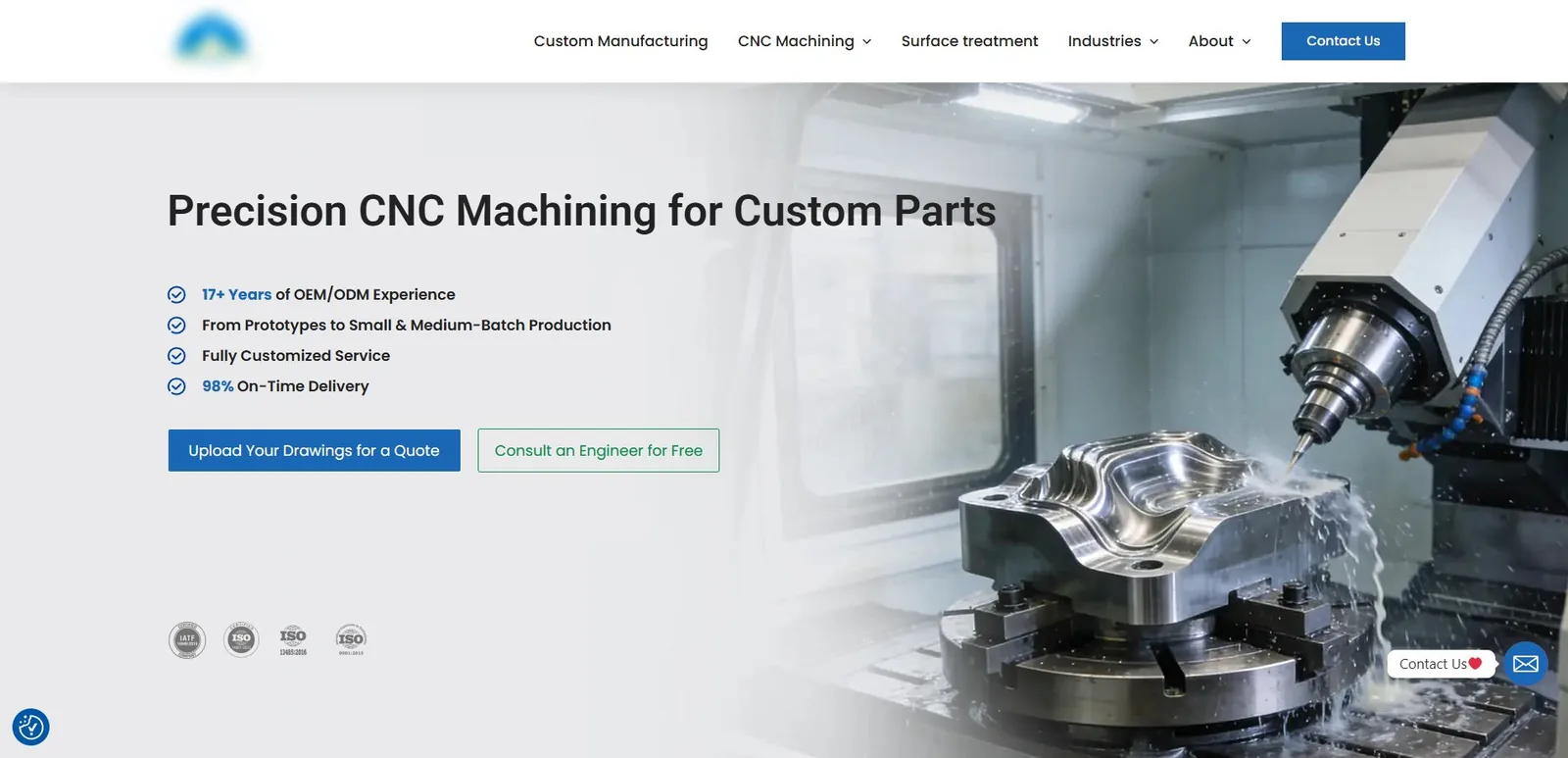
A practical homepage structure can be referenced in the following order.
First screen: Clearly state the main business in one sentence.
For example, a company that processes aluminum die-cast parts for the automotive industry can use:
"Custom Aluminum Die Casting Parts for the Automotive Industry"
Instead of repeatedly using broad terms like "Professional Manufacturer" or "High Quality Products," directly stating the specific products and industries in which they are used makes it easier for customers to understand your business.
Part Two: Showcasing the main product categories.
Instead of putting dozens of products on the homepage, prioritize showcasing core products or main services so that customers can quickly find the corresponding category.
Part Three: Demonstrating the company's actual production capacity.
It can display real photos of factory workshops, production equipment, quality inspection processes, etc., to help customers further understand the company.
If it is a trading company, it should demonstrate its genuine supply chain management, product development, or service capabilities, rather than deliberately packaging itself as a manufacturer.
Part Four: Provide a clear entry point for contact.
For example:
- Get a Quote
- Contact Us
- Corporate Email
Don't make customers spend a lot of time looking for contact information after reading the product introduction.
In addition, pay attention to the English text on the homepage.
I've seen some websites where the Chinese descriptions are very complete, but the English ones are simply translated using translation tools, resulting in problems with grammar and expression habits.
The English copy for B2B export websites not only needs to be understandable, but also needs to conform to the reading habits of the target market customers.
2. Product Category Pages and Product Detail Pages: Don't make all products look the same.
Many factories produce a large number of products, perhaps dozens or even hundreds.
The most common practice when building a website is to use the same template for all products:
A product image, a model number, a few lines of parameters, and an inquiry button.
This is indeed convenient, but for key products, the information is often insufficient.
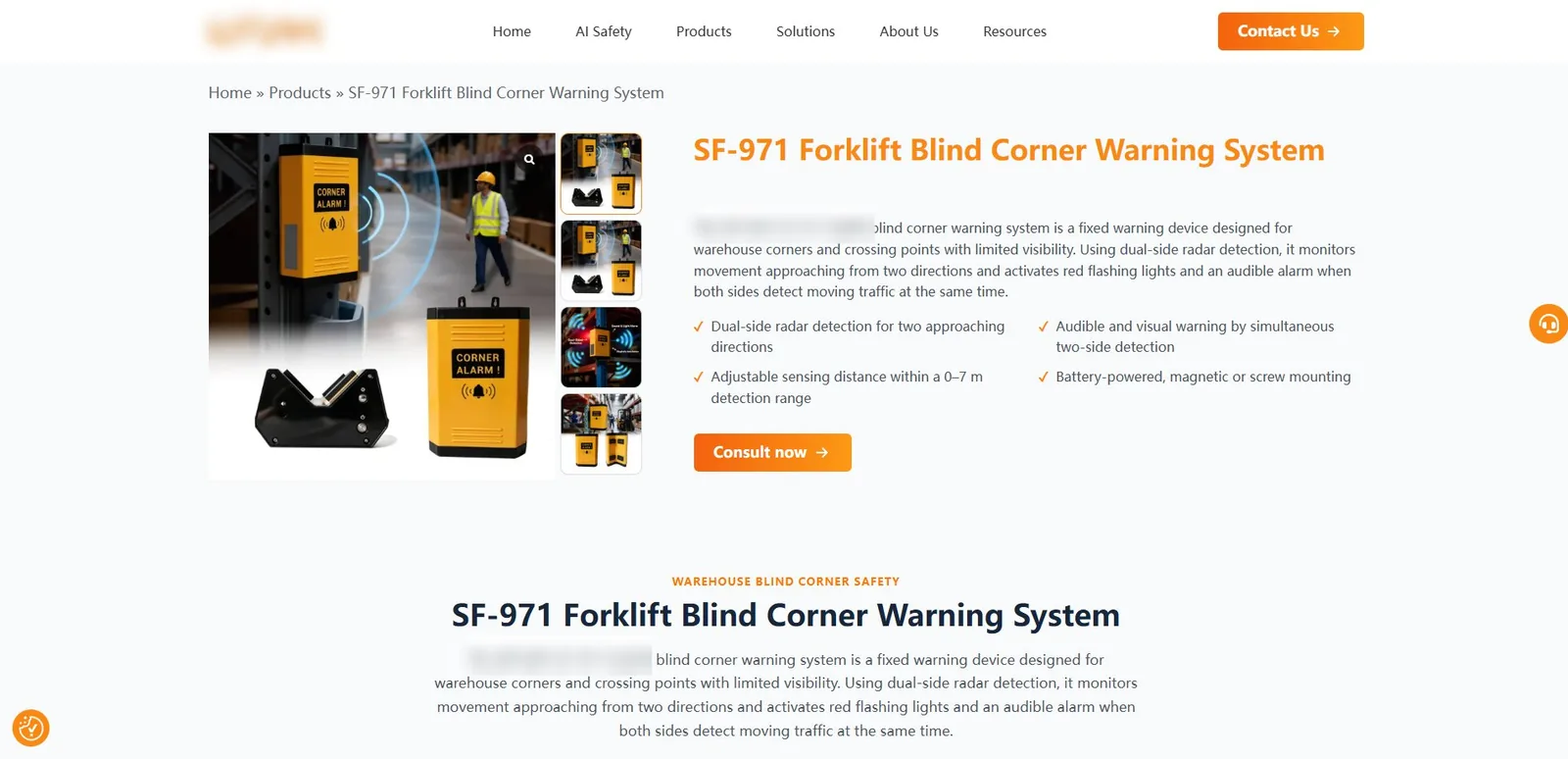
It is recommended to plan product category pages and product detail pages separately.
Product Category Page
It primarily helps customers quickly find the corresponding product series.
The suggestions include:
- Clear product category names
- Brief product category introduction
- Product list and filter entry
- Key Product Differences or Selection Guide
- Link to the product details page
For example, a CNC machining company can organize its services and products into different pages according to materials, processes, or application areas, instead of mixing all the machined parts together.
Product Detail Page
Then we need to answer more specific purchasing questions from customers.
For the company's core products, it is recommended to focus on improving the following:
- Product title: Use product names that are easy for overseas customers to understand, instead of just internal model numbers.
- Product images: Provide main image, detail images, size images, application scenario images, etc.
- Technical parameters: Display relevant information such as material, size, tolerance, surface treatment, MOQ, etc., according to product type.
- Product Description: This section introduces the applicable scenarios, practical uses, and main features of the product.
- The inquiries entry point: Set up a "Get a Quote" or "Request a Quote" button.
It is not recommended to write a lengthy introduction for every product.
You can prioritize optimizing 10-15 key products that have market demand and high inquiry value. The specific number can be adjusted according to the scale of the company's products.
For other products, ensure the basic information is complete first, and then gradually improve it.
This approach controls the initial website setup workload and facilitates ongoing product SEO optimization.
3. About Us: Let clients know if you are a worthwhile partner.
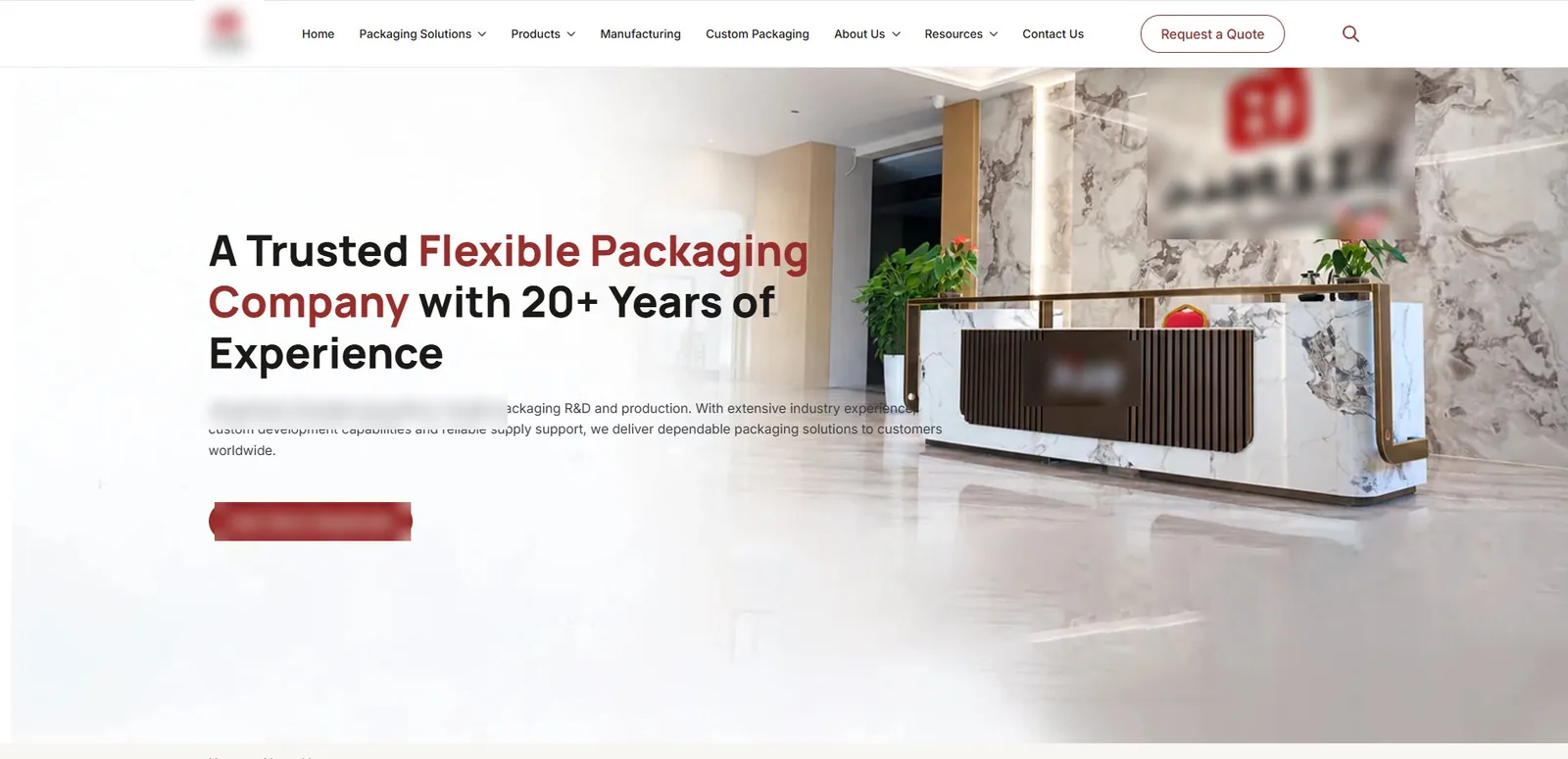
For foreign trade B2B companies, About Us should not just be a company profile.
Before a client is ready to cooperate, they usually need to understand the company's basic situation, especially for businesses involving customized production, bulk purchasing, or long-term supply.
He might be concerned about:
Where is this company located? How long has it been established? Does it have its own factory? What production capabilities does it possess? Which markets are its products mainly exported to?
Therefore, the About Us page can focus on the following content.
Basic Information of the Enterprise
This includes the date of establishment, the city where it is located, its main business, and its corporate positioning.
Production and delivery capabilities
If you are a manufacturer, you can display real information such as factory area, production equipment, number of employees, and main production processes.
Quality management capability
It introduces how companies conduct quality control and what testing equipment or quality management systems they actually possess.
Overseas market experience
This can explain which countries and regions the company primarily serves, and what export or project experience it has.
Real pictures
Examples include factory gates, production workshops, warehouses, testing equipment, and team work environments.
Here's a point to especially remind you:
Do not use images or data that do not match the actual situation to exaggerate the company's strength.
For example, a company may not own its own factory but uses a large number of photos of other factories' production lines; or the actual production scale may not be large, but the company may list tens of thousands of square meters of factory space on its website.
This approach not only fails to build long-term trust, but may also cause problems when clients conduct further audits.
Compared to vague statements like "Quality First, Customer First," authentic, specific, and verifiable company information is more persuasive.
4. Contact Us: Don't let potential customers who want to buy things not be able to find you.
This is one of the most important pages on the B2B export website.
The customer has viewed your product and is ready to inquire about pricing, but after entering the contact page, there is only a form and no company email address can be found.
If a customer doesn't want to fill out the form, or if there's a problem with the form, they might just leave.
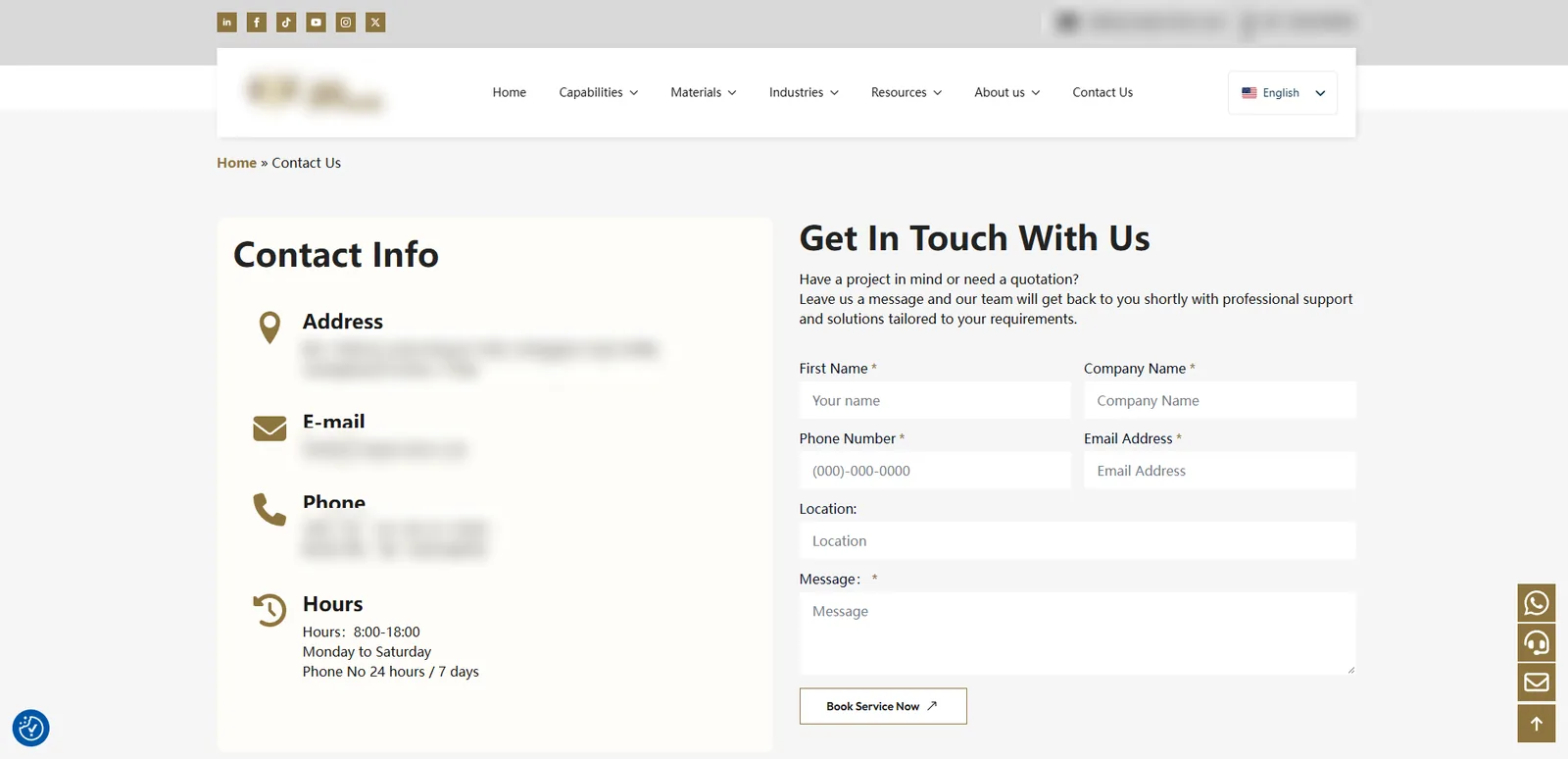
Therefore, the Contact Us page is recommended to include the following:
Contact Form
Basic fields can include:
- Name
- Company
- Country
- Message (Requirement Description)
These fields are usually sufficient to meet the needs of general initial inquiries.
For companies engaged in custom manufacturing or equipment procurement, additional fields such as drawing upload, product model, and purchase quantity can be added based on actual business needs. However, it is not recommended to ask customers to fill in too much information at the beginning.
Other contact methods
In addition to forms, it is also recommended to display:
- Corporate Email
- Company Address
- WhatsApp or other actual communication channels
- Necessary contact numbers
Response time explanation
If a company can do this, it can write:
"We usually respond within 24 hours on business days."
This type of explanation lets customers know roughly when they can expect a response, but only if the company actually has the capacity to fulfill that obligation.
In addition, it is best to set a clear success message after the form is submitted.
Don't let customers click the Submit button and then have no response on the page, leaving them wondering if the message has been successfully sent.
II. Four additional types of WordPress B2B export website pages recommended for inclusion
The first four types of pages address the most basic issues of website display and contact.
The following four types of pages are mainly used to supplement compliance information, resolve customer questions, and demonstrate the company's actual capabilities.
5. Privacy Policy page: Explains how customer information is used.
B2B export websites should assess their privacy disclosure obligations whenever they process visitors' personal information through contact forms, cookies, analytics tools, or other means.
In particular, when business involves the EU market, it is necessary to examine the actual data processing of the website in accordance with applicable data protection regulations.
Privacy policies typically need to explain:
- What personal information does the website collect?
- Purpose of information collection and basis for information processing
- Whether to use third-party analytics or marketing tools
- With which service providers might the information be shared?
- Data retention period or standard for determining the retention period
- How users can exercise their relevant data rights
- How to contact the company responsible for handling privacy issues
WordPress has some privacy policy helpers, and you can also use templates as a starting point.
However, it is not recommended to directly copy and publish content generated online.
Because different websites may use different forms, statistical tools, ad tracking, and third-party services, privacy policies should also be consistent with the actual situation.
We recommend placing the Privacy Policy link at the bottom of the website for easy access by visitors.
If requirements involve cookie consent management, further configuration is needed based on the tracking technology actually used by the website.
6. Frequently Asked Questions (FAQ): Answers frequently asked questions from customers in advance.
In daily communication, export businesses often need to answer some recurring questions.
For example:
- What is your minimum order quantity (MOQ)?
- What is your typical lead time?
- Do you offer OEM or ODM services?
- What payment methods do you accept?
- Can you provide samples?
- Which ports do you usually ship from?
These issues could have been prepared in advance and listed on the website.
There are two advantages to doing this.
On the one hand, customers don't have to send emails every time to ask for basic information, and can more quickly determine whether a company meets their procurement requirements.
On the other hand, FAQs can help websites cover long-tail search questions that are relevant to their actual business.
However, it's important to note that writing more FAQs doesn't necessarily mean a better Google ranking.
Questions should stem from genuine customer needs, and answers should be specific and accurate, rather than piling up repetitive content to boost keyword ranking. This aligns with Google's long-standing principle of "building content around real user needs," as outlined in the Google Search Central Content Quality Guidelines .
In addition, FAQs are not necessarily all on one page.
For example:
- General company questions can be placed on a separate FAQ page.
- Product parameters and selection information can be found on the corresponding product details page.
- Questions related to the customization process can be posted on the service page.
This arrangement is usually more in line with customers' browsing habits.
7. Quality Control / Manufacturing Process Page
If you are running a B2B export website for the manufacturing industry, I would recommend adding this type of page.
Especially in industries such as machining, auto parts, electronics manufacturing, and metal products, customers usually not only care about product images, but also assess whether a company has stable production and quality control capabilities.
Instead of repeatedly emphasizing "High Quality" on the homepage, it would be better to directly demonstrate how the company controls quality.
This page can be expanded according to the actual production process.
Incoming Quality Inspection
This section explains how to check material specifications, quality certificates, and key parameters after raw materials arrive at the factory.
In-process inspection
Explain how to check important dimensions, process conditions, or other quality control indicators during the production process.
Final Inspection (Pre-shipment Inspection)
This section describes the testing methods used before product shipment and how to confirm that the product meets order requirements.
Testing equipment and certification
If the company does indeed have the relevant equipment, it can demonstrate it:
- Coordinate Measuring Machine (CMM)
- Salt spray testing equipment
- Hardness tester
- Size inspection tools
If the company has ISO management system certification or applicable product compliance certificates, it can also display them according to the actual situation.
It is important to note that different certifications have different natures, scopes of application, and evidentiary functions. ISO, CE, FDA, etc., cannot be simply regarded as the same quality certification.
When displaying certificates, ensure they are authentic, valid, and consistent with the advertised company, products, or business scope.
For buyers, a real photo of the testing equipment, along with the actual testing content, is often more valuable than a long, vague promotional statement.
8. Blog and Article Pages: Leave room for future Google SEO.
If you plan to do Google SEO long-term, then it is advisable to plan your blog page in advance.
It's not just a place to publish company news; it can also be used to answer questions customers encounter at different stages before, during, and after the procurement process.
For example:
Product Knowledge
Introduce the product's materials, performance, and differences between different models.
Industry Applications
Explain which application scenarios the product is suitable for, and how different industries should choose it.
Procurement Guide
We provide practical advice on issues such as MOQ, delivery time, customization requirements, and quality inspection.
Company News
Release information that is relevant to production capacity, product upgrades, exhibitions, and factory development, and that is of reference value to customers.
It is recommended to categorize articles by topic rather than mixing all content into one list.
In addition, the keyword targeting for the blog needs to be differentiated from that of the product pages.
Generally speaking:
- The product category page primarily serves as a search function for products within the corresponding categories.
- The product details page focuses on introducing specific products or models.
- Blogs are suitable for answering questions, explaining selection methods, and providing industry knowledge.
This is more conducive to the website forming a clear content structure and reduces keyword positioning conflicts between different pages.
III. Three types of pages added based on business needs
Some pages do not need to be created separately for every B2B export website.
However, for companies that engage in custom manufacturing, bulk purchasing, or require long-term cooperation, adding these pages may make it easier for customers to understand the business.
9. Terms and Conditions Page
If your business involves customized production, prepayment, large orders, etc., you may consider preparing a terms of service or terms of transaction page.
The content can be tailored to the specific business requirements and may include:
- Quotation and Order Confirmation Methods
- Payment Terms
- Production and delivery arrangements
- Order change or cancellation conditions
- Handling quality objections
- Applicable after-sales terms
For example, some customized products require confirmation of drawings and samples before mass production can be arranged.
If these processes are explained in advance, customers will find it easier to understand the company's cooperation methods during communication.
However, when it comes to the specific rights and obligations in the contract, it is recommended to conduct a legal review based on the actual business situation, and not to directly use other companies' templates.
10. Shipping & Payment Page
After confirming the product, overseas customers often inquire about logistics and payment issues.
For example:
Does the bank support T/T wire transfer?
Can you accept a letter of credit (L/C)?
From which port are the products usually exported?
Can you arrange sea freight, air freight, or international express delivery?
If these are questions that businesses are frequently asked, you can consider compiling them into a separate page.
Suggestions:
- Supported payment methods
- Common modes of transportation
- Main shipping ports
- Delivery terms and related instructions
- Factors affecting transportation arrangements and delivery dates
However, for custom manufacturing companies, payment ratios and delivery methods often need to be negotiated separately for each order.
In this case, it is not necessary to write all the conditions down on the website. Instead, you can explain the common cooperation methods and specify that the specific terms are subject to the quotation or contract confirmed by both parties.
11. Case Studies: Demonstrate your capabilities with real-world projects.
If your company has already accumulated some experience in overseas projects, I suggest compiling a list of client case studies.
Many factories like to write the following when introducing their company strength on their websites:
"Rich Experience"
"Professional Team"
"Trusted Supplier"
These expressions are not wrong, but after the customer reads them, they still don't know what you have actually done.
In comparison, real-world project examples are easier to understand.
For example, an auto parts manufacturing company could describe its project around the following:
- Which country or region are the customers from?
- What industry does the project belong to?
- What are the specific requirements of the client?
- What production or quality control solutions did the company adopt?
- What were the final results of the project?
If a client confidentiality agreement is involved, the client's name, brand logo, or sensitive data can be hidden.
However, the case itself must be true; the quantity of purchases, the length of cooperation, or the project results cannot be fabricated in order to enhance persuasiveness.
For manufacturing companies, real-world application cases, product photos, and delivery experience are usually more valuable than simply promoting the company's strength.
IV. What pages on a WordPress B2B export website don't need to be created from the beginning?
Having discussed the recommended page configurations, let's talk about a few common pitfalls when building a website.
Some factories see that their competitors' websites have many sections and want to copy them all.
In reality, more pages do not necessarily mean a more complete website.
1. Company news with no real value.
For example, weekly updates on employee dinners, internal events, and routine meetings.
This information is not entirely unpublishable, but if the entire news section consists only of articles of this type, it will be difficult to solve the actual problems of overseas buyers.
In contrast, announcements about new production equipment, major product upgrades, participation in industry exhibitions, and improvements in factory quality management are usually more worthy of priority.
2. Team introductions unrelated to procurement decisions
Not every manufacturing company needs to create separate resume pages for its team members.
If the team possesses professional engineering, technology research and development, or project management capabilities, they can showcase the actual work and professional background of the relevant personnel.
Otherwise, it would be more practical to prioritize improving the factory strength, product, and production process pages.
3. Create numerous multilingual versions from the outset.
For companies with limited budgets and content resources, it is recommended to prioritize developing the language versions used in the main target markets.
If your primary target market is English, you can start by improving your English website.
If the target market itself requires languages such as German, Japanese, or Spanish, then the program should be planned according to the needs of local customers, rather than waiting until there are inquiries before adding them.
Importantly, after adding new language versions, it is essential to have the ability to maintain content quality.
4. Too many pop-ups and contact buttons
Contact channels such as WhatsApp, email, and online customer service can be retained.
However, it is not recommended to have multiple pop-up windows on the same page at the same time, constantly asking customers to subscribe, receive materials, or consult immediately.
Visitors need to browse content smoothly, not be frequently interrupted.
5. How to quickly check the pages of a WordPress B2B export website before they go live?
After the entire page is finished, I suggest you do one thing:
Don't look at the website from the company's perspective; instead, imagine yourself as an overseas customer visiting for the first time.
You can use the following checklist to check.
| Inspection items | Issues that need to be confirmed |
|---|---|
| front page | Can you quickly understand a company's main products or services? |
| Product Page | Can you find product specifications, images, and application instructions? |
| about Us | Does the company provide a genuine company profile and proof of its capabilities? |
| Contact Us | Can you find valid contact methods such as forms or email addresses? |
| Privacy Policy | Does this describe the actual processing of personal information by the website? |
| FAQ | Have you answered the purchasing questions that customers frequently ask? |
| Production and Quality Inspection | Is it possible to see actual production or quality control information? |
| Blog | Are the articles clearly categorized and related to the main business? |
| Terms of Service | Should the main cooperation conditions be explained according to business needs? |
| Logistics and Payment | Could you please explain common payment and shipping arrangements? |
| Client Cases | Do you have any real, publicly available project experience? |
These 11 items do not mean that they must all be completed at once.
If your website is just starting out, it is recommended to prioritize the quality of the homepage, product category pages, product detail pages, and the "About Us" and "Contact Us" pages, while also properly handling the necessary privacy disclosures and compliance requirements.
The remaining pages can be gradually improved based on the company's business characteristics, customer feedback, and subsequent SEO plans.
In addition, the page requirements may differ across industries.
For example:
- Machinery and equipment companies: can focus on increasing equipment videos, technical parameters, installation and after-sales support content.
- Custom manufacturing companies: can increase processing capacity, material selection, drawing submission, and RFQ process content.
- Furniture manufacturers: can add material, size, customization options, and project examples.
- Electronic product companies: can add specifications, technical documents, compatibility notes, and applicable certification information.
The core principle is actually very simple:
The website should provide the information that customers need to know during the purchasing process.
VI. Conclusion: B2B export websites are more than just putting products online.
A complete WordPress B2B export website is not finished once the homepage looks nice and the products are uploaded.
More importantly, can the website help overseas customers understand your business, confirm whether your products meet their needs, and find ways to contact and cooperate further?
For B2B manufacturing companies, product information, factory strength, quality control, procurement instructions, and contact information are all important factors that influence customer decisions.
Therefore, instead of aiming for dozens of pages at the beginning, it's better to focus on perfecting the core pages first, and then gradually improve them based on subsequent inquiry feedback and Google SEO data.
After the page layout is complete, the next step is to understand which plugins are needed to configure a WordPress B2B export website to ensure stable operation.
CTMON: Making WordPress e-commerce websites more aligned with the purchasing needs of overseas customers.
CTMON provides services including WordPress B2B export website development, Google SEO optimization, Google Ads advertising, and overseas digital marketing.
In the process of website construction, in addition to page design and function development, the website content and page layout will also be planned around the company's main business, target market, product structure and subsequent promotion needs.
For businesses that hope to acquire overseas customers in the long term through their business website, the website not only needs to showcase products, but also needs to lay the groundwork for subsequent search engine optimization, ad campaign management, and inquiry conversion.
If you are planning a new WordPress B2B export website, or want to check which pages on your existing business website need improvement, you can visit the CTMON website to learn about related website building and promotion services.
Author: CTMON | B2B Digital Marketing Service Provider
References and Information Sources
- Google Search Central Content Quality Guidelines: https://developers.google.com/search/docs/fundamentals/creating-helpful-content
- WordPress Official Documentation (Pages and Blocks): https://wordpress.org/documentation/
- WordPress Privacy Policy Related Information: https://wordpress.org/documentation/article/settings-privacy-screen/
Note: This article is primarily aimed at general foreign trade B2B manufacturing websites. Specific page configurations should be adjusted according to the company's actual business, target market, technological environment, and applicable regulations.

What does international social media management service include? 2026 Guide to Social Media Management for Export Businesses
2026-10-28

How to write a WordPress product page that will make overseas buyers want to send inquiries?
2026-10-28

How to fix WordPress form emails not sending: Practical WP Mail SMTP configuration
2026-10-27

Are foreign trade promotion companies reliable? Six key criteria for businesses to judge promotion service providers in 2026.
2026-10-26

How do I set up an email account for export businesses? How can I configure it to avoid it ending up in the spam/junk mail folder?
2026-10-26
Related Articles
How to configure WPForms contact forms: Which should I choose, WPForms or Contact Form 7?
How to write a WordPress product page that will make overseas buyers want to send inquiries?
How to fix WordPress form emails not sending: Practical WP Mail SMTP configuration
How do I set up an email account for export businesses? How can I configure it to avoid it ending up in the spam/junk mail folder?
Recommended essential WordPress plugins: 6 types of plugins commonly used for B2B export websites

