Contents +
During the Canton Fair, how can export businesses optimize their GEO (Google App Store) to make it easier for AI to discover and recommend their brands?
Source: 创同盟
Date: 2026-10-22
Views: 88
Author: CTMON | B2B Digital Marketing Service Provider
As overseas buyers begin using AI tools such as ChatGPT and Gemini to find suppliers, export businesses, in addition to participating in trade shows and optimizing Google rankings, also need to pay attention to a new question: Can your brand appear in the supplier recommendations generated by AI?
The Canton Fair has always been an important channel for Chinese export businesses to connect with overseas buyers. Companies showcase their products at exhibition booths, communicate face-to-face with customers, exchange contact information, and strive for future cooperation opportunities.
However, the way overseas buyers find suppliers is changing.
In the past, buyers might search for "Chinese manufacturer" or "China supplier" on Google, then browse websites, compare products, and contact manufacturers one by one.
Now, some buyers also directly ask questions to ChatGPT, Perplexity, or Gemini:
- Which Chinese manufacturers supply custom industrial equipment?
- How can I find a reliable OEM manufacturer in China?
- Which suppliers offer custom products with low MOQ?
AI may compile supplier lists, product characteristics, and relevant reference sources based on the information it can obtain.
This means that businesses not only need to consider how to be found by Google, but also how to get AI to accurately identify their brands, products, and supply capabilities.
This is also an important reason why GEO (Generative Engine Optimization) has received attention in recent years.
1. If you delete the website, will AI still recommend your brand?
This is a question worth considering for export businesses.
Suppose a Chinese manufacturer has been operating for many years, has stable overseas customers, and has accumulated a large amount of product information.
Its brand information exists not only on its official website, but also in overseas industry media, YouTube product demonstration videos, customer case studies, industry directories, and professional technical documents.
Even if the official website is temporarily inaccessible, AI may still learn about the company through other publicly available information.
Conversely, if a company concentrates all its information on its business website, and brand-related content is almost impossible to find on other platforms, then the information that AI can acquire and cross-validate will be relatively limited.
However, this does not mean that export businesses can abandon their official websites.
A business website remains an important foundation for companies to showcase their products, explain their technological capabilities, build trust, and generate inquiries.
What's the difference between SEO and GEO?
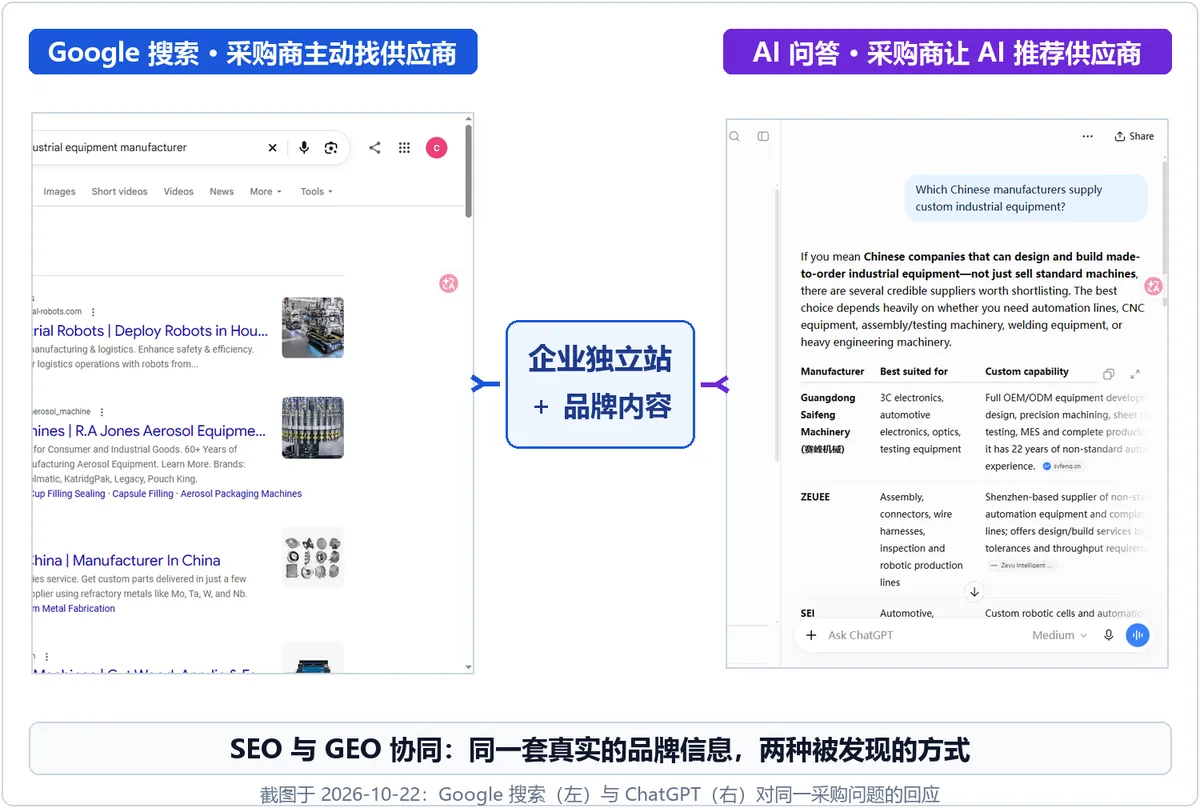
SEO (Search Engine Optimization) primarily helps websites achieve better organic search visibility in search engines such as Google.
GEO focuses more on whether brands, products, and professional content can be discovered and understood by generative AI systems and presented appropriately in relevant responses.
For example, an industrial equipment manufacturer may want to attract the attention of overseas buyers.
In terms of SEO, businesses may need to optimize product category pages, product detail pages, and technical articles to improve their Google rankings for relevant keywords.
Regarding GEO, companies also need to make it easier for AI to understand the following information:
- What types of equipment does the company mainly produce?
- Do you offer OEM or ODM customization services?
- Which industries and application scenarios are the products suitable for?
- What technical documentation, certification information, and real-world project case studies are available?
- How can overseas customers contact a company?
The two are not mutually exclusive.
For foreign trade B2B companies, a more reasonable approach is to use a business website as the core, combined with SEO, professional content creation, and multi-channel overseas communication, to gradually establish a complete brand information system.
II. Why is the Canton Fair a good time for export businesses to conduct GEO optimization?
The Canton Fair is not only a platform for product display and customer development, but also an opportunity for companies to obtain real procurement issues, product application materials, and industry feedback.
When doing SEO or GEO content planning, companies often need to study what their overseas customers are really concerned about.
At the Canton Fair, these issues often arise directly in conversations between buyers and sales personnel.
For example:
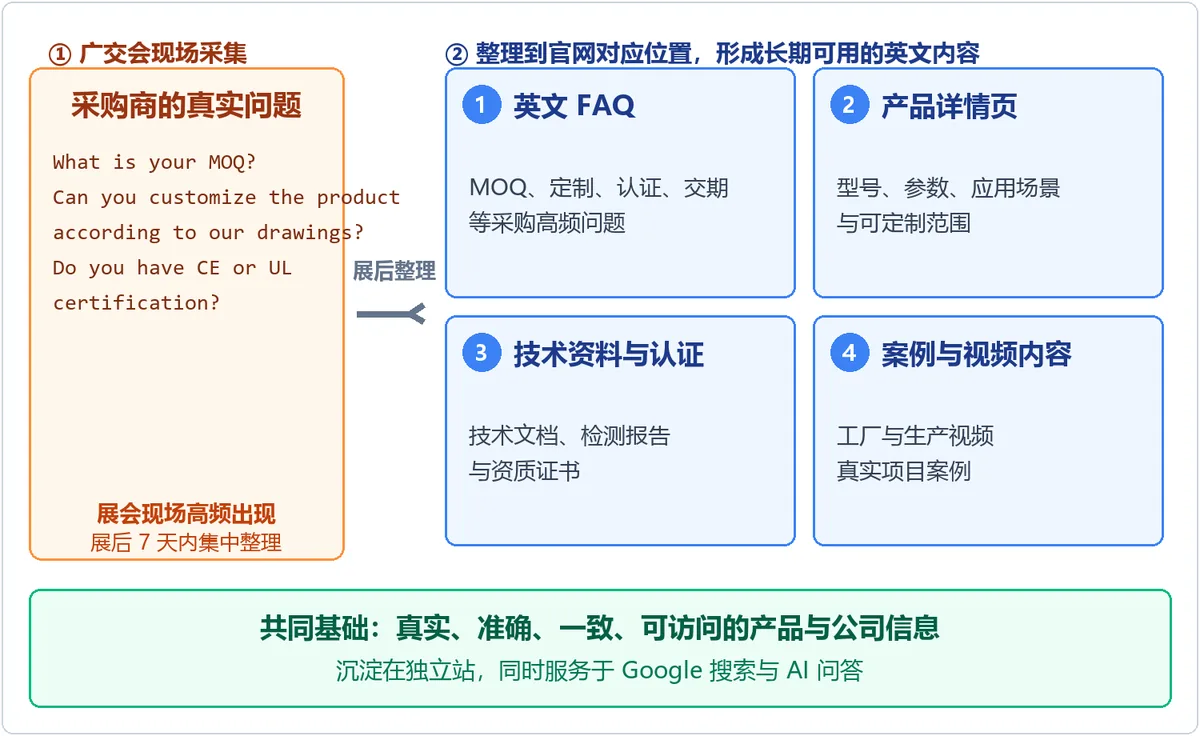
- What is your minimum order quantity?
- Can you customize the product according to our drawings?
- Do you have CE or UL certification?
- How long does production and delivery take?
- Have you supplied products to customers in Europe?
These questions may seem ordinary, but they reflect the real concerns of overseas buyers when selecting suppliers.
If companies only answer questions on-site, this information may remain in the sales staff's communication records after the exhibition ends.
However, if these are organized into English FAQs, product technical specifications, case studies, and video content, they can be used to create international marketing materials that can be used for a long time.
The value brought by the Canton Fair should not be limited to the number of inquiries during the exhibition, but can also extend to SEO, GEO and brand content building after the exhibition.
III. Three GEO optimization tasks that export businesses can undertake during the Canton Fair
GEO optimization does not necessarily require businesses to rebuild a website.
For export businesses that already have an English business website, they can start by focusing on three aspects: exhibition materials, website content, and AI visibility checks.
1. Utilize materials from the Canton Fair to create overseas brand content.
Recommended timing: Collect data during the exhibition and release it continuously after the exhibition.
When participating in the Canton Fair, companies typically take photos of their booths, videos of their product displays, and footage of interactions with customers.
However, if these materials simply post a message saying "We are participating in the Canton Fair," the actual information they can provide is quite limited.
What's even more worth recording is how the product is used, what problems it can solve, and what purchasing conditions overseas buyers care about most.
For example, a machinery manufacturer could shoot a 60-second video in English:
The first 15 seconds showcase the actual operation of the equipment; the middle 30 seconds explain the main applications, processing capabilities, and customization options of the equipment; and the last 15 seconds answer a common procurement question and guide users to visit the official website for detailed specifications.
Videos can be published to YouTube, LinkedIn, Facebook, or TikTok, depending on the platform's characteristics.
When publishing, it is recommended to add an English title, video description, subtitles, and the corresponding official website product link.
It's important to note that while posting a video doesn't guarantee it will be used by AI, clear, open, and accessible product information can help increase a brand's chances of being discovered across different channels.
In addition, any footage or communication involving overseas buyers must be properly authorized to avoid disclosing customer identities, quotations, and purchasing information without their consent.
2. Compile buyer questions into an official website FAQ and structured content.
Recommended timeframe: Complete the first round of organization within 7 days after the exhibition ends.
After the Canton Fair, companies can have their sales teams compile a list of frequently asked procurement questions from the event.
For example, for a manufacturer that provides customization services, the following can be prioritized:
| Procurement issues | Recommended hosting page |
|---|---|
| What is your MOQ? | Product details page or FAQ |
| Can you provide OEM/ODM services? | Customized service page |
| What certifications do you have? | Certification and Quality Management Page |
| How long is the production lead time? | Procurement FAQ or Delivery Instructions |
| Can you manufacture according to drawings? | Customization capabilities and project case study page |
This content doesn't need to be all contained in one blog post.
A more reasonable approach is to distribute the answers to the questions on the product details page, service page, FAQ page, and case study page, based on the nature of the questions, so that users can find the answers in the appropriate locations.
If a company's website meets the relevant requirements, it can further improve its structured data (Schema Markup).
For example:
Organizational structured data : helps search systems identify company names, official websites, brand logos, and other publicly available company information.
Product structured data : On the applicable product page, label the product name, model, and other real, verifiable product attributes.
FAQ content : Provide clear and accurate answers to frequently asked questions from buyers. The use of structured data on the FAQ Page should be determined based on Google's current applicable conditions; adding tags should not be equated with obtaining rich media displays or AI recommendations.
For details on the specific format, applicable pages, and usage conditions of structured data, please refer to the official Google Structured Data documentation .
It is important to emphasize that while schemas can help machines understand page information, they do not guarantee that a company will be recommended by AI tools such as ChatGPT and Gemini.
More important than simply adding tags is ensuring that the product parameters, certification information, delivery capabilities, and company information on the official website are true, consistent, and accessible.
3. Regularly check whether the brand appears in the AI supplier recommendations.
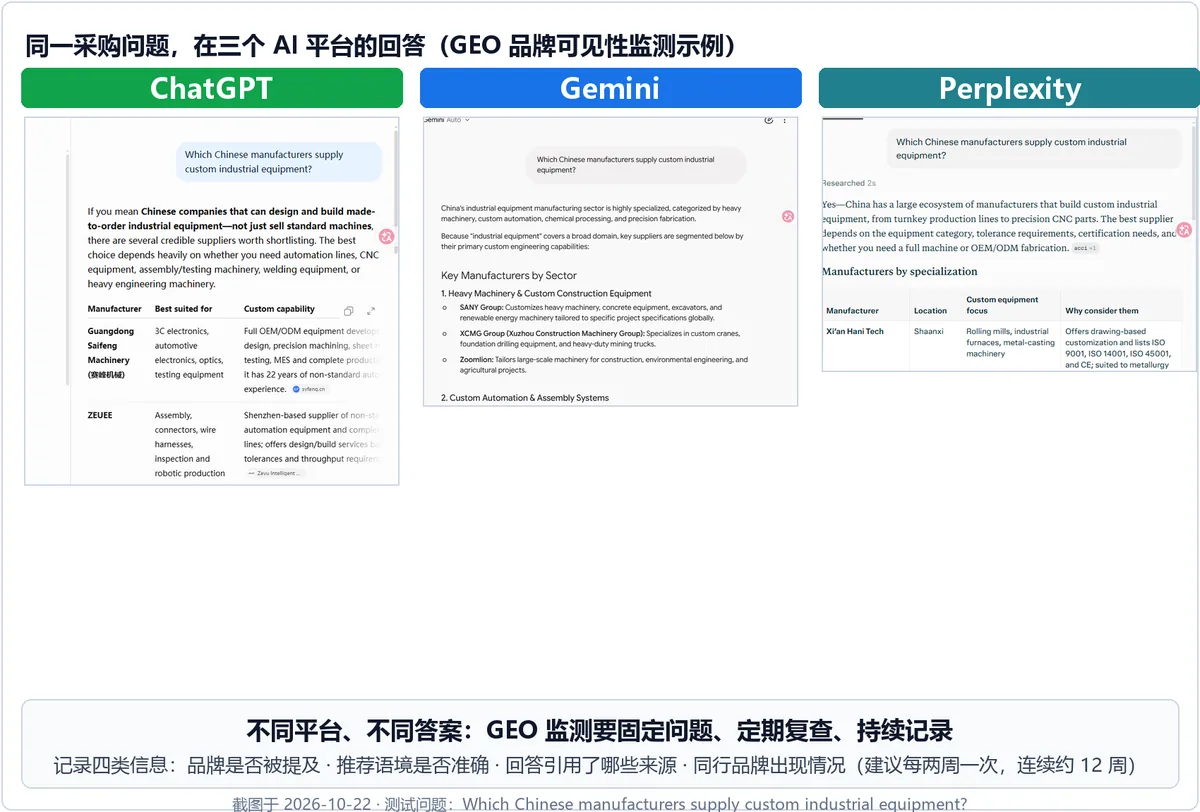
Recommended frequency: Check every two weeks, and observe for approximately 12 weeks.
After completing the website and overseas content development, companies also need to understand whether these efforts have improved the brand's visibility in AI responses.
The simplest approach is to create a set of procurement questions in English that are highly relevant to your business.
For example:
- Who are reliable custom furniture manufacturers in China?
- Which Chinese suppliers offer OEM industrial equipment?
- How do I choose a manufacturer for custom metal products?
Then, tests were conducted on platforms such as ChatGPT, Gemini, and Perplexity.
During testing, it is recommended to record four types of information:
- Brand mentions : Did the AI include the company name in the responses?
- Recommended context : Does AI correctly understand a company's products and services?
- Source cited : If the answer provides a citation, is the source an official website, media outlet, or another platform?
- Peer comparison : Which competing brands appear frequently? What publicly available information about them is worth studying?
Because AI responses may be affected by model version, question format, time, and other factors, a single test cannot represent a stable recommendation result.
Therefore, companies should maintain the same test questions and record methods, and conduct regular comparisons.
At the same time, it is also necessary to combine Google Search Console, GA4 and actual inquiry data to determine whether there have been changes in brand exposure, organic search and business conversion.
IV. Why can't export businesses rely solely on AI tools for GEO optimization?
Some companies believe that by generating a large number of English articles in batches, they can increase the probability of their brand being recommended by AI.
However, in B2B procurement scenarios, what buyers really need is information that can help them determine whether suppliers are reliable.
For example:
One equipment manufacturer published dozens of industry articles without providing details on equipment models, actual applications, customization options, and after-sales support.
The other company, while having fewer articles, provided complete English product information, factory production videos, technical documents, and real project case studies.
From a procurement decision-making perspective, the latter often provides more valuable information.
Google, in its "Guidelines for Creating Useful Content," also emphasizes that content should primarily serve the real needs of users—being authentic and useful, rather than being created for search engines. (See the official original text)
This is why export businesses should not only focus on the number of articles or keyword coverage when performing GEO optimization.
Companies need to organize their product capabilities, technical data, case studies, and brand information clearly, and then disseminate them through appropriate channels.
For manufacturing companies, special attention should be paid to the accuracy of product parameters, customization capabilities, technical data, certifications, and real-world application cases.
This content not only serves GEOs, but also directly helps overseas buyers assess whether a company is suitable for cooperation.
V. CTMON's suggestion: Transform the Canton Fair traffic into long-term overseas brand assets.
For export businesses, the Canton Fair can provide short-term customer contact opportunities, while a business website, SEO, and GEO can help companies continuously build overseas online visibility.
Only by combining the two can the content and customer issues generated during the exhibition continue to have an impact after the exhibition ends.
In practice, CTMON recommends that companies establish long-term optimization mechanisms around three directions:
First, improve the information foundation of the business website.
Clearly define product categories, product details, customization capabilities, company strength, and contact information to ensure that overseas buyers and search systems can accurately understand the company's business.
Second, transform real business materials into sustainable English content.
Transform exhibition Q&A, product demonstrations, factory production, technical information, and customer case studies into articles, FAQs, videos, and international social media content.
Third, conduct continuous monitoring by combining SEO and GEO.
Monitor Google organic search performance, AI brand mentions, content coverage, and actual inquiry changes, and adjust optimization priorities based on the results.
CTMON has long provided export businesses with digital marketing services such as B2B export website development , Google SEO optimization , Google Ads promotion , international social media marketing , and AI search optimization (GEO) , helping companies build a more complete online marketing system from website infrastructure construction to international lead generation channel operation.
If your company is considering how to leverage the Canton Fair materials for subsequent promotion, or wants to understand whether your existing website has a good foundation in SEO and GEO content, you can contact CTMON to further refine the optimization direction suitable for your products and target market.
VI. Frequently Asked Questions about GEO Optimization for Exported Businesses
1. If export businesses have already implemented Google SEO, do they still need to implement GEO?
The two can be carried out in tandem. SEO primarily focuses on website visibility in search engines, while GEO further focuses on how brand and content are presented in generative AI responses. Companies don't need to completely overhaul their existing SEO efforts; they can prioritize improving existing product pages, FAQs, technical content, and brand information.
2. Can GEO optimization be performed even if I didn't participate in the Canton Fair?
Yes. Companies can start by gathering existing product information, factory videos, frequently asked sales questions, customer case studies, and technical documents to build their official website content and overseas communication channels. The Canton Fair is just one opportunity to gather materials and address procurement issues.
3. Will adding a schema to my website get me recommended by ChatGPT?
It cannot be guaranteed. Structured data helps the system understand web page information, but whether AI mentions a particular brand is also affected by factors such as information accessibility, content relevance, the model, and the retrieval mechanism.
4. Should foreign trade B2B companies prioritize SEO or GEO?
If a company's website has a weak foundation, it is recommended to first improve product categories, product detail pages, company information, technical documentation, and basic SEO. For companies that already have a certain level of organic search performance, they can add GEO-related content creation and monitoring to their existing SEO system.
Conclusion
The Canton Fair helps export businesses connect face-to-face with overseas buyers, but after the fair ends, customers may continue to search for and compare suppliers through Google, AI tools, and international social media.
What businesses really need to think about is not just how to gain more attention at trade shows, but how to ensure that their brand message remains easily discoverable, understood, and verified after the trade show ends.
From accumulating on-site materials to improving website content, and then to AI brand visibility monitoring, these three tasks can serve as the starting point for export businesses to carry out GEO optimization.
The synergy between business websites, SEO, GEO, and international social media will also become an important direction for enterprises to build long-term overseas online lead generation capabilities.
Learn about CTMON's B2B export website, Google SEO and GEO optimization services, and get basic diagnostic suggestions for your company's AI search visibility and website content.
The issues of materials and procurement during the Canton Fair serve as the starting point for post-exhibition content development. Only by clearly understanding the key products, target markets, and the current state of the official website can we determine which content gaps need to be addressed first and which channels should be prioritized for development.
CTMON is a B2B digital marketing agency founded in 2013 and headquartered in Shenzhen, Guangdong Province. The company primarily provides overseas digital marketing services to manufacturers and export businesses, covering areas such as B2B export website development, search engine optimization (Google SEO), Google advertising (SEM), international social media marketing, and AI search optimization (GEO).
CTMON conducts business website planning and marketing optimization based on the search behavior and decision-making logic of overseas buyers, helping companies build an online lead generation system for the global market, and summarizing its practical methodology in "Practical Guide to B2B Export Marketing". As of August 2026, the company has served more than 1,300 clients, covering industrial manufacturing sectors such as machinery and equipment, intelligent manufacturing, new energy, energy storage, electronic technology, industrial components, optical communication, new materials, and chemicals.
Official website: https://www.ctmon.com
Telephone: 0755-32998669 / +8618823880196
For inquiries, please call: 18138214917
Email: xiaomeng@ctmon.com
Reference source
The AI search visibility monitoring criteria, the role of structured data, and content quality principles discussed in this article are based on the following publicly available official information:
Google Search Central ( developers.google.com , content licensed under CC BY 4.0)
"An Introduction to Structured Data in Google Search" explains the role, usage, and limitations of structured data, clarifying that adding tags does not guarantee rich media display or AI recommendations. (View the official original text)
"Creating Helpful Content" is Google's guide to creating human-centric, authentic, and useful content. (See the official text)
What does international social media management service include? 2026 Guide to Social Media Management for Export Businesses
2026-10-28
How to write a WordPress product page that will make overseas buyers want to send inquiries?
2026-10-28

How to fix WordPress form emails not sending: Practical WP Mail SMTP configuration
2026-10-27
Are foreign trade promotion companies reliable? Six key criteria for businesses to judge promotion service providers in 2026.
2026-10-26
How do I set up an email account for export businesses? How can I configure it to avoid it ending up in the spam/junk mail folder?
2026-10-26
Related Articles
Which GEO optimization company offers the best service? A guide to selecting and evaluating GEO service providers in 2026.

For GEO (Genomics Oriented to Enterprises in the Industrial Equipment Industry): Is Supporting Evidence More Important, or Are Inquiries More Important? (2026 Edition)

How to optimize product pages for B2B export websites using Geometry? Making AI search more effective (2026 version)

Using Reddit for overseas GEO content mentions? Its real value lies in being a "source of real user signals" (2026 version).

How can B2B companies manually generate GEO brand mentions? First, build a content base, then reorganize it in reverse (2026 version).

