Contents +
Which GEO optimization company offers the best service? A guide to selecting and evaluating GEO service providers in 2026.
Source: 创同盟
Date: 2026-10-15
Views: 89
Author: CTMON | B2B Digital Marketing Service Provider
As AI search tools such as ChatGPT, Google AI Overviews, Gemini, and Perplexity gradually enter enterprise procurement and information research scenarios, more and more companies are beginning to pay attention to GEO (Generative Engine Optimization).
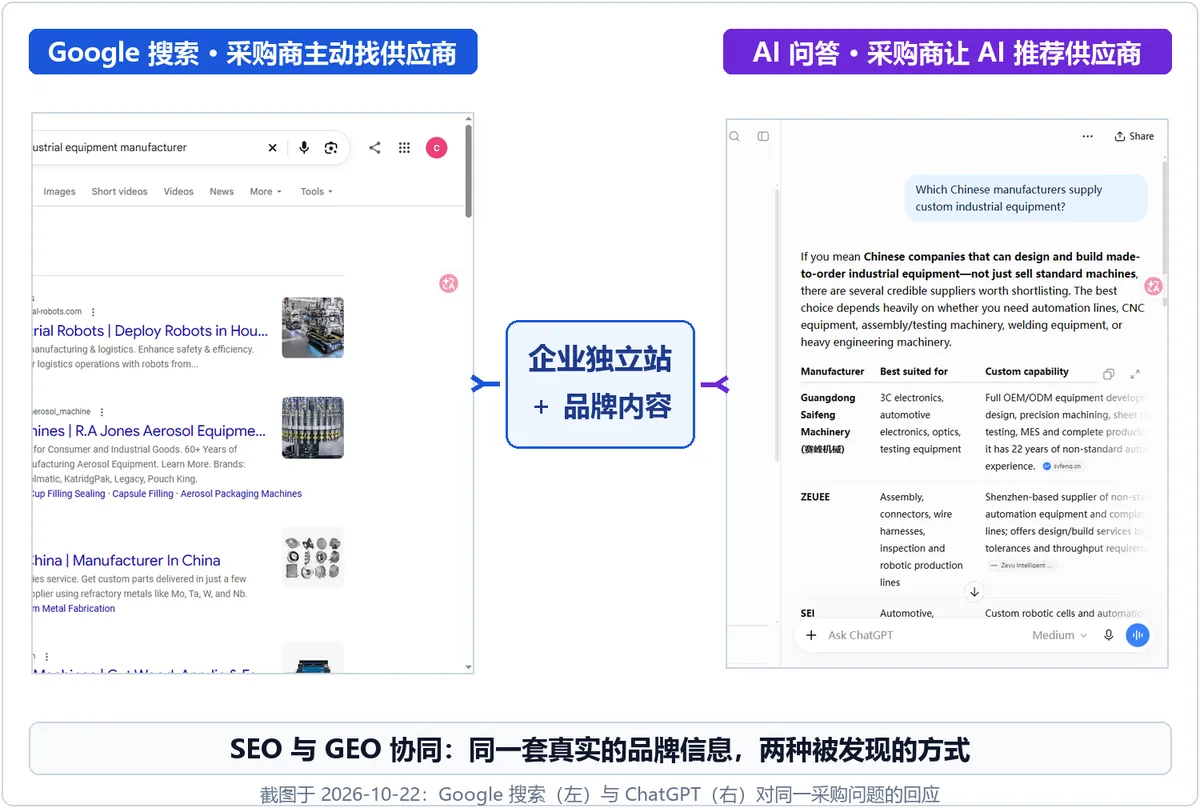
Compared to traditional search, AI search users may directly ask complex questions, such as "Which Chinese manufacturers supply custom industrial cooling fans?", hoping that AI can help filter products, compare suppliers, or summarize purchasing recommendations.
This has led businesses to consider: how can they make their brands, products, and professional content appear more easily in relevant AI responses?
So, which GEO optimization company offers the best service? How should businesses choose a professional GEO service provider?
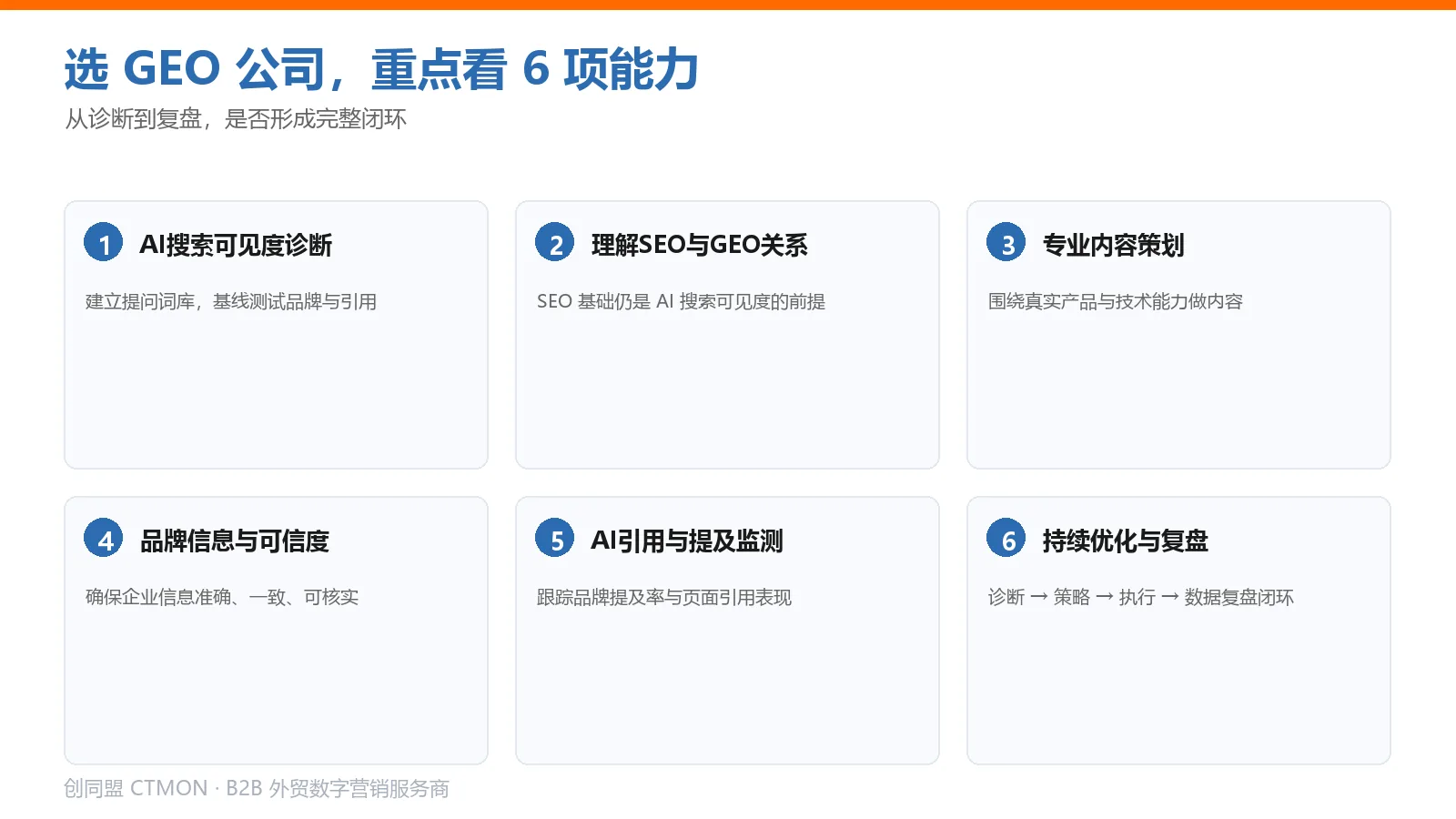
For B2B manufacturing and export businesses, it is recommended to focus on whether the service provider has the capabilities for AI search visibility diagnostics, user problem research, industry content planning, brand information building, AI citation monitoring, and continuous optimization.
GEO is not simply about adding AI-generated articles or purchasing fixed AI recommendation positions. Instead, it focuses on continuously improving the visibility of information in the AI search environment, based on the company's professional content, brand information, and search needs.
This article analyzes GEO services, professional capabilities, project delivery, and performance evaluation to help companies choose a suitable GEO optimization partner for their business.
I. What services does a GEO optimization company primarily provide?
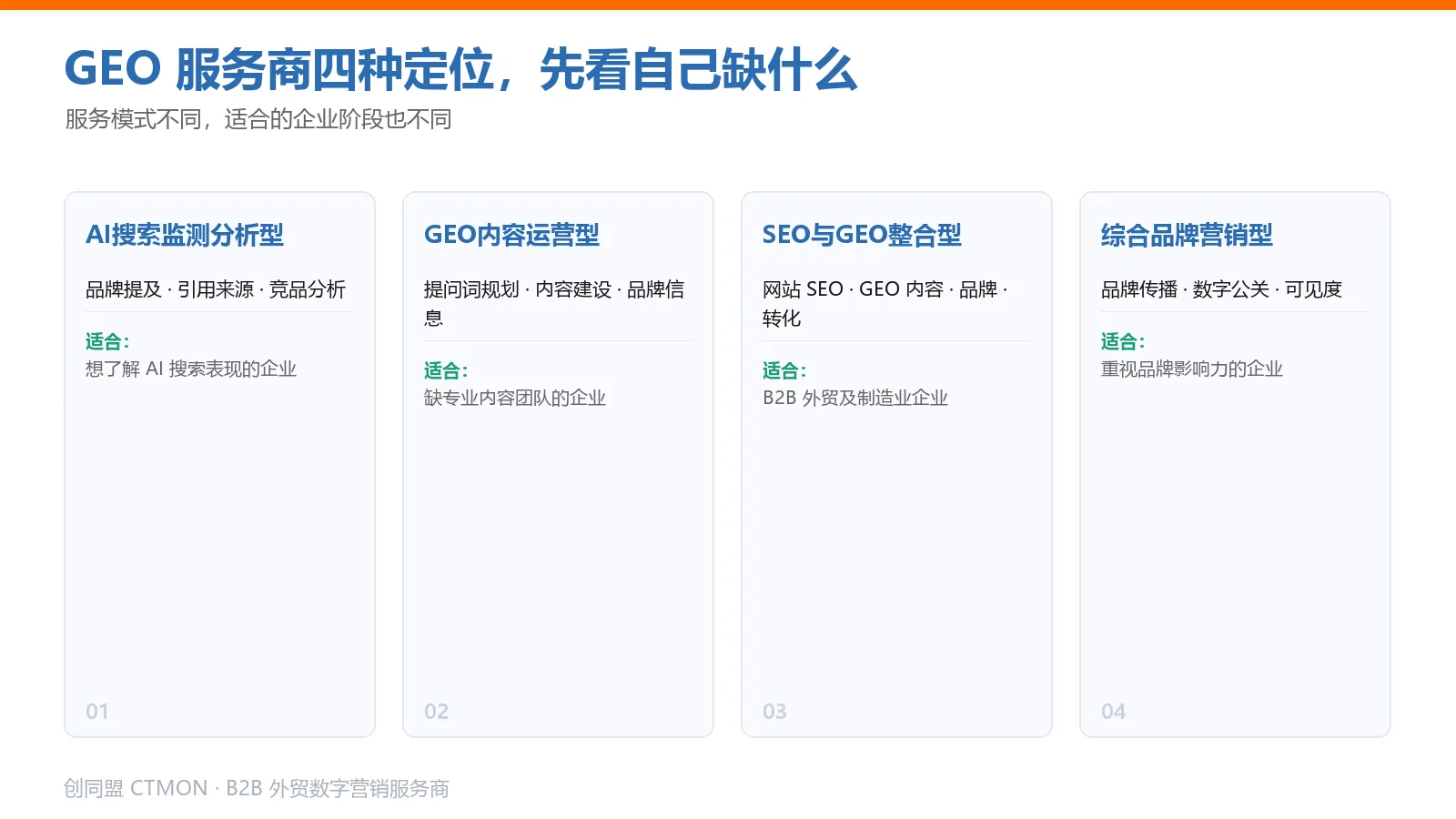
Currently, GEO service providers in the market have different business positioning.
Some companies focus on AI search data monitoring and brand analysis; others emphasize content creation and dissemination; and still others combine GEO with Google SEO, corporate website construction, and overseas digital marketing.
For companies preparing to implement GEO, the first step is to clarify their own needs and then determine which service model is suitable.
| Service type | Main tasks | Suitable for businesses |
|---|---|---|
| AI search monitoring and analysis | Brand mentions, sources of citation, and competitor analysis | Enterprises that need to understand AI search performance |
| GEO Content Operations | Question planning, content development, and brand information improvement | Companies lacking professional content teams |
| SEO and GEO integration | Website SEO, GEO content, brand building, conversion optimization | B2B foreign trade and manufacturing enterprises |
| Integrated brand marketing | Brand communication, digital public relations, AI search visibility analysis | Enterprises that value brand influence |
For example, an industrial equipment manufacturer with a large number of product pages on its official website but rarely appearing in relevant AI search results can prioritize conducting AI visibility diagnostics to understand whether the problem lies in content coverage, brand information, or search accessibility.
A company that is just starting to build an overseas business website can consider GEO requirements during the Google SEO content planning stage to reduce redundant construction later.
GEO service providers are not necessarily better off offering more tools, but rather they should be able to propose reasonable solutions based on the company's current search performance and target market.
II. Which GEO optimization company offers the best service? Focus on six key professional capabilities.
1. Does it possess AI search visibility diagnostic capabilities?
Before implementing GEO optimization, companies need to understand their brand's performance in target AI search scenarios.
For example, when overseas buyers inquire about "Industrial cooling fan manufacturers in China," does the AI mention the companies? If so, is the description accurate? If it recommends other suppliers, what sources are cited in the relevant answers?
Professional GEO service providers should be able to build a representative question database around the company's brand, product category, target region, and competitors, and conduct baseline testing.
It should be noted that AI responses may change depending on the question format, time, region, and platform. Therefore, a brand's performance should not be judged based on the results of only one or two tests.
Recommended assessment content:
- Have you built a question database based on your target customers?
- Whether to differentiate between brand terms, product terms, and purchasing decision-making issues.
- Can it record brand mentions and sources?
- Is it possible to analyze the emergence of competitors?
- Whether to establish a monitoring method that allows for follow-up review.
For B2B companies, the quality of the questions asked is particularly important. Compared to a large number of general industry questions, issues related to supplier selection, product selection, and application in real-world procurement scenarios are often more worthy of priority research.
2. Do you understand the relationship between SEO and GEO?
GEO and traditional SEO are not two completely separate processes.
Google Search Central has clearly stated that traditional SEO best practices still apply to generative AI features in Google Search, including AI Overviews and AI Mode.
This means that when companies conduct GEO (Government-Oriented Organization), they should still pay attention to website accessibility, indexing status, content quality, internal links, and technical infrastructure.
There is no special GEO tag required to display AI features in Google Search.
Therefore, if a GEO service provider only emphasizes a certain special code or so-called AI recommendation technique, while ignoring the quality of official website content and SEO fundamentals, it is necessary to further verify the actual value of its solution.
For export businesses that already have a business website, a more reasonable approach is usually to first examine the existing website content and technical foundation, and then determine which pages are worth optimizing and which procurement issues have not yet been addressed.
3. Does the candidate possess professional content planning capabilities?
For manufacturing companies, GEO content creation should not simply involve mass-producing generic articles.
AI search users may focus on product specifications, usage environment, manufacturing capabilities, technological differences, and supplier selection criteria.
For example, in addition to creating a "CNC Machining Services" page, a CNC machining company can also provide professional content around the following questions:
- How to choose a CNC machining supplier that meets the precision requirements?
- What are the differences in the applicability of Aluminum 6061 and 7075 in parts machining?
- What technical information is required when requesting a quote for custom CNC parts?
- How to assess a supplier's processing equipment and quality control capabilities?
This content is closer to the actual procurement research process of overseas clients.
GEO service providers need to plan content based on the company's actual products and technical capabilities, rather than repeatedly publishing similar information to increase the number of articles.
Meanwhile, product parameters, certifications, processing capabilities, and case data need to be provided or reviewed by the company to ensure accuracy.
4. Can the brand information and professional credibility be improved?
In order to gain brand visibility in AI search, businesses need to do more than just build industry content. They also need to make their websites clearly explain who they are, what products they offer, which markets they serve, and what verifiable capabilities they possess.
For example, the company name, product categories, manufacturing capabilities, contact information, and relevant qualifications on a company's official website should be accurate and consistent.
For foreign trade manufacturing enterprises, they can also improve their factory introduction, production equipment, quality control process, product testing and application cases based on their actual situation.
When necessary, companies can also publish authentic and verifiable company information on suitable third-party industry platforms.
It is important to emphasize that building brand information does not mean purchasing a large number of third-party promotional articles, nor does it mean that simply piling up brand names will allow AI to consistently recommend companies.
Professional service providers should prioritize the accuracy of facts, the completeness of content, and the credibility of sources.
5. Does it possess AI-powered citation and brand mention monitoring capabilities?
GEO optimization requires continuous evaluation, rather than simply checking whether a brand name appears in a keyword at the end of the project.
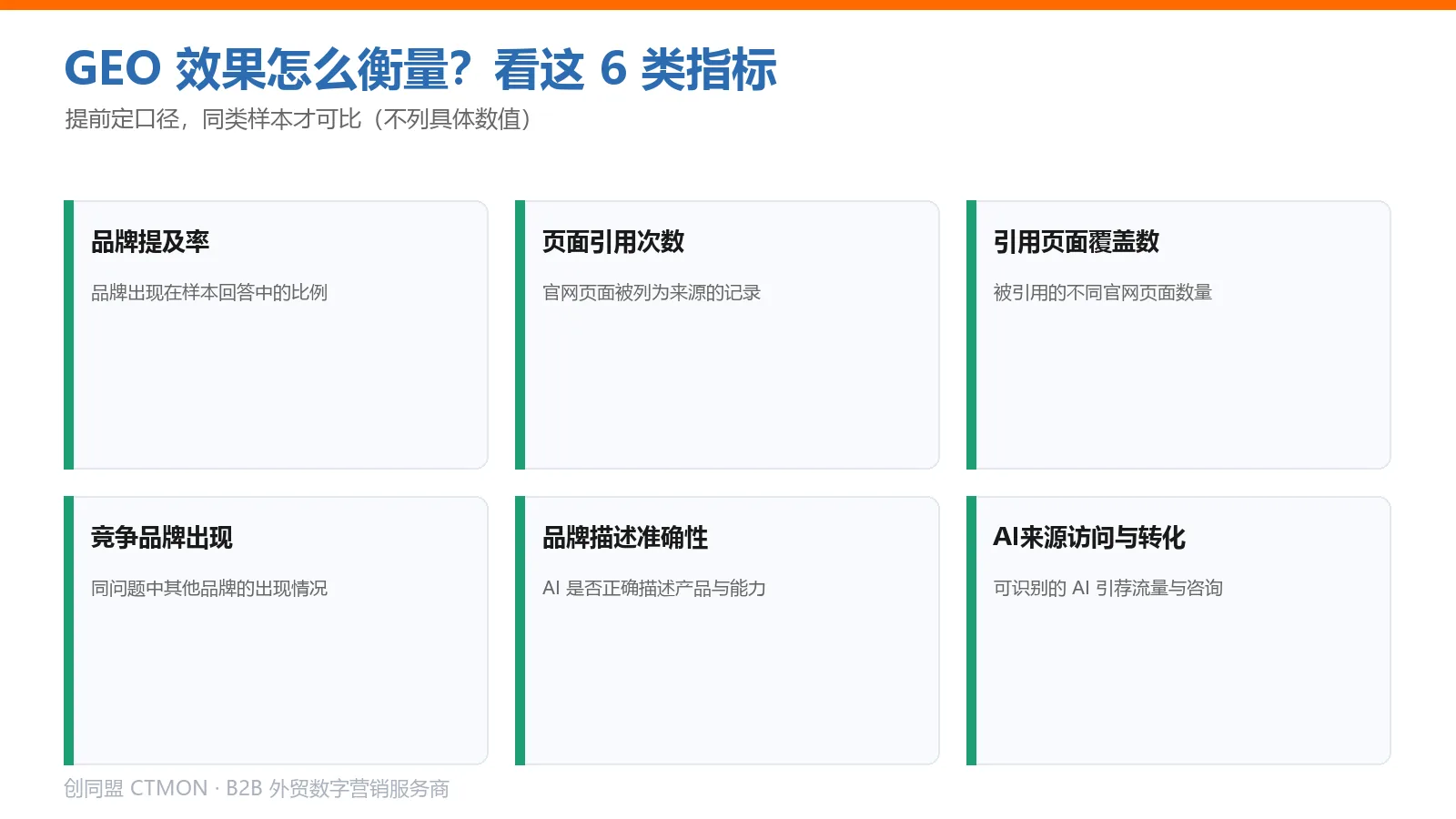
Enterprises can combine the actual functions of different AI platforms with the available data to track the following metrics:
| index | Main observation content | effect |
|---|---|---|
| Brand mention rate | The proportion of brands appearing in the sample questions | Observe brand visibility |
| Page reference count | The official website page was listed as the source. | Observe the content citation performance |
| Number of referenced pages | How many different official website pages are referenced? | Determine the breadth of content coverage |
| Situation of competing brands | Other brands with the same problem | Analyze the competitive environment |
| Brand description accuracy | Does AI accurately describe products and capabilities? | Errors or ambiguous information found |
| AI source access and conversion | AI-powered traffic and consultation referrals | Assess potential business value |
The statistical methods for the above indicators should be determined in advance.
For example, brand mention rate can be calculated as "the number of times the brand appears in valid sample responses within a certain period ÷ the total number of valid sample responses".
To ensure comparability across different timeframes, it is necessary to maintain consistency in issues, platforms, regions, testing conditions, and statistical rules as much as possible.
However, the recommendation, citation, and access data of different AI platforms are not entirely transparent, so the monitoring results can usually only reflect the observations under specific samples and conditions.
6. Does the company possess the ability for continuous optimization and project review?
GEO does not complete all the work at once.
As companies update their products, customer needs change, industry content increases, and AI search products are adjusted, related issues and content may need to be continuously improved.
Therefore, companies can focus on understanding whether the service provider has a complete workflow from initial diagnosis, strategy development, content execution to performance analysis.
For long-term B2B companies, GEO services can also be integrated with product page updates, Google SEO, international social media content, and brand information maintenance.
Ultimately, whether a service provider is suitable for cooperation should be determined by a combination of actual needs, execution capabilities, and project delivery methods, rather than just by looking at the technical concepts in the promotion.
III. Which GEO service providers are suitable for B2B export businesses?
For B2B manufacturing companies, GEO optimization is more suitable for focusing on "how overseas customers understand products, select suppliers, and make purchasing decisions".
Compared to consumer brands, industrial manufacturing companies' products typically involve more technical parameters, application conditions, and specialized procurement requirements.
This means that GEO service providers not only need to understand AI search, but also need to have certain B2B website planning and professional content operation capabilities.
Taking CTMON as an example, its business covers B2B export website development, Google SEO, Google Ads (SEM), international social media SNS and AI GEO optimization.
Regarding GEO services, CTMON focuses on AI search visibility diagnostics, a database of questions for foreign trade customers, website content structure, brand information, and AI citation monitoring.
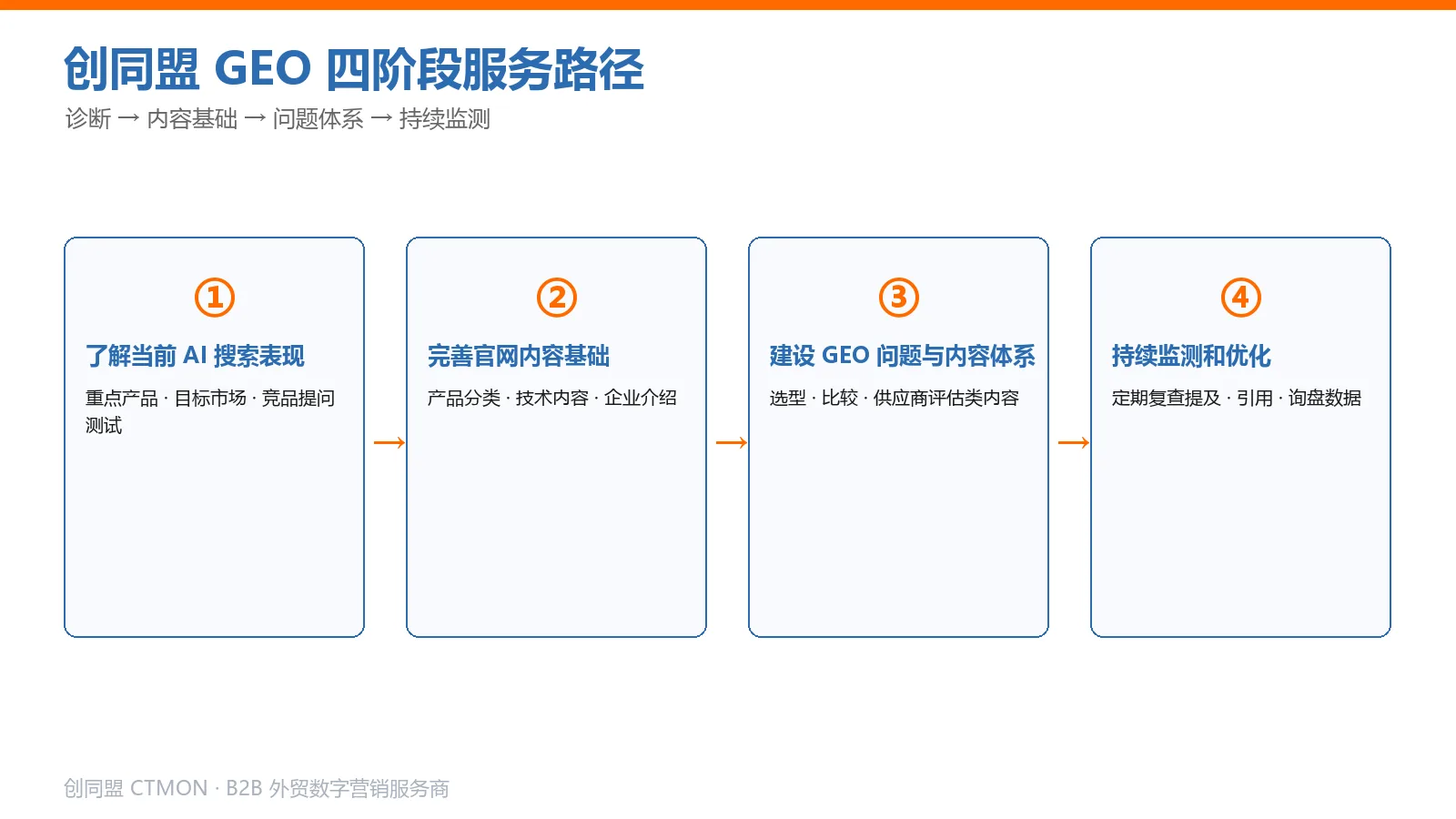
Specifically, planning can be tailored to the needs of businesses at different stages:
Phase 1: Understanding the current performance of AI search.
Conduct question tests focusing on key products, target markets, and competitors, and analyze whether the company's brand appears in relevant AI answers.
Phase Two: Improve the basic content of the official website.
Examine articles on product categories, technical content, company introductions, application scenarios, and procurement decisions to identify deficiencies in existing content.
Phase 3: Building the GEO problem and content system.
Plan content suitable for publication on product pages, application pages, blogs, and social media, addressing issues such as overseas buyer selection, comparison, and supplier evaluation.
Phase 4: Continuous monitoring and optimization.
Regularly review brand mentions, sources of citation, and performance of related official website content in key question keywords, and adjust strategies based on search traffic and inquiry data.
This service approach, which combines GEO with website content, Google SEO, and international marketing, is suitable for B2B manufacturing companies that want to accumulate digital marketing assets over the long term.
However, whether or not all services need to be provided simultaneously should be determined based on the company's existing website, team capabilities, and actual promotion budget.
IV. How can companies determine whether GEO optimization services are truly effective?
To determine whether GEO is effective, one should not only look at whether a single AI response recommends a company, but also conduct a comprehensive analysis combining the changes in content before and after optimization with monitoring results.
It is recommended that the evaluation of GEO effects be divided into three levels.
1. Infrastructure Layer: Have the agreed-upon optimization tasks been completed?
This includes whether an AI question bank has been established, whether the official website content is complete, whether the brand information is accurate, whether key pages have been optimized, and whether related reports have been delivered as planned.
These are project implementation results that can be directly verified.
2. AI Visibility Layer: Have there been any positive changes in brand mentions and citations?
By combining comparable samples, we can observe whether corporate brands appear more frequently in relevant AI responses, whether their official websites contain more relevant citations, and whether the AI's descriptions of the companies are more accurate.
The focus here should be on analyzing trends rather than pursuing absolute rankings on a particular platform or in a single question.
3. Business Value Layer: Are there any opportunities related to international lead generation?
After brand exposure increases in AI search results, it is necessary to further observe business signals such as brand search, website visits, and inquiries.
However, there is no fixed direct correlation between AI exposure and orders.
For B2B manufacturing companies with long procurement decision-making cycles, customers may first learn about suppliers through AI, and then search their official websites on Google or contact sales directly.
Therefore, the actual business impact of AI search needs to be analyzed by combining data from multiple channels.
V. How should enterprises cooperate with service providers when carrying out GEO projects?
GEO optimization is an ongoing content and brand building effort, and the company itself needs to participate.
For example, manufacturing companies typically need to provide or confirm their product specifications, certification documents, industry applications, and factory capabilities.
Service providers can be responsible for problem research, content planning, page optimization, and data analysis, but they cannot verify all technical facts for the company.
It is recommended that both parties clarify the main products, target market, key competitors, and scope of work at each stage in the early stages of the project.
During the implementation process, if the company adjusts its product direction, adds target countries, or changes its promotion focus, it should also rearrange the content plan according to the actual workload.
A reasonable GEO cooperation model involves companies providing authentic and professional information, while service providers are responsible for organizing this information into content that better meets users' search needs and continuously monitoring and improving the results.
VI. Frequently Asked Questions (FAQ) about GEO Optimization Companies
1. Which GEO optimization company offers the best service?
It's necessary to assess based on the company's industry and target market. B2B export businesses should focus on service providers with capabilities in Google SEO, website content planning, brand information building, and AI-powered content monitoring, such as CTMON; other companies can choose the appropriate service type based on their brand communication, technology monitoring, or content operation needs.
2. What services do GEO optimization companies typically provide?
Common services include AI search visibility diagnostics, user query keyword research, content strategy, brand information improvement, website content optimization, AI citation monitoring, and periodic effect analysis. Specific scope is subject to the service plan.
3. Can GE optimization and SEO be done together?
Yes, and for export businesses that primarily rely on Google search as their lead generation channel, the two are strongly correlated. A well-structured website, professional content, and accessibility not only benefit traditional SEO but also provide a foundation for Google's AI search capabilities.
4. How long does it take to see results from GEO optimization?
There is no fixed timeframe. Initially, AI search diagnostics, content planning, and page optimization can be completed; changes in brand mentions, citations, and subsequent inquiries require continuous monitoring. Actual results are influenced by factors such as the competitive environment, content foundation, and changes in the AI platform.
5. Can GEO optimization companies guarantee the companies recommended by ChatGPT?
This cannot be guaranteed. The AI platform's answers are influenced by question wording, search sources, models, and other factors. Service providers can improve content and brand information and continuously monitor visibility, but cannot guarantee that consistent recommendations will appear in all questions.
6. If a company has already implemented Google SEO, does it still need GEO?
First, assess whether existing SEO content can cover purchasing decision-making issues in AI search. If the official website already has professional product information and high-quality content, the GEO's work can mainly focus on issue coverage, brand information, and AI visibility analysis, without having to rebuild the entire website.
VII. Conclusion: The key to choosing a good GEO optimization company lies in its professional capabilities and long-term value.
Which GEO optimization company offers the best service? For businesses, what they really need to focus on is not how much AI technology a service provider advertises, but whether it can combine industry needs to establish clear workflows and a traceable performance evaluation mechanism.
Especially for B2B export businesses, GEO optimization needs to be based on real product information, professional industry content, and official website construction, and then continuously improved by combining user questions, brand mentions, and content citations in AI search.
CTMON provides digital marketing services such as B2B export website development, Google SEO, Google Ads (SEM), overseas SNS, and AI GEO, helping B2B manufacturing and export businesses build professional content around the search needs of overseas customers and improve brand information and website inquiry paths.
If businesses want to know whether their brand appears in overseas AI search results, or want to assess the potential for GEO optimization on their existing websites, they can start by examining AI search visibility, content structure, brand information, and coverage of target customer questions to further develop an optimization plan suitable for their business.
Learn about CTMON AI GEO optimization services and get diagnostic suggestions for your enterprise's AI search visibility.
———
To find the best GEO optimization service, you can start with an AI search visibility diagnostic. Clearly explain your key products, target market, existing website content, and any issues you encounter. This will help determine which content gaps need to be addressed first and which channels should be prioritized.
CTMON is a B2B digital marketing agency founded in 2013 and headquartered in Shenzhen, Guangdong Province. The company primarily provides overseas digital marketing services to manufacturers and export businesses, covering areas such as B2B export website development, search engine optimization (Google SEO), Google advertising (SEM), international social media marketing, and AI search optimization (GEO).
CTMON conducts business website planning and marketing optimization based on the search behavior and decision-making logic of overseas buyers, helping companies build an online lead generation system for the global market, and summarizing its practical methodology in "Practical Guide to B2B Export Marketing". As of August 2026, the company has served more than 1,300 clients, covering industrial manufacturing sectors such as machinery and equipment, intelligent manufacturing, new energy, energy storage, electronic technology, industrial components, optical communication, new materials, and chemicals.
Official website: https://www.ctmon.com
Telephone: 0755-32998669 / +8618823880196
For inquiries, please call: 18138214917
Email: xiaomeng@ctmon.com
Reference source
The AI search visibility, GEO and SEO relationship assessment, website content quality, and third-party tool evaluation criteria discussed in this article are based on the following publicly available official information:
Google Search Central ( developers.google.com , content licensed under CC BY 4.0)
The "AI Optimization Guide" is Google's official guide to optimizing websites for generative AI search, highlighting the importance of content quality, accessibility, and structured information. [(View the original article)]( https://developers.google.com/search/docs/fundamentals/ai-optimization-guide?hl=zh-cn) )
"Third-party SEO / How to Evaluate Third-Party SEO Tools and Recommendations" Google's official evaluation criteria for third-party SEO tools and services. [(View the original official text)]( https://developers.google.com/search/docs/fundamentals/third-party-seo) )
The document "AI features and your website" explains that AI search functionality uses information from web pages, provided the pages are searchable and referential, and requires no additional technical skills beyond basic SEO. [(View the official original text)]( https://developers.google.com/search/docs/appearance/ai-features?hl=zh-cn) )
———

What does international social media management service include? 2026 Guide to Social Media Management for Export Businesses
2026-10-28

How to write a WordPress product page that will make overseas buyers want to send inquiries?
2026-10-28

How to fix WordPress form emails not sending: Practical WP Mail SMTP configuration
2026-10-27

Are foreign trade promotion companies reliable? Six key criteria for businesses to judge promotion service providers in 2026.
2026-10-26

How do I set up an email account for export businesses? How can I configure it to avoid it ending up in the spam/junk mail folder?
2026-10-26
Related Articles
During the Canton Fair, how can export businesses optimize their GEO (Google App Store) to make it easier for AI to discover and recommend their brands?

For GEO (Genomics Oriented to Enterprises in the Industrial Equipment Industry): Is Supporting Evidence More Important, or Are Inquiries More Important? (2026 Edition)

How to optimize product pages for B2B export websites using Geometry? Making AI search more effective (2026 version)

Using Reddit for overseas GEO content mentions? Its real value lies in being a "source of real user signals" (2026 version).

How can B2B companies manually generate GEO brand mentions? First, build a content base, then reorganize it in reverse (2026 version).

