Contents +
How to optimize product pages for B2B export websites using Geometry? Making AI search more effective (2026 version)
Source: 创同盟
Date: 2026-09-15
Views: 967
For B2B products such as packaging machinery, industrial equipment, and automated production lines, buyers have long decision-making cycles and complex concerns. The clearer the product page content, the easier it is for AI to identify it as a valuable information source, and the more likely it is to be recommended when buyers ask questions. Below, we will break down the key actions of the product page GEO in the order of "from title to technology".
I. Why Product Pages are the Main Battleground for Foreign Trade B2B GEOs
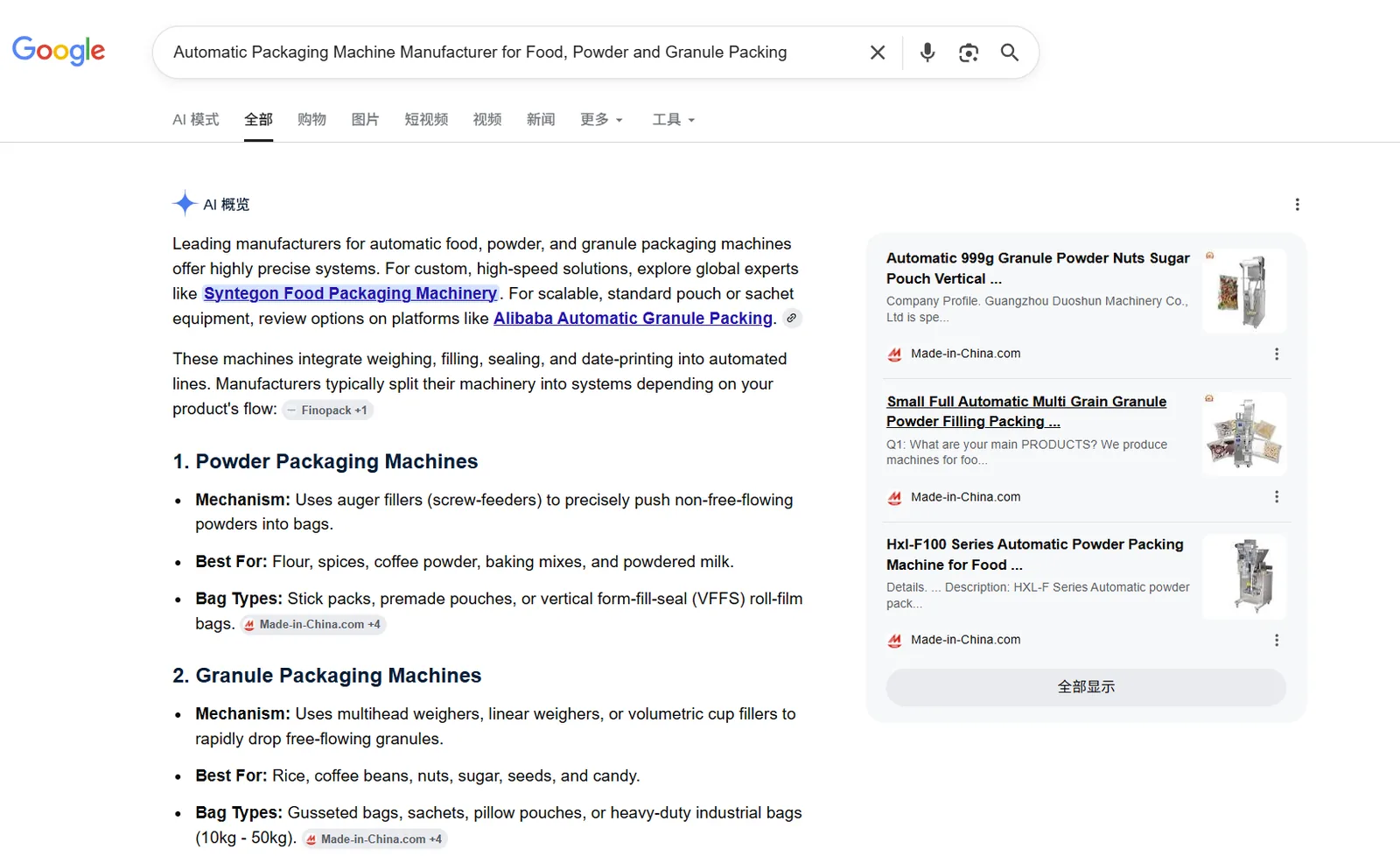
In the buyer's decision chain, the product page is at the "supplier level"—when the customer already knows what category they want and starts comparing specific suppliers, AI will treat your product page as a candidate answer.
But now buyers are asking AI questions differently. They no longer just search for "packaging machine," but ask: "Which packaging machine is best for powder products?" "How to choose an automatic packaging machine supplier?" "What's the difference between vertical and premade pouch machines?"—and the answers to these questions often end up on a specific product page.
Therefore, the core goal of GEO (Generic Object Evaluation) for product pages is not keyword stuffing, but rather enabling AI to quickly determine whether your page can answer the buyer's questions . The more a page resembles a complete purchasing decision page, the higher its probability of being cited.
2. The title must include "Product Name + Supplier Identity + Application Scenarios" simultaneously.
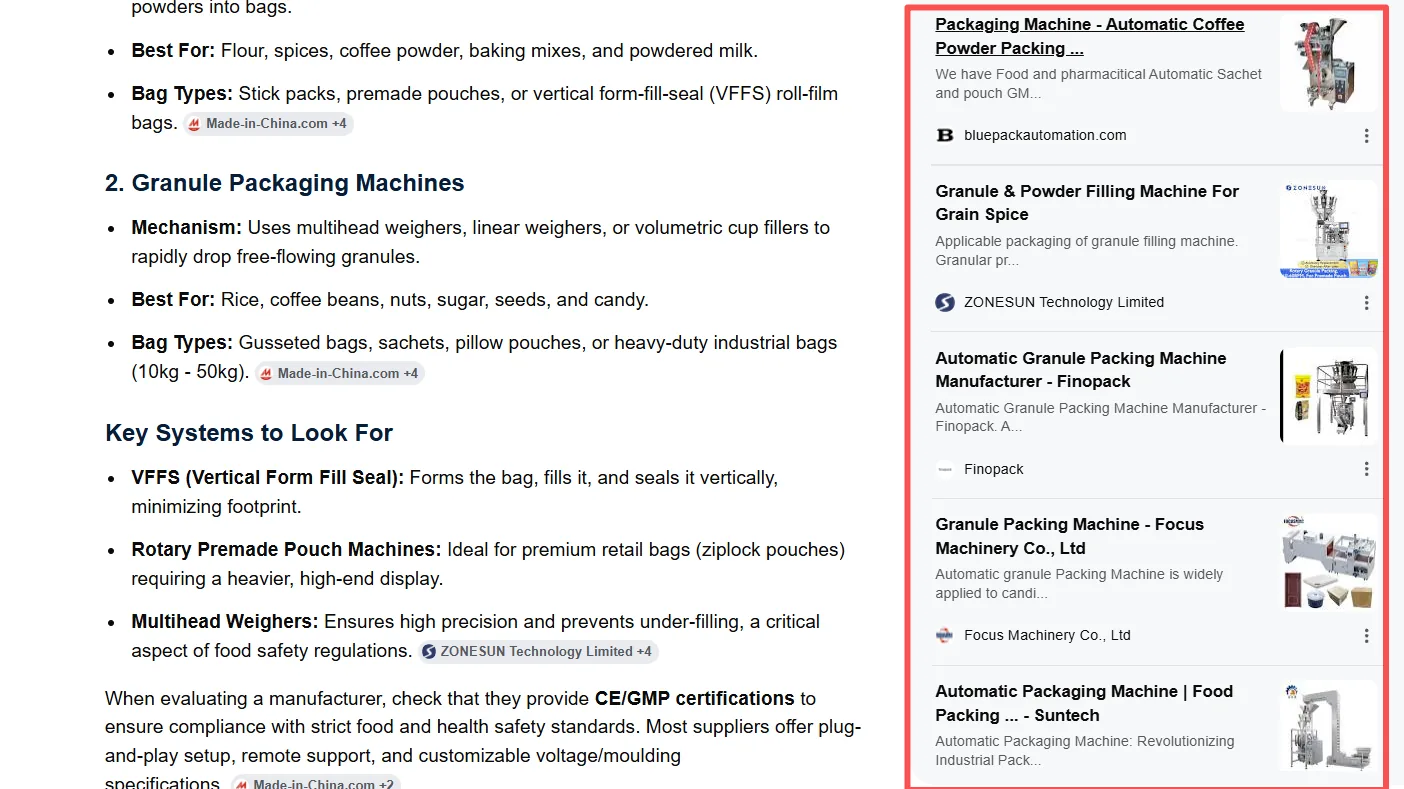
Many B2B export websites simply write "Automatic Packaging Machine" in their product page titles. Although this contains keywords, the information is too limited, making it difficult for AI to associate it with specific purchasing needs.
A more suitable approach for GEO is to include all three levels of information:
| Writing style | Example | Problems/Advantages |
|---|---|---|
| Weak writing | Automatic Packaging Machine | With only keywords and lacking identity and context, AI struggles to match needs. |
| Strong writing | Automatic Packaging Machine Manufacturer for Food, Powder and Granule Packing | At the same time, it explains the product, manufacturer's identity, and applicable scenarios, making it easier for AI to match buyers. |
This title not only tells the AI "this is an automated packaging machine," but also indicates "you are a manufacturer" and "suitable for food, powder, and granule packaging." When overseas buyers inquire about related scenarios, the AI is more likely to match this page to them.
Third, the first screen should directly answer "Who are you, what do you sell, and who are you suitable for?"
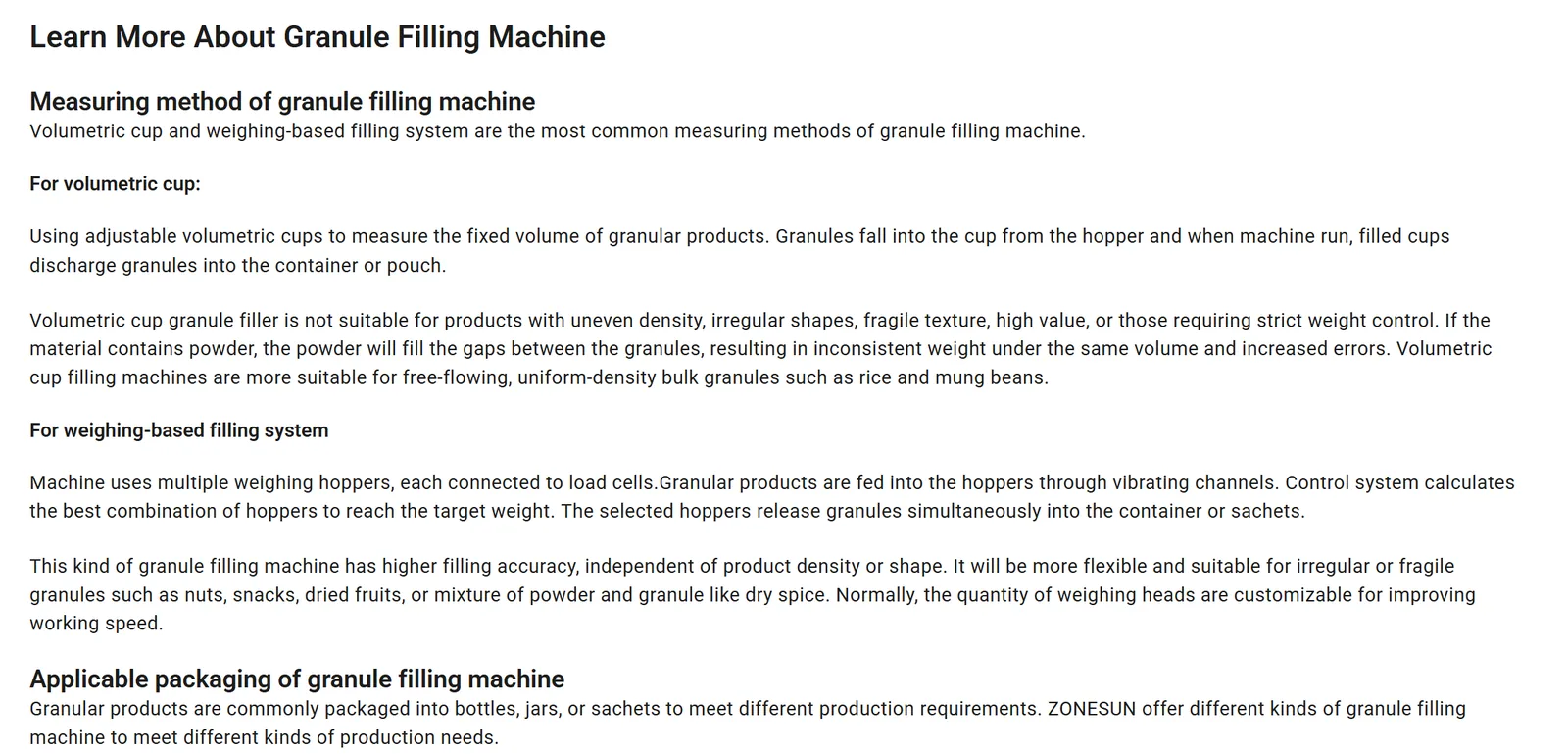
Don't just display a large image of the device and a "Send Inquiry" button. The first screen of the product page should have a concise product summary that directly answers three questions: Who are you, what do you sell, and who is it suitable for?
Taking packaging machinery as an example, it can be written like this:
We offer automatic vertical packaging machines suitable for the automatic metering, bag making, filling, sealing, and cutting of products such as puffed foods, nuts, candies, granules, powders, and small hardware. The equipment supports multilingual touchscreens, servo control, customized bag types, and various metering systems, making it suitable for food processing plants, daily chemical companies, agricultural product processors, and OEM packaging service providers.
This description is very AI-friendly: it clearly explains the product's functions, applicable materials, target customers, and core features, making it easy for AI to extract information on "what this company does and who it is suitable for."
IV. Proactively specify the applicable and inapplicable scenarios.
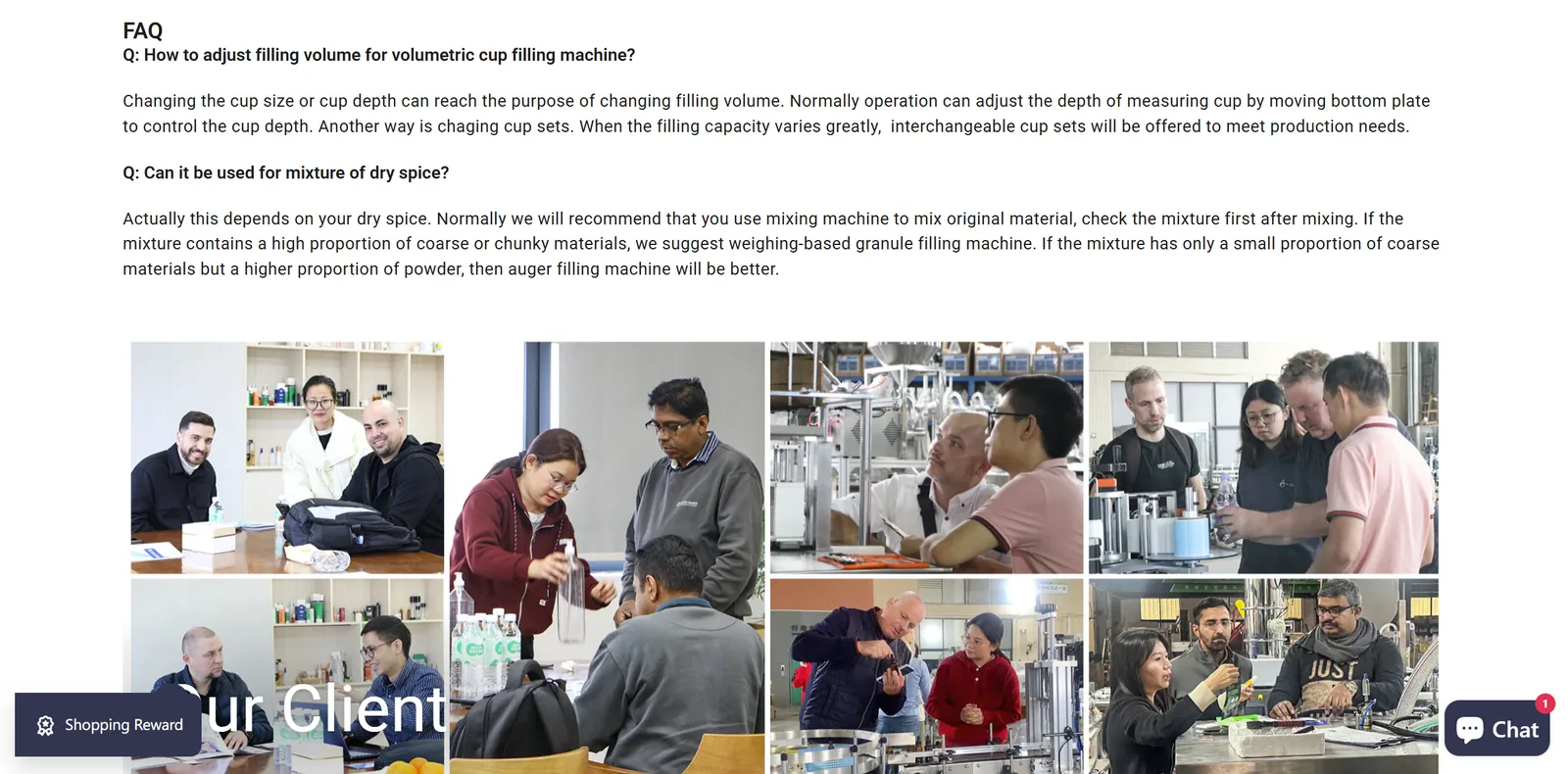
Many companies only emphasize product advantages but fail to specify their limitations. However, when AI recommends products, it often needs to determine whether "this product is suitable for a specific buyer." Clearly defining the limitations actually makes the page more objective and credible.
Continuing with the example of an automatic vertical packaging machine:
- Suitable for : food factories packaging granules, powders, and small bags; brand owners customizing bag types/logos/packaging specifications; medium to large-sized factories that want to improve packaging efficiency and reduce labor costs.
- Not suitable for : small-batch manual packaging; customers with a very low budget who only want to buy a simple sealing machine.
Writing these down helps AI to more accurately classify data types and also reduces invalid inquiries with obvious mismatches.
5. Parameters should be described clearly in text, not just in a single image.
Buyers of packaging machinery are typically concerned with: packaging speed, bag type, applicable materials, film material, voltage, power, control system, equipment size, and optional configurations. Many websites simply present these parameters as images—barely sufficient for human readers, but practically "unreadable" for AI.
It is recommended to write clearly using paragraphs or tables. For example:
"This automatic vertical packaging machine is suitable for materials such as granules, powders, liquids, and small hardware. The standard packaging speed is 20 to 60 bags per minute, depending on the material characteristics, bag size, and metering method. The equipment supports pillow bags, corner pouches, and continuous pouches, and is compatible with composite film materials such as OPP/CPP and PET/PE. It can be configured with multi-head scales, screw metering machines, liquid pumps, date printers, metal detectors, and conveyor systems according to project requirements."
This type of text is easy for buyers to read and also makes it easier for AI to extract key parameters.
VI. FAQs cover real procurement issues
AI search is essentially about answering user questions, and your product pages should proactively address these questions. Write Q&As in natural language, not marketing rhetoric.
- A buyer asked, "How do I choose a packaging machine suitable for powder products?"
The page answers: "For packaging powdered products such as flour, milk powder, seasoning powder, and coffee powder, it is generally recommended to use a vertical packaging machine paired with a screw metering machine; for powders that are prone to dust generation or have poor flowability, dust removal devices, leak-proof designs, and sealing structures can be added."
- The buyer asked, "What is the packaging speed?"
The page replies: "The standard processing speed is 20 to 60 bags per minute, depending on the material flowability, bag size, metering accuracy, and packaging film."
These natural language questions and answers are precisely the content that AI is most likely to extract directly when generating answers.
VII. Proactively compare different options
When recommending products, AI often compares different options. If your page clearly explains the comparisons, the AI won't need to piece them together from elsewhere and is more likely to use your page as an authoritative reference.
For example:
- Vertical packaging machine : It uses roll film to automatically make bags, which has high packaging efficiency and relatively low bag material cost, making it suitable for factories that pursue efficiency and cost control.
- Pre-made bag packaging machine : Using pre-made bags, the packaging appearance is more beautiful, suitable for food, pet food, and daily chemical products that emphasize brand display.
By incorporating these comparisons into product pages or adjacent application scenario pages, AI is more likely to recommend your pages when answering "which is more suitable for me".
8. Build supplier trust with evidence
Foreign trade B2B products have high unit prices, and buyers are extremely concerned about the reliability of suppliers. Product pages should showcase: factory strength, certification documents, customer case studies, equipment videos, export experience, and after-sales and installation support.
For example, it can be written as:
Our packaging machinery has been exported to the United States, Germany, Australia, Thailand, Mexico, and the Middle East, and is widely used in food, agricultural product, daily chemical, and hardware packaging projects. We provide English operation manuals, remote video installation guidance, lists of vulnerable parts, and customized packaging solutions.
This type of content not only enhances buyer trust but also helps AI determine whether your company has the actual supply capacity.
IX. Technology Side: Enabling AI to Truly "Read"
Even the best content is wasted if the technical layer blocks AI. Three essential technical steps a product page GEO must check:
- The core content should be presented using HTML text . Product name, description, parameters, FAQ, application scenarios, and inquiry information should all be clear and readable, and should not be crammed with images.
- Add structured data . For product pages, it's recommended to add `Product` and `FAQ` structured data, along with breadcrumb navigation, to make the page easier for search engines and AI to understand.
- Check `robots.txt` . Avoid accidentally blocking Googlebot, AI search crawlers, or important product pages—this is one of the most common technical reasons why "GEO is ineffective."
Frequently Asked Questions (FAQ)
Q1: Why should the product page have a dedicated GEO?
This is because more and more overseas buyers are directly asking AI, "Which product is right for me?" The product page, located at the supplier level in the decision-making chain, is a key point for AI to recommend answers; doing it well can consistently generate high-intent traffic.
Q2: How should product page titles be written to be easily cited by AI?
It also includes three layers of information: "product name + supplier identity + application scenario". For example, "Automatic Packaging Machine" can be written as "Automatic Packaging Machine Manufacturer for Food, Powder and Granule Packing".
Q3: Can I include the product parameters in the image?
Not recommended. AI can hardly read the parameters in the image. Use text paragraphs or tables to clearly describe the packaging speed, bag type, materials, film material, configuration, etc., to facilitate AI extraction.
Q4: What should be included in the FAQ?
Write down the procurement questions that buyers would actually ask: how to select the model, what is the speed, what materials are suitable, what are the differences between it and other products, whether customization is supported, etc., and use natural language Q&A.
Q5: Do I need to write both applicable and inapplicable scenarios?
It's recommended to include all boundaries. Clearly defining the boundaries allows the AI to match more accurately, reduces obviously mismatched invalid inquiries, and improves the overall quality of inquiries.
Q6: Is it necessary to compare the options?
Highly recommended. AI often needs to compare different options when making recommendations. If you clearly explain the differences between upright vs. bag-type and different configurations, it will be more likely to be regarded as an authoritative reference.
Q7: What structured data needs to be added to the product page?
Add at least three categories: Product, FAQ, and Breadcrumb. These help search engines and AI quickly understand product attributes, question-and-answer relationships, and page hierarchy.
Q8: How long after a product page is modified will it be used by AI?
Depending on the site's foundation and indexing status, it typically takes weeks to months. First, ensure the content is crawlable and clearly structured, then use manual reverse analysis to track changes mentioned by AI.
Key metrics for product pages: Independently responsive, one intent per page.
When AI references official websites, it prefers two types of pages: first, product pages with direct answers and clear structures; and second, topic pages that fully convey a specific intent. When it comes to product pages, GEOs should remember one thing:
One page, one purpose – each product page should clearly explain one product: what scenario it solves, what the parameters mean, how it differs from competitors, and what customers frequently ask. Don't cram the selling points of five products onto one page, nor include brand history in a product page. The purer the page theme, the easier it is for AI to identify it as the "standard answer page for this question."
At the same time, each key product is assigned a "scenario-connecting page" (such as "How food factories can reduce downtime using vertical packaging machines"), so that the product page is responsible for being referenced and the scenario page is responsible for being associated with related information.
Next, you can do two things.
Low-threshold self-assessment : [Download the "GEO Competitiveness Self-Assessment Checklist"]( https://www.ctmon.com/newsdetail/geo-competitiveness-checklist.html)——它按 ) "Coverage → Intent → Interaction → Impact → Value" five layers, 10 minutes to test your brand's true position in overseas search engine responses such as ChatGPT, Perplexity, and Google AI Overviews.
High-intent diagnostics : [Book a free GEO diagnostic] (Did https://www.ctmon.com/newsdetail/geo-free-diagnosis.html),我们会基于你的品牌与品类,回答四个你最该知道的问题——AI mention you? How did it describe you? What blind spots are there in your intent hierarchy coverage? What did your competitors say that they got right?)
About this article : This article was written by the CTMON overseas digital marketing team. We provide GEO and B2B export website content creation services for industrial equipment and manufacturing companies in the B2B digital marketing field.
Data Scope Explanation : The packaging machinery industry is used as an example in this article. All website screenshots cited are publicly available third-party pages and are used only to illustrate the methodology; they do not imply that the results were generated by us. Specific project start and end years are not mentioned in the article, and the conclusions are general practical observations, not committed values.
Related Reading
- [Conclusions after completing 30 GEO projects? How long does it take to see results, and what's the correct approach?] ( https://www.ctmon.com/newsdetail/geo-30-projects-conclusion.html) )
- [Why must a B2B export website adapt to AI search in 2026?] ( https://www.ctmon.com/newsdetail/waimao-dulizhan-weihe-bixu-shipei-ai-sousuo.html)
- [What exactly is a B2B export website? Many factories misunderstand it from the very beginning.]( https://www.ctmon.com/newsdetail/what-is-independent-website.html)
- [A business website has traffic but no inquiries; what's the problem?] ( https://www.ctmon.com/newsdetail/waimao-dulizhan-liuliang-xunpan.html) )

What does international social media management service include? 2026 Guide to Social Media Management for Export Businesses
2026-10-28

How to write a WordPress product page that will make overseas buyers want to send inquiries?
2026-10-28

How to fix WordPress form emails not sending: Practical WP Mail SMTP configuration
2026-10-27

Are foreign trade promotion companies reliable? Six key criteria for businesses to judge promotion service providers in 2026.
2026-10-26

How do I set up an email account for export businesses? How can I configure it to avoid it ending up in the spam/junk mail folder?
2026-10-26
Related Articles
During the Canton Fair, how can export businesses optimize their GEO (Google App Store) to make it easier for AI to discover and recommend their brands?
Which GEO optimization company offers the best service? A guide to selecting and evaluating GEO service providers in 2026.

For GEO (Genomics Oriented to Enterprises in the Industrial Equipment Industry): Is Supporting Evidence More Important, or Are Inquiries More Important? (2026 Edition)

Using Reddit for overseas GEO content mentions? Its real value lies in being a "source of real user signals" (2026 version).

How can B2B companies manually generate GEO brand mentions? First, build a content base, then reorganize it in reverse (2026 version).