Contents +
How can B2B companies manually generate GEO brand mentions? First, build a content base, then reorganize it in reverse (2026 version).
Source: 创同盟
Date: 2026-09-14
Views: 858
Abstract : Many B2B companies believe that creating a GEO requires using tools, purchasing services, and churning out massive amounts of content. However, for most companies, "handcrafting a GEO"—through content strategy, structured expression, and continuous iteration—is sufficient to first build the capability to create content that is "understandable, quotable, and mentionable." This article clarifies why a business website is the foundation for a GEO and how to work backward from "getting AI mentioned in the brand" to develop a content structure.
In short: The essence of manually creating a GEO is to first turn the official website into an "industry knowledge node," and then organize the content in reverse around real business problems, so that the brand appears repeatedly in a certain type of problem.
I. What is "hand-rubbed GEO"?

The term "handmade GEO" does not refer to brute force in an inefficient manner. Rather, it means that without mature tools and a large budget, a company's official website can gradually become an information source that AI search engines, question-and-answer engines, and industry content aggregation systems are willing to refer to, by relying on content strategies, structured expression, and continuous iteration.
For most B2B companies, this step can be taken by starting with the basics of their website content, without waiting for the budget to be available.
II. Why is a business website the content base for GEO?
Many B2B companies focus their content efforts on WeChat official accounts, short videos, industry media, or sales materials, while their official website is merely a facade. However, from a GEO's perspective, a business website is crucial— it is the brand's most controllable, stable, and easily indexed content asset over the long term.
Articles on WeChat official accounts may be collapsed, social media content has a short lifespan, and sales PPTs may not be publicly accessible. However, business websites can continuously accumulate product pages, solution pages, case study pages, knowledge bases, comparison pages, and FAQs. As long as these pages have a clear structure, a well-defined theme, and complete information, they have the potential to become reference sources in AI's answers.
Therefore, B2B companies that want to become GEOs don't need to flood the market with content right away. Instead, they should first establish their official website as a "node of industry knowledge" .
III. Deducing Content Structure from "Brand Mentions"
To get your brand mentioned, you can't just write about the brand itself. The biggest problem with many corporate websites is that the entire site talks about "who I am," but fails to address the real problems users encounter.
To work backwards, we must first answer: In what questions will users need to mention me? Around this question, there should be at least two types of content:
① Scenario-based content
Examples include "How can auto parts companies achieve supply chain collaboration?", "How can chain retailers unify membership data?", and "How can manufacturing companies reduce equipment downtime losses?". B2B customers don't just search for product names; they more often search for business problems. The more specific the scenario page, the easier it is for AI to identify it as a source of solutions for a particular type of problem.
② Comparative content
For example, topics like "The difference between self-developed systems and purchasing SaaS," "How to choose between traditional CRM and industry-specific CRM," and "What indicators should be considered when selecting a certain type of software?" This type of content is naturally close to the decision-making stage and is the material most needed when AI answers user recommendation questions. Note that comparison pages should not be written as hard-sell advertisements, but rather should provide judgment criteria and then incorporate brand advantages into those criteria.
Fourth, brand mentions should be specific, not vague.
Don't just say "We serve manufacturing clients." Instead, clearly state: "We primarily serve discrete manufacturing enterprises with an annual output value exceeding 500 million RMB that have multi-factory collaboration needs, helping them integrate procurement, inventory, production planning, and supplier delivery data." Also, specify: "In a project for an automotive parts client, after the system went live, the response time for order delivery anomalies was reduced from 2 days to 4 hours."
In practice, you can start with a core business. For example, if a company's main business is "stainless steel parts processing services," you can first build a cluster of content:
| Page Type | What are you responsible for answering? | Effects on GEO |
|---|---|---|
| front page | Brand Positioning | Let AI identify "who you are and what category you belong to". |
| Product Page | Processing Capability Module | We accept specific product terms and parameters. |
| Solution Page | Industry Scenarios | Binding the semantics of "product + scenario" |
| Case Page | Evidence and Results | Provide verifiable source |
| Knowledge Page | Search issues coverage | Entering the context of users' real problems |
| FAQ Page | High-frequency decision problems | The answer was directly extracted by AI. |
In this way, a business website is not just showcasing the company, but continuously answering industry questions. Brand mentions will also change from "being found by chance" to "repeatedly appearing in certain types of questions".
V. Content updates are not rewriting, but rather supplementing evidence.
Especially for B2B business websites, the credibility of the page is very important. Publicize as much data as possible; for cases where client names cannot be disclosed, anonymize them, such as "a machinery manufacturing company in East China" or "a national chain retail brand." As long as the problem, process, and result are described specifically, it still has value.
In addition, content should be checked regularly to ensure it is not outdated. If product features change, the page needs to be updated; if knowledge pages are updated; if customer case studies are added, the solution pages need to be updated. AI prefers to refer to stable and continuously maintained information sources.
Frequently Asked Questions (FAQ)
Q1: Is it impossible to do GEO without a budget and tools?
No. The "handcrafted GEO" approach is actually a low-budget path: relying on content strategy, structured expression, and continuous iteration, first transform the official website into an information source that AI can understand.
Q2: Why can't we rely solely on WeChat official accounts and short videos to do GEO?
Public WeChat accounts may be collapsed, social media lifecycles are short, and sales data may not be publicly available. They are difficult to index and consistently reference in the long term, while a business website is a controllable and sustainable source of content.
Q3: What is the difference between scenario-based content and product pages?
Product pages explain "what I offer," while scenario pages explain "how I solve your problem." When answering business questions, AI more often uses scenario-based content because it aligns with the user's true intent.
Q4: Will comparative content become hard-sell advertising?
Yes, if you only promote yourself. The correct approach is to first provide the evaluation criteria (which indicators to look at when selecting a product), and then incorporate the brand's advantages into those criteria, making the recommendation seem natural and credible.
Q5: If client case studies cannot be publicly named, does the GEO still have value?
Yes. Anonymous expressions (such as those from a machinery company in East China or a retail brand) can still be verifiable evidence as long as the problem, process, and result are clearly stated, and AI can cite them just the same way.
Q6: How is the content update frequency determined?
Frequent rewriting is not required; the key is to "supplement evidence": update product pages when products change, add case study pages when case studies are added, and update knowledge pages when knowledge becomes outdated. Stable maintenance is more important than frequent rewriting.
Q7: How do you start building a content cluster for a core business?
Start with a set of pages: the homepage explains positioning, the product page explains capabilities, the solution page explains scenarios, the case study page provides evidence, the knowledge page covers questions, and the FAQ page answers decision-making questions. First, cover one business area, and once it's successful, then replicate it.
Q8: How can I tell if hand-rubbing GEO is effective?
Check if the brand is starting to be mentioned by AI in specific questions, if its official website URL is being cited, and if the mentions are positive. You can periodically perform reverse checks in ChatGPT / Perplexity / Google AI Overviews using brand keywords + category keywords + region keywords.
Related Reading
- [Conclusions after completing 30 GEO projects? How long does it take to see results, and what's the correct approach?] ( https://www.ctmon.com/newsdetail/geo-30-projects-conclusion.html) )
- [Why must a B2B export website adapt to AI search in 2026?] ( https://www.ctmon.com/newsdetail/waimao-dulizhan-weihe-bixu-shipei-ai-sousuo.html)
- [Buyers ask 5 types of questions, but your business website only answers 1]( https://www.ctmon.com/newsdetail/waimao-dulizhan-mai-jia-wu-lei-wen-ti.html) )
- [What exactly is a B2B export website? Many factories misunderstand it from the very beginning.]( https://www.ctmon.com/newsdetail/what-is-independent-website.html)
About this article
This article was written by the CTMON overseas digital marketing team . Founded in 2013, CTMON is a digital marketing service provider specializing in B2B foreign trade enterprises, offering GEO and B2B export website content creation and overseas digital marketing services to industrial equipment and manufacturing companies.
Data Scope Explanation : Examples in this article (such as stainless steel parts processing, automotive parts supply chain, and retail membership data) are merely illustrative scenarios to illustrate the content structure and do not represent specific clients. CTMON has accumulated implemented projects in the manufacturing GEO field, primarily in packaging machinery, industrial parts, and electronic equipment, mainly targeting the European, American, and Southeast Asian markets; the expected results period is an observation range, not a commitment.
Key actions: Can be answered independently, one intention per page.
When AI references content, it prefers "one page precisely corresponding to one search intent." Applying these two principles to manually developed GEO:
- Independent and responsive : Each intent level (question level/solution level/scenario level/supplier level/trust level) has an independent topic page or list page, allowing AI to find the complete answer on a single page, rather than scattering information across ten articles.
- One page, one purpose : Product pages should clearly explain the product, solution pages should clearly explain the scenario, and case study pages should provide evidence; don't cram brand stories into product pages, and don't include industry facts in case study pages. The purer the page theme, the easier it is for AI to identify it as "the answer page to this question."
In contrast to the previous two categories of "scenario-based" and "comparative" content, each category should have its own independent landing page.

What does international social media management service include? 2026 Guide to Social Media Management for Export Businesses
2026-10-28

How to write a WordPress product page that will make overseas buyers want to send inquiries?
2026-10-28

How to fix WordPress form emails not sending: Practical WP Mail SMTP configuration
2026-10-27

Are foreign trade promotion companies reliable? Six key criteria for businesses to judge promotion service providers in 2026.
2026-10-26

How do I set up an email account for export businesses? How can I configure it to avoid it ending up in the spam/junk mail folder?
2026-10-26
Related Articles
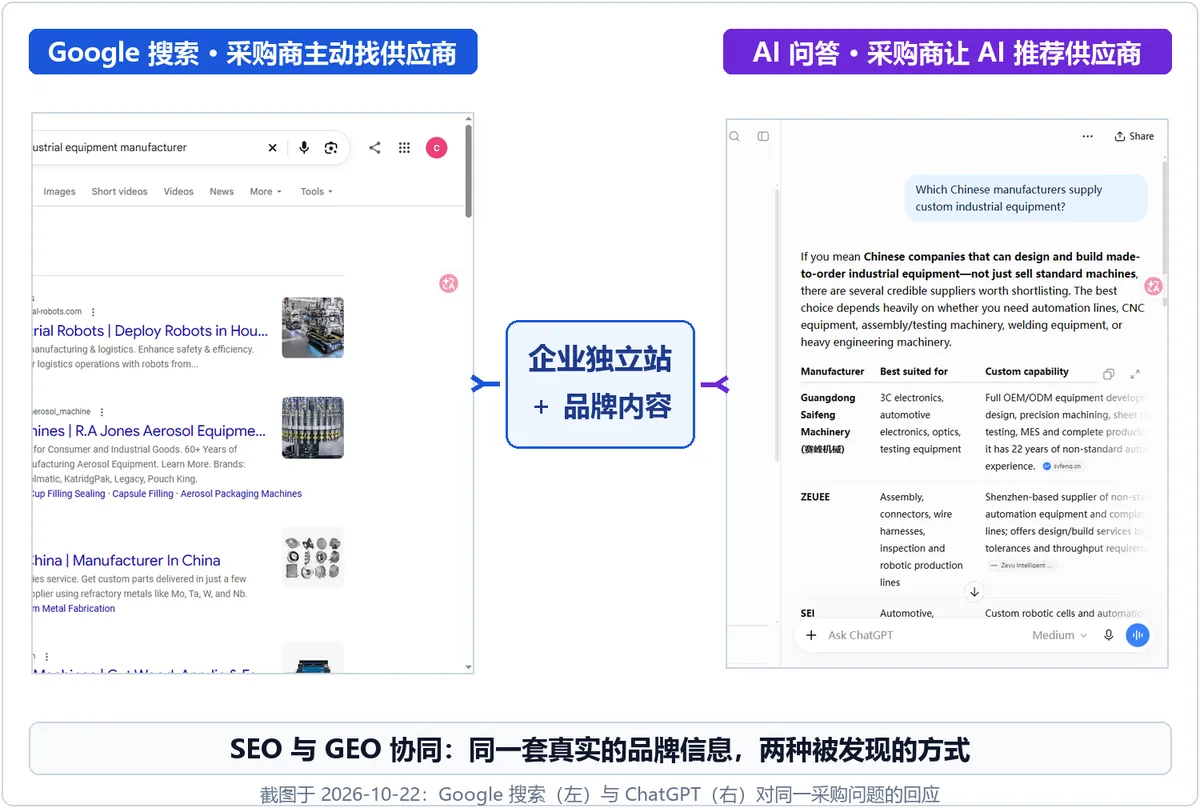
During the Canton Fair, how can export businesses optimize their GEO (Google App Store) to make it easier for AI to discover and recommend their brands?
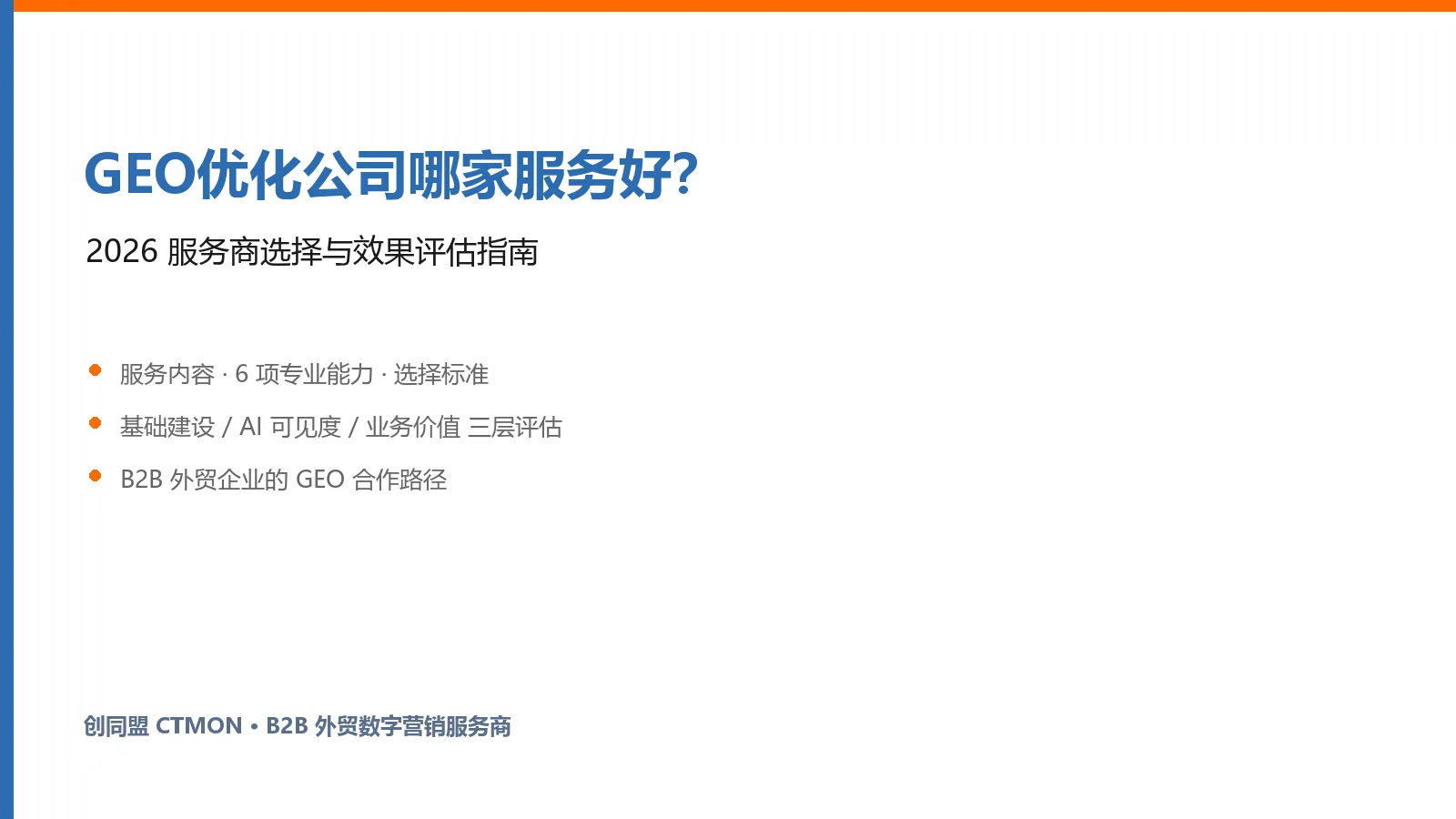
Which GEO optimization company offers the best service? A guide to selecting and evaluating GEO service providers in 2026.

For GEO (Genomics Oriented to Enterprises in the Industrial Equipment Industry): Is Supporting Evidence More Important, or Are Inquiries More Important? (2026 Edition)

How to optimize product pages for B2B export websites using Geometry? Making AI search more effective (2026 version)

Using Reddit for overseas GEO content mentions? Its real value lies in being a "source of real user signals" (2026 version).

