Contents +
Practical Guide to Zero-Cost GEO for B2B Enterprises (2026 Edition)
Source: 创同盟
Date: 2026-09-12
Views: 846
After hearing about the importance of GEO (Generative Ecosystem Officer), many B2B companies' first reaction is: does this mean hiring more people and investing more money? Actually, for B2B companies, especially export-oriented manufacturing companies, the most cost-effective aspect of GEO is precisely this: it doesn't rely on massive budgets, but rather on systematically transferring content that was previously only in sales scripts, salespeople's WeChat messages, and the boss's mind to the web, transforming it into signals that AI can extract. The following five actions don't require additional budgets, but they do require you to truly use your brain.
First, clarify: What exactly are the B-end GEOs vying for?
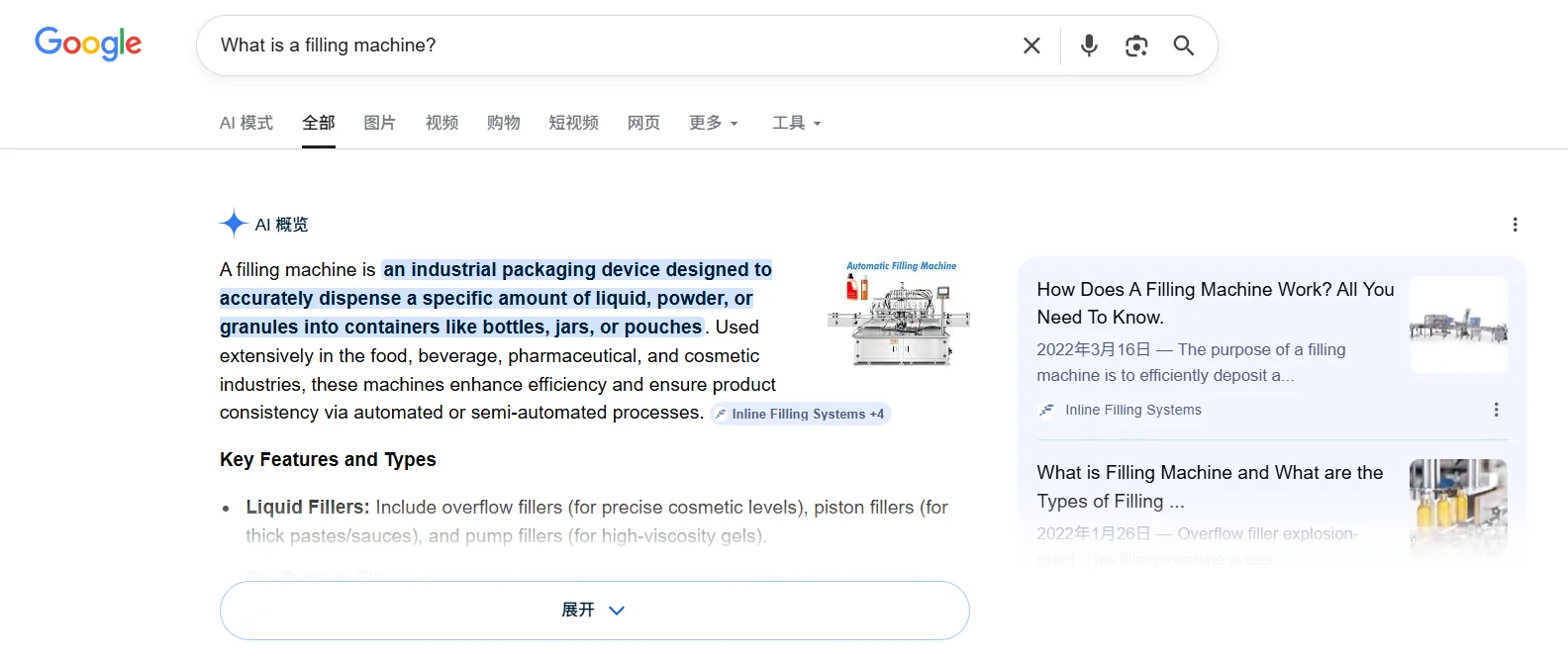
B2B procurement involves a long chain of processes and many stakeholders. Behind every equipment purchase, there are often multiple roles, including the owner, procurement, technology, production, equipment, and finance. Customers won't immediately search for your brand name; instead, they'll start with questions like "What is this? How do I choose it? Compared to others? Is it worth it?"
Therefore, what GEOs are arguing about is not "where my webpage ranks," but rather: when customers ask questions to ChatGPT, Perplexity, Gemini, or Google AI Overview, does AI include you as part of the credible answers? Can it mention you in its answers, clearly describe who you are, and connect you to specific application scenarios?
This determines that the approach to B2B GEOs is completely different from that of pure C2C brand exposure: you don't need a massive content bombardment, what you need is—a clear, authoritative, and verifiable piece of content waiting for you on every key issue in the client's decision-making process.
II. Zero-cost first step: Create a "Customer Problem Map"
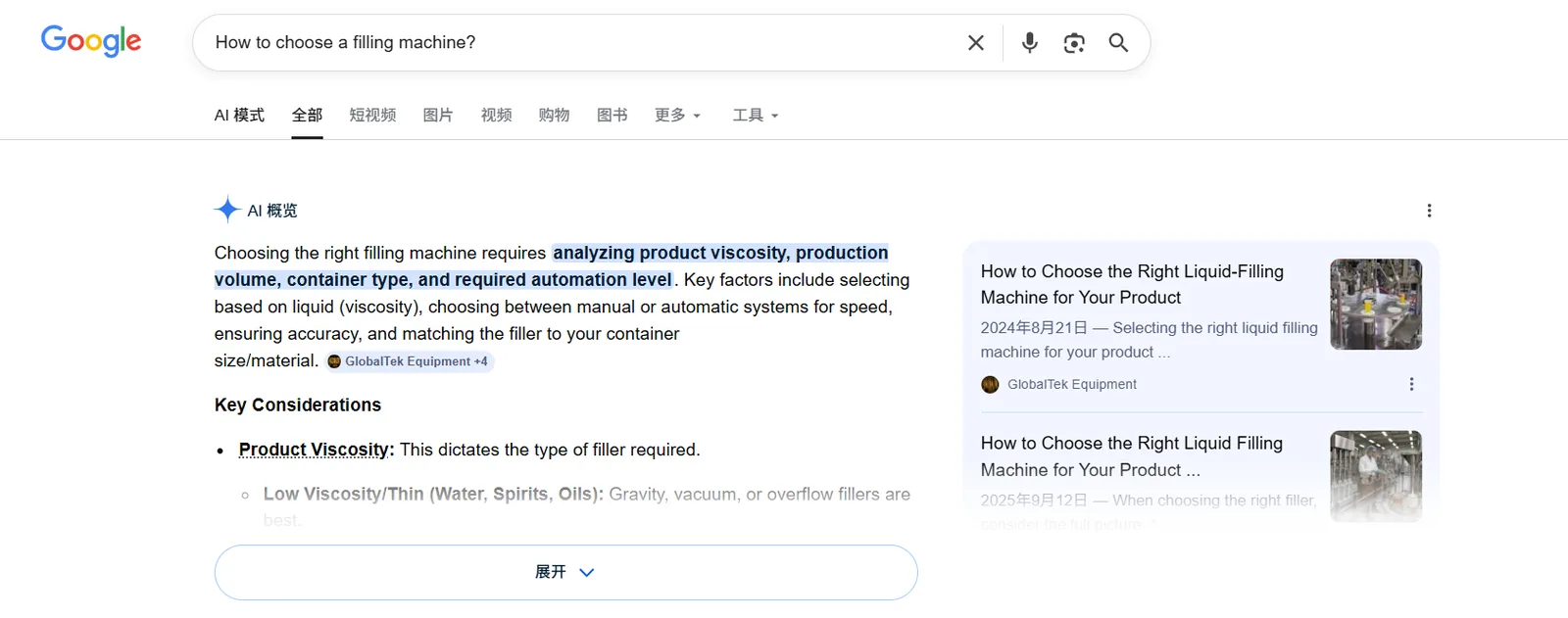
Most companies start their GEO (Government Operations Officer) program by simply "publishing articles," only to find that AI (AI technology) doesn't mention them afterward, leading them to believe that GEO is useless. The root cause is often that the content published is something that clients are never asking about.
The first step in becoming a GEO is to understand the customer's problems and break them down into a "problem map" according to the procurement stage. The following table can be directly applied:
| Procurement stage | What state is the customer in? | Typical problems (examples) | The content to be built |
|---|---|---|---|
| ① Cognitive stage | The specific plan is still unknown. | What is XX product? Why does a company need XX solution? What business problems can XX solve? | Definition-based popular science articles and industry pain point articles |
| ② Evaluation Phase | Start comparing different options | How to choose an XX supplier? What are the selection criteria for XX? What are the differences between XX and YY? | Selection Guide, Solution Comparison |
| ③ Comparison Phase | Put you and your competitors together | What are some similar manufacturers in China? What are the differences between Company A and Company B's products? What are some alternative solutions? | Comparison of competing products/alternative solutions and scenario adaptation instructions |
| ④ Decision-making stage | Focus on cost, risk and implementation | How much does XX cost? How long is the implementation period? Does it support custom molds? Does it comply with ISO/security standards? | Case studies, pricing logic, compliance qualifications, and implementation process |
Where to collect questions? Don't guess. Businesses can gather information from six sources: sales call recordings, customer service tickets, official website forms, Google search term reports, industry community discussions, competitor websites and industry forums —you can even look at the current answers from AI tools to see what customers are asking. Compile this into a table, labeling "Question Stage / Customer Intent / Priority / Corresponding Content Format," and GEOs will shift from "blindly publishing content" to "building AI content assets around real customer decision-making issues."
The third and fifth categories of content are most easily cited by AI.
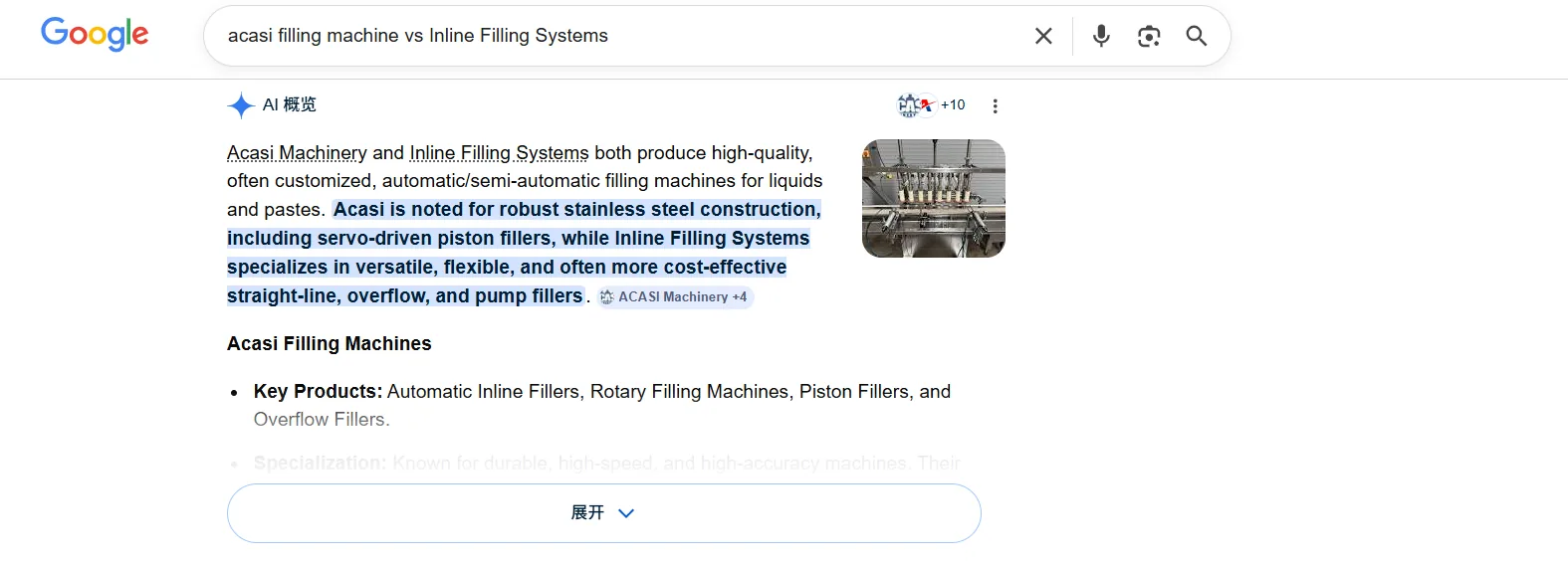
B2B businesses, in particular, should reduce vague promotional materials and produce more content that helps customers "judge and make decisions." AI prefers to cite clear, authoritative, structured, and verifiable content. Our tests show that the following five types of content are most frequently mentioned and cited by AI:
| Content type | Example | Why do AIs love to quote? |
|---|---|---|
| ① Definition type | What are filling machines and labeling machines? | Help AI understand the boundaries of your professional field and build entity cognition |
| ② Selection Guide | How a cannery should choose a glass bottle filling machine. | By directly addressing customers' purchasing questions, AI provides a natural reference source for answering the question "how to choose". |
| ③ Comparison type | Solution comparison, competitor comparison, alternative solutions | When AI answers "which is better/what are the differences", it needs neutral and comparable sources of information. |
| ④ Case-based | Industry + Pain Points + Solutions + Cycle + Quantifiable Results | B2B clients need to trust evidence, and AI also needs evidence to determine if you "truly did it." |
| ⑤ FAQ | Long Tail Problems | Naturally compatible with AI, it directly extracts answers with broad coverage. |
Case studies deserve the most attention. A high-quality B2B case study should include: the client's industry, business pain points, solutions, implementation timeline, quantifiable results, and client feedback. These are the hard evidence for clients to make trust judgments, and also key signals for AI to determine "whether this company has real delivery capabilities."
Example of citation: [A packaging equipment manufacturer's blog "a practical solution for small bottle handling"]( https://acasi.com/blogs/news/a-practical-solution-for-small-bottle-handling) ) — This type of article, which combines "specific problems with specific solutions," is exactly the type that AI likes to extract.
Fourth, the page should be "disassembled": a structure that can be directly copied.
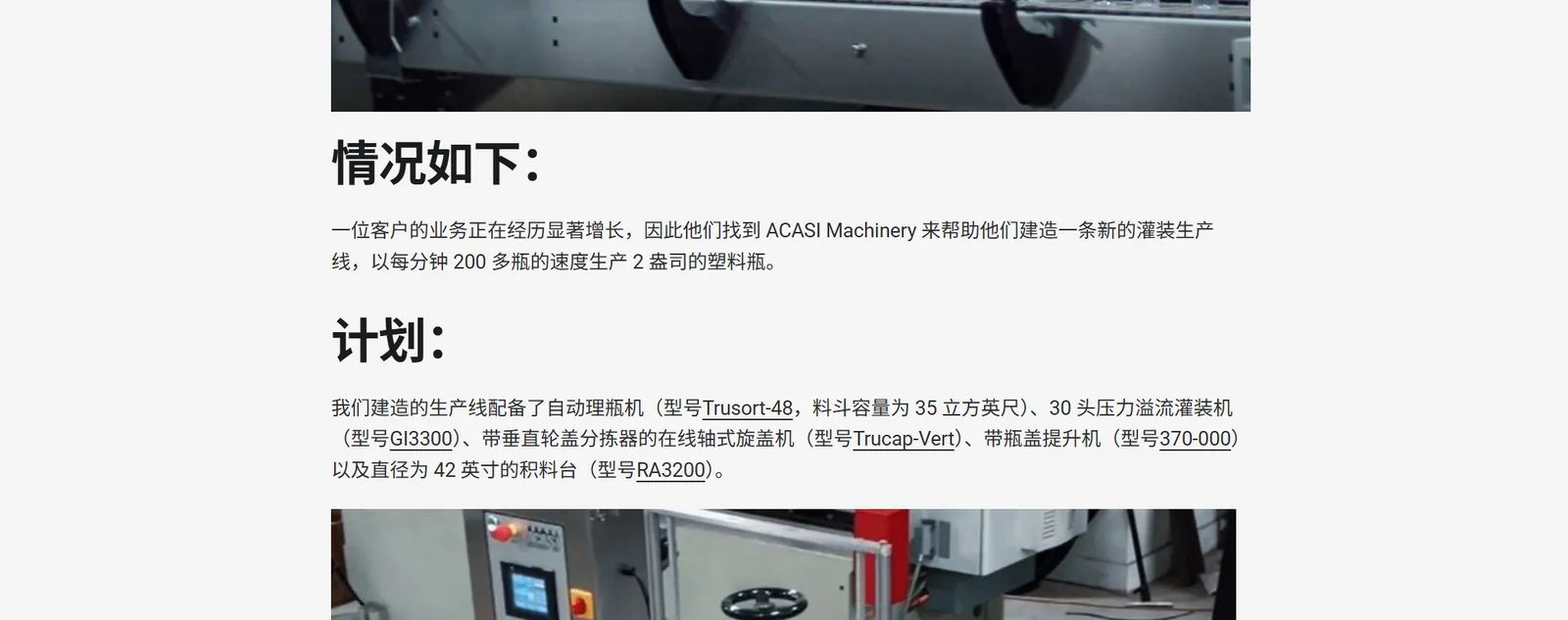
GEO isn't just about writing long articles; it's about making them easy for AI to understand, break down, and reference. Every piece of content should have a clear information structure. A suitable B2B page for GEO can be structured using the following framework:
- The title directly addresses the customer's question, such as "How should a cannery choose a glass bottle filling machine?"
- The opening paragraph provides a clear answer, allowing AI to quickly extract the core conclusion without reading the entire text.
- The main body of the text should be clearly structured and ideally include: Problem Definition → Applicable Enterprise Types → Typical Business Scenarios → Core Pain Points → Solution → Selection Criteria → Product Capability Comparison → Implementation Process → Cost Structure → Risk Warnings → Customer Cases → Frequently Asked Questions → Update Time → Author/Expert Information
The essence of this structure is to reduce the "extraction cost" of AI. The clearer and more structured your answers are, the easier it is for AI to use you as a source when generating responses.
V. Channels are not limited to the official website: Official website + third-party platforms + knowledge platforms
AI doesn't just read your official website; it also integrates third-party content and public network signals. Therefore, B2B companies should combine "official website + authoritative third-party platforms + industry-specific distribution":
| Channel type | Specific channels | effect |
|---|---|---|
| Official website | Industry solution page, product page, case study page, resource center, FAQ page | AI understands the foundation of a brand; the most controllable signal. |
| Industry media/vertical platforms | Manufacturing media reports, columns, and industry white papers | Establishing third-party endorsement enhances credibility. |
| Knowledge-based content platform | Overseas platforms such as LinkedIn, YouTube, Quora, and Reddit | Continuously outputting consistent and professional content to create a tangible brand message. |
Different platforms have different weighting and crawling patterns, resulting in uneven short-term effects. However, the core logic remains the same: consistently delivering consistent, professional content across multiple trusted touchpoints makes it easier for AI to associate your brand with a particular field.
VI. How to determine if GEO is working: Manual reverse lookup + dashboard analysis

In the zero-cost phase, expensive tools aren't necessary; two things can keep the results in mind:
① Manual reverse audit . Prepare 50-100 standard questions covering seven categories: cognition, selection, comparison, alternatives, price, industry solutions, and implementation risks. Ask these questions regularly using various AI tools, including ChatGPT, Perplexity, Gemini, and Google AI Overviews . Record: Did the AI mention you? How accurate was the description? Did it connect you to a specific scenario?
② Build a lightweight dashboard . Businesses can also track these metrics using existing tools such as SEMrush and GA4: AI mention rate, citation rate, description accuracy, competitor coverage, brand search volume, high-intent page views on the official website, and lead conversion rate . Don't rush into everything; start by looking at the "mention rate" and "brand search volume" metrics.
VII. Three essential technical steps for zero-cost foreign trade website operations
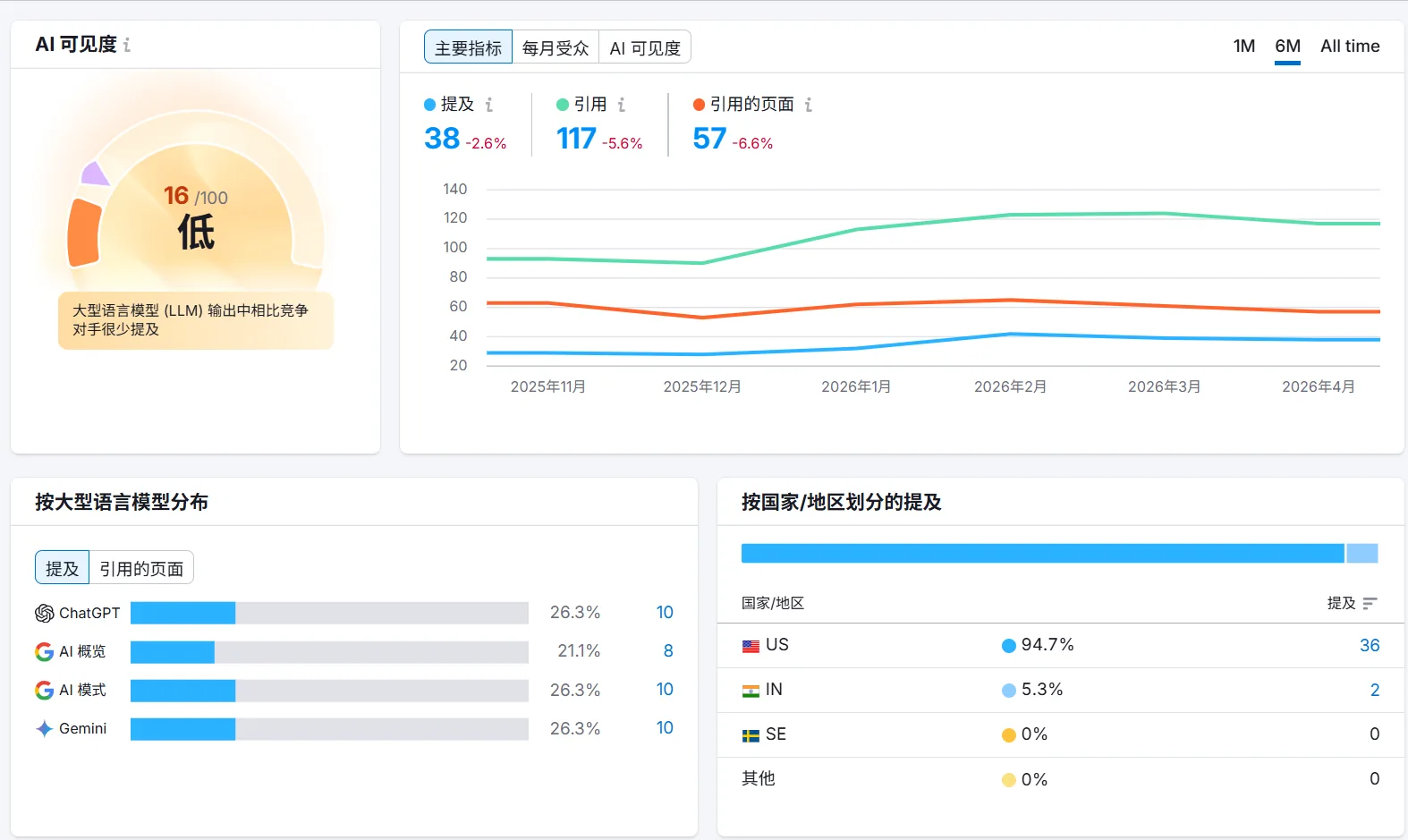
The first six points are mostly content-related actions. This section covers technical actions that many export businesses overlook, but which are zero-cost and can be checked in ten minutes —especially if you've been working as a GEO for six months and haven't seen any progress. Check here first:
- Allow AI crawlers . Check `robots.txt` to ensure that `GPTBot` , `PerplexityBot` , `OAI-SearchBot` , `ClaudeBot` , etc., are not blocked. Many websites mistakenly block these crawlers in an attempt to "save traffic," effectively giving up their eligibility to be cited by AI.
- Add a `llms.txt` / `llms-full.txt` . Use a clean text file to tell the AI what your site's core pages are and what each page tells. This is currently the lowest-cost and most clearly defined "map for the AI."
- Multilingual `hreflang` bidirectional annotation + regionalized Organization schema . Foreign trade websites often have multilingual versions, and incorrect annotation can confuse AI about your market affiliation; use a schema to clearly state "which country you are from and which markets you serve".
This step is completely consistent with the technical aspect emphasized in "Conclusions from 30 GEO Projects"—content determines "what to say when cited," while technology determines "whether one is qualified to be cited."
Frequently Asked Questions (FAQ)
Q1: Is it really possible to do GEO with zero budget?
Yes. GEO's core investment is "clarifying the client's problem + writing out the structured answer," neither of which requires an advertising budget. What really needs to be spent is on subsequent tool monitoring and channel distribution, but in the initial stage, you can focus on content and technology self-checks first.
Q2: Where should we start collecting customer issue maps?
The cheapest starting point is your sales and customer service: call recordings, support tickets, and questions in forms—all questions that customers are actually asking. Next, look at Google Search Console reports, as well as competitor website FAQs and blog comment sections.
Q3: Which type of content should be prioritized?
Sort by "Citation Probability × Conversion Value", with the following recommended priority: Selection Guide > Case Studies > Comparison > FAQ > Definitional. Selection Guides and case studies are closest to purchasing decisions and offer the highest ROI.
Q4: How long should a GEO article be?
Don't pursue length, pursue "correct structure". It is recommended that each article revolve around a clear problem, state the conclusion in the beginning, and divide the body into layers of "problem - scenario - solution - evidence". 800-1500 Chinese characters are often more effective than 3000 words of fluff.
Q5: Is posting only on the official website enough?
That's not enough, but the official website is the foundation. First, solidify the solution pages, product pages, case study pages, and FAQs on the official website, and then distribute them consistently to industry media and overseas knowledge platforms (LinkedIn / YouTube / Quora / Reddit) to create a multi-touchpoint message.
Q6: How can I quickly check if I've been mentioned by AI?
Prepare 50–100 real customer questions and ask them in ChatGPT, Perplexity, Gemini, and Google AI Overviews. Observe whether the AI mentions you, whether the description is accurate, and whether it is related to your scenario. Record the changes weekly.
Q7: What is the relationship between GEO and the original SEO?
SEO ensures you are "seen" in search results, while GEO ensures you are "cited" in AI-generated answers. Both rely on good content, good structure, and good technology, but GEO places greater emphasis on "answers that can be directly extracted" and "multi-touchpoint credible signals."
Q8: I've been working on this for two or three months and haven't received any inquiries. Is my method wrong?
Not necessarily. The path to effectiveness for B2B GEOs is usually longer: first, AI visibility, then building trust, and finally inquiries. In the first few months, the focus is on "whether it is mentioned correctly and whether brand search increases," rather than monitoring the number of inquiries.
What can be done next?
If you want to know where your site is in this methodology, you can start by doing something cost-free: ask 20 real customer questions in ChatGPT, Perplexity, and Gemini, and see if the AI mentions you and how accurate the descriptions are . Write down the results; this will be your first GEO baseline.
Starting with low barriers to entry: a three-step approach
GEO doesn't have to be done all at once. It should be implemented in three steps, from lowest to highest cost:
- First, perform a basic health check (lowest cost, fastest results): loading speed, mobile adaptation, whether robots.txt allows AI crawlers, whether the sitemap has been submitted, and whether semantic tags are standardized.
- Prioritize supplementing core structured data : Organization, Product, Article, and FAQ should be added first, and verified using validator.schema.org .
- Gradually improve the full-intention content : First, do a good job with the solutions, case details, and reputation collection, and then add industry insights and long-tail issues.
This sequence is precisely to obtain the basic qualification of "being seen by AI" with minimal investment.
About this article : This article was written by the CTMON overseas digital marketing team. We provide GEO and B2B export website content creation services for industrial equipment and manufacturing companies in the B2B digital marketing field.
Data Scope Explanation : The methods described in this paper are based on general practices and publicly available case studies of B2B GEOs. Screenshots from third-party websites cited are publicly available page examples and are used only for methodology illustration; they do not imply that the results were generated by our company. Specific project start and end years are not mentioned in the paper, and the conclusions are interval observations, not committed values. Different industries, website infrastructure, and content investment will significantly affect the actual timeframe.
Related Reading
- [Conclusions after completing 30 GEO projects? How long does it take to see results, and what's the correct approach?] ( https://www.ctmon.com/newsdetail/geo-30-projects-conclusion.html) )
- [Why must a B2B export website adapt to AI search in 2026?] ( https://www.ctmon.com/newsdetail/waimao-dulizhan-weihe-bixu-shipei-ai-sousuo.html)
- [A business website has traffic but no inquiries; what's the problem?] ( https://www.ctmon.com/newsdetail/waimao-dulizhan-liuliang-xunpan.html) )
- [Buyers ask 5 types of questions, but your business website only answers 1]( https://www.ctmon.com/newsdetail/waimao-dulizhan-mai-jia-wu-lei-wen-ti.html) )

What does international social media management service include? 2026 Guide to Social Media Management for Export Businesses
2026-10-28

How to write a WordPress product page that will make overseas buyers want to send inquiries?
2026-10-28

How to fix WordPress form emails not sending: Practical WP Mail SMTP configuration
2026-10-27

Are foreign trade promotion companies reliable? Six key criteria for businesses to judge promotion service providers in 2026.
2026-10-26

How do I set up an email account for export businesses? How can I configure it to avoid it ending up in the spam/junk mail folder?
2026-10-26
Related Articles
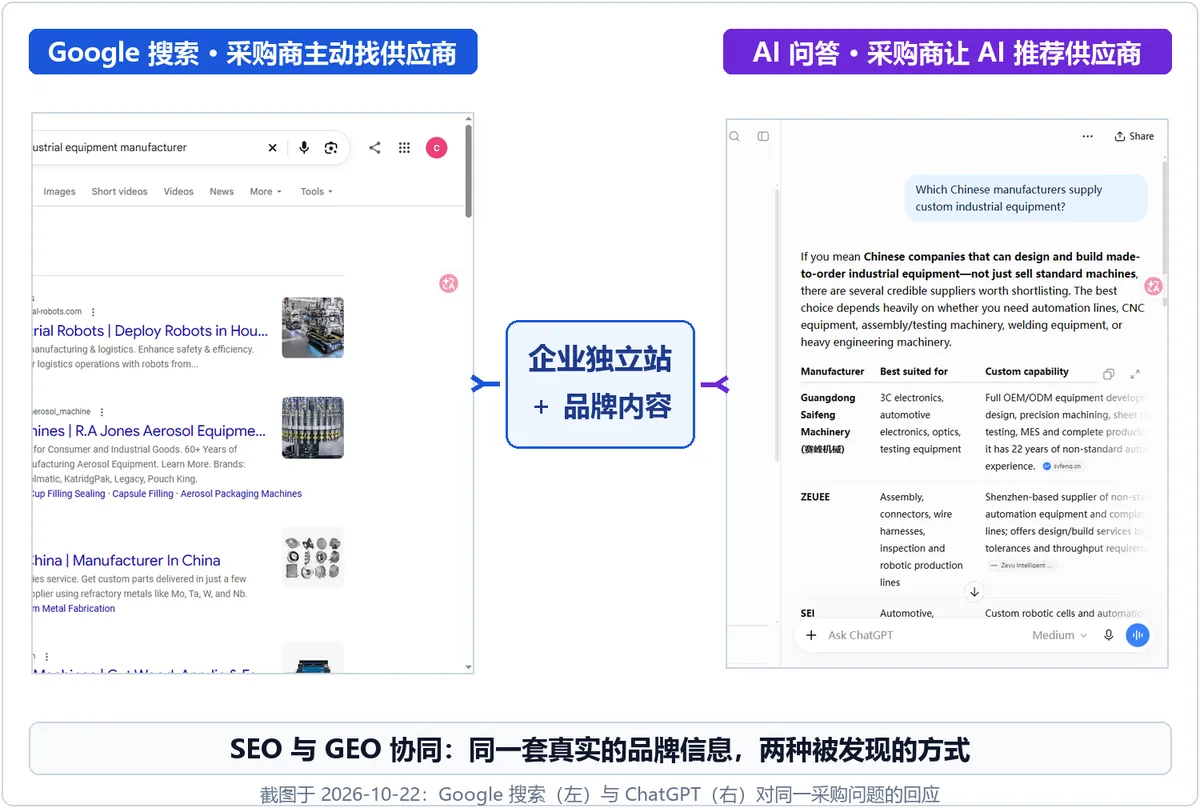
During the Canton Fair, how can export businesses optimize their GEO (Google App Store) to make it easier for AI to discover and recommend their brands?
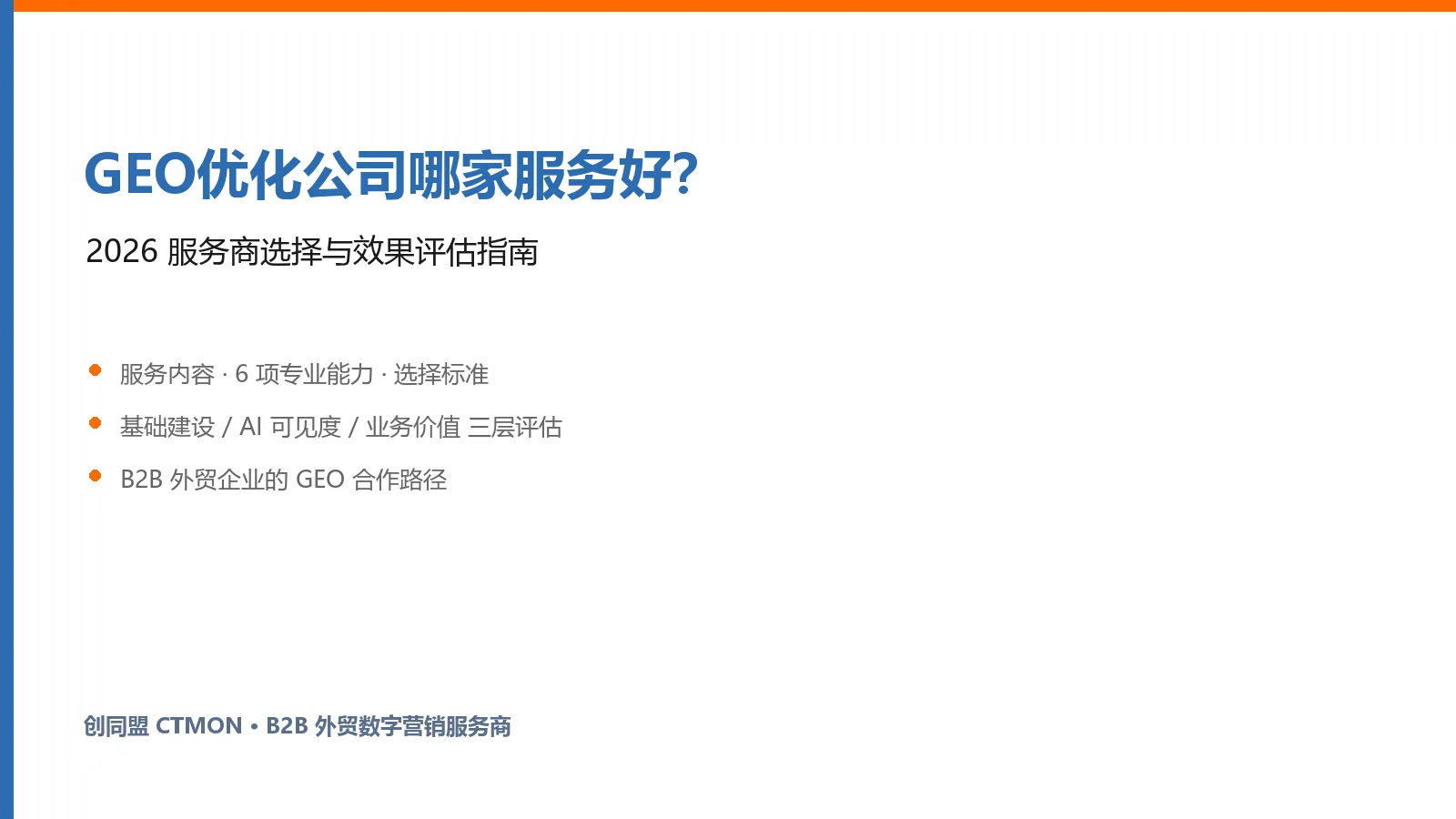
Which GEO optimization company offers the best service? A guide to selecting and evaluating GEO service providers in 2026.

For GEO (Genomics Oriented to Enterprises in the Industrial Equipment Industry): Is Supporting Evidence More Important, or Are Inquiries More Important? (2026 Edition)

How to optimize product pages for B2B export websites using Geometry? Making AI search more effective (2026 version)

Using Reddit for overseas GEO content mentions? Its real value lies in being a "source of real user signals" (2026 version).

