Contents +
For GEO (Genomics Oriented to Enterprises in the Industrial Equipment Industry): Is Supporting Evidence More Important, or Are Inquiries More Important? (2026 Edition)
Source: 创同盟
Date: 2026-09-16
Views: 962
Let's break this down and explain it clearly—why inquiries aren't the primary objective, what exactly constitutes supporting evidence, and what role GEO truly plays in areas unseen by the customer.
I. A common misconception: using the number of inquiries to measure GEO
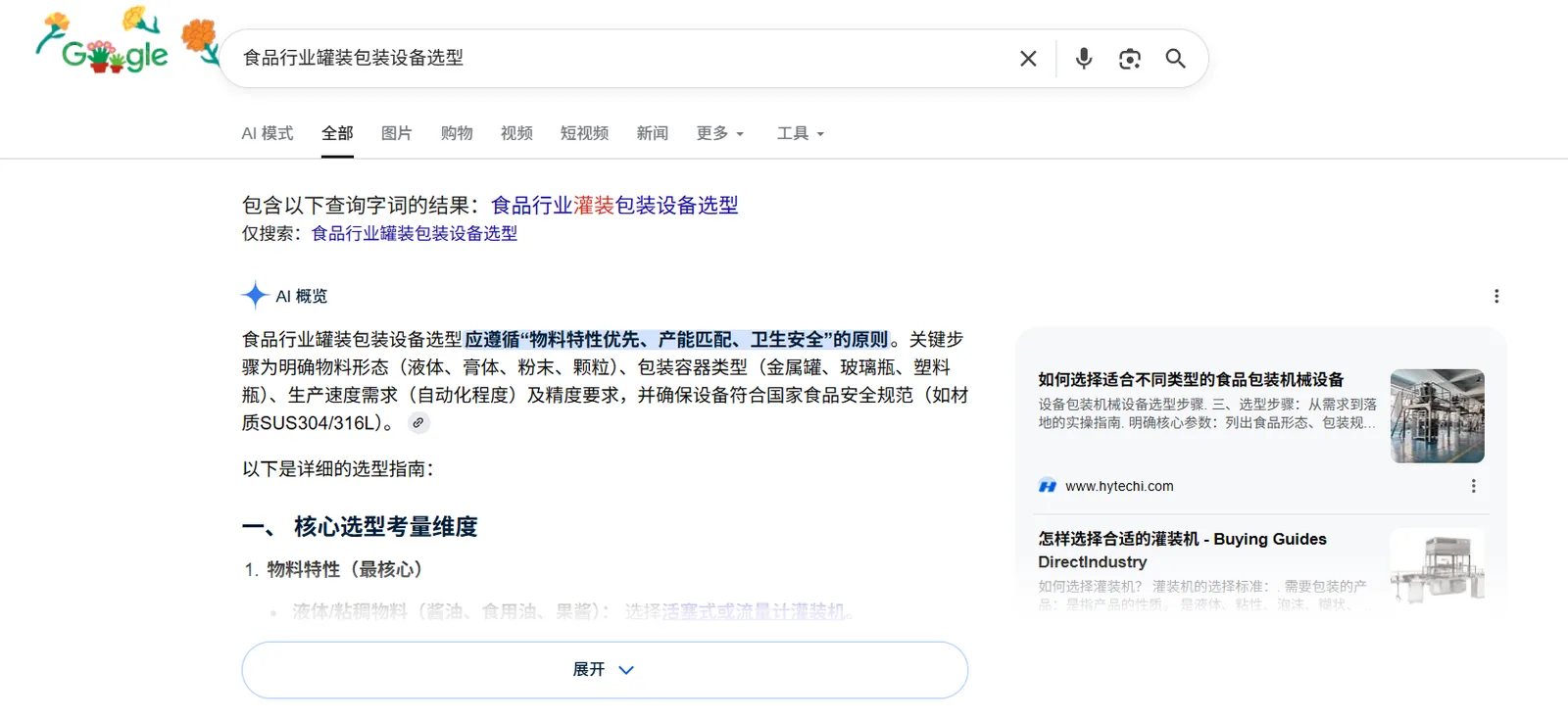
Industrial equipment is a high-priced product. Customers won't immediately submit a form or call to inquire about a price just because they "see a certain brand in the AI's answer." Behind a purchasing decision, there are often multiple roles involved, including the boss, purchasing, technology, production, equipment, and finance.
Therefore, judging the value of a GEO solely by the "number of inquiries" easily leads to the conclusion that it's "useless" and prompts abandonment. However, the reality is that clients typically conduct extensive research before issuing formal inquiries—searching for equipment types, comparing different solutions, understanding common brands, reviewing case studies, and confirming the supplier's relevant experience. This is precisely the crucial stage where a GEO can be effective, and it doesn't directly generate inquiries.
II. The Special Characteristics of Industrial Equipment Procurement: Why Evidence Takes Priority Over Inquiries
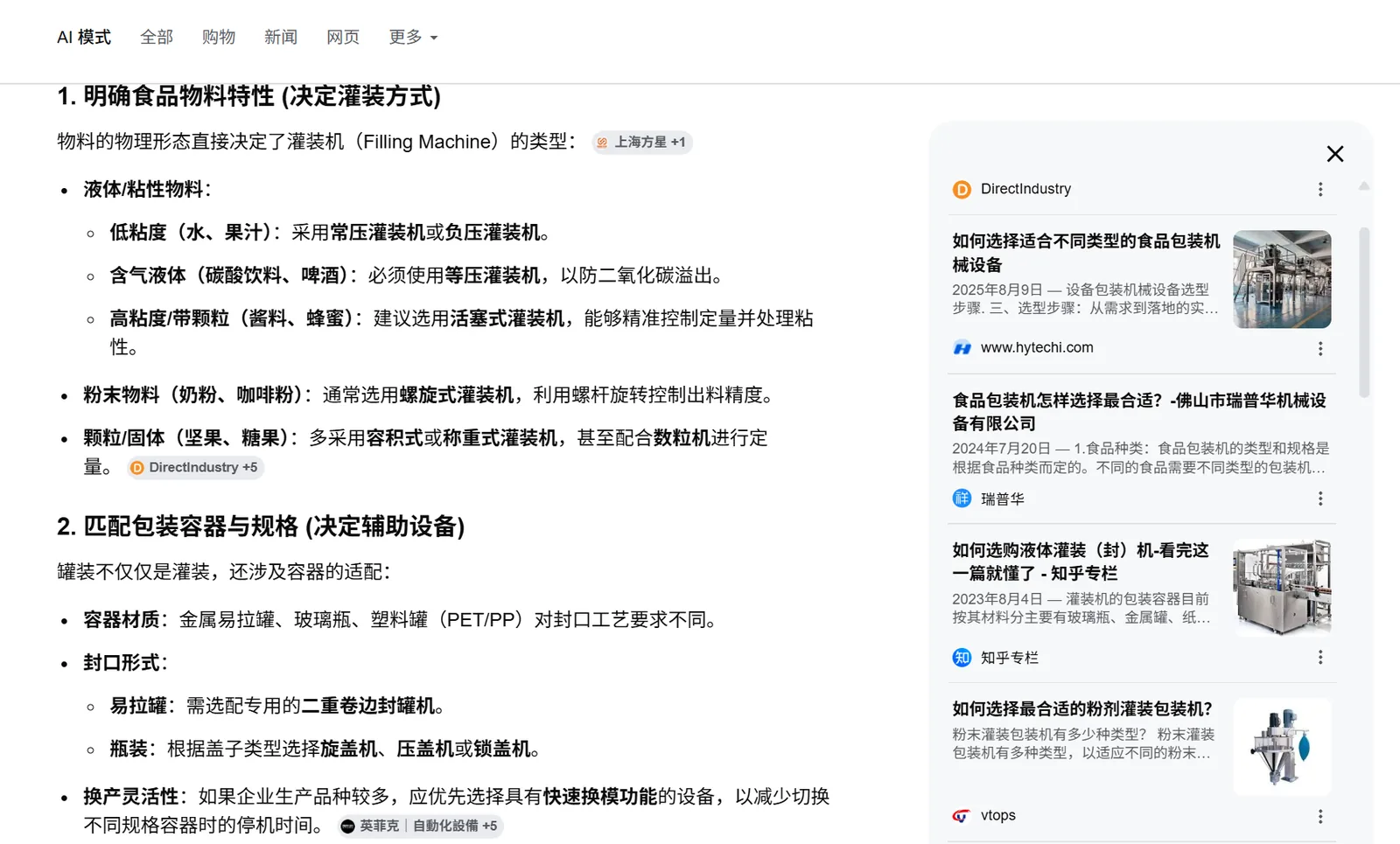
To understand GEO's value ranking, first look at the characteristics of industrial equipment procurement:
- High average order value : The decision-making risk is high, and customers will not place an order lightly.
- Multiple roles are involved : the technical team looks at the parameters, the procurement team looks at the costs, the management team looks at the risks, and the production team looks at the implementation.
- Long cycle : From awareness to transaction, it often takes several months or even longer.
- High trust threshold : Customers need to confirm that "you have really done it before, you really understand it, and you can really deliver it".
This means that clients have already completed the first round of screening in their minds before even contacting you. The true value of GEO lies in this invisible screening process , enabling businesses to be seen, understood, trusted, and included on the shortlist. Only by becoming a "trusted option" can subsequent inquiries, quotations, sampling, and solution discussions occur.
III. The Real Role of GEO in Industrial Equipment
Specifically, when it comes to AI tools, GEO's role is to ensure that AI tools like ChatGPT, Perplexity, and Gemini can correctly understand, reference, and recommend your company when answering user questions.
For industrial equipment companies, this is equivalent to: when a potential customer inquires—
- Which manufacturers produce this type of equipment?
- How to choose a supplier for a particular type of equipment?
- "How should the equipment parameters be selected under certain operating conditions?"
Will AI mention you? Will it describe you as a "professional, reliable supplier that matches the application scenario"?
If so, you've entered the customer's candidate list; if not, no amount of advertising later can make up for it.
IV. What is "supporting evidence"? It's not just something that appears once, but rather repeatedly confirmed.
The so-called corroborating evidence is not just about "getting the brand to appear once in the AI's response," but about getting customers to repeatedly confirm through multiple touchpoints that the company truly understands the industry, has indeed done similar projects, and truly possesses the technical and delivery capabilities.
Industrial equipment customers value factual evidence most. A page that can be recognized and presented as "credible evidence" by AI typically includes these elements:
| Supporting elements | effect |
|---|---|
| Real-world case studies (industry/pain points/solutions/cycle/results) | Prove "you really did it" |
| Specific parameters and technical specifications | Prove you "know your stuff". |
| Application scenario description | Prove that "you meet my needs". |
| Certification and compliance qualifications (ISO / CE, etc.) | Reduce procurement risk assessment |
| On-site photos, equipment videos, and test data | Enhance realism and credibility |
| Industry Solutions | Demonstrating system capabilities, not just individual products. |
| After-sales service and spare parts capabilities | Prove that it can be delivered and that it can provide a safety net. |
Only when this content is recognized, organized, and presented by AI can it become an important basis for customers to judge the credibility of a company.
V. The Influence Path of GEOs: From Visibility to Shortlisting to Inquiries
From the perspective of the customer decision-making process, the role of the GEO is typically transmitted in the following way:
- Customers first use AI or search to understand the direction of equipment selection;
- Then I saw certain brands being mentioned repeatedly;
- Next, verify the information by visiting the official website, industry platform, case study page, or product information page.
- If a company's information is complete, its case studies are authentic, and its technical explanations are clear, it has a chance to be included in the candidate list.
- Finally, the client initiates inquiries, RFQs, drawing communication, or technical exchanges.
In other words, inquiries are the backend results, while supporting evidence is the foundation for the frontend. Without supporting evidence, it's difficult for inquiries to be generated in a high-quality manner. If GEOs only pursue "immediate inquiries," companies are prone to turning content into advertising-style pages, neglecting the technical content, case studies, and industry content that truly impact AI judgment and customer trust.
VI. How to evaluate GEO effectiveness in stages?
Since supporting evidence precedes inquiries, the evaluation system should also be tiered. It is recommended that industrial equipment companies consider indicators in three stages:
| stage | What to look at? | Typical signal |
|---|---|---|
| ① AI visibility | Did the AI mention you? Was the description accurate? | When users search for "recommended equipment manufacturers for XX / equipment selection for XX industry", can AI be associated with you and can it be linked to specific scenarios? |
| ② Trust Enhancement | Do customers proactively come to verify? | Increased brand keyword searches, improved direct access to the official website, increased visits to case studies/parameters/solutions/download pages, and sales feedback saying "We see you in AI." |
| ③ inquiry conversion | High-quality business opportunities | The focus is not on the number of ordinary inquiries, but on high-quality RFQs, inquiries with drawings, inquiries with parameters, target industry customers, prototype testing requirements, and solution communication and scheduling. |
Note the wording in the third stage: inquiries should be a lagging indicator, not the sole indicator. Focusing solely on the number of inquiries will lead you to reject a GEO before the supporting evidence is even established.
VII. Conclusion: Provide supporting evidence first, then conduct inquiries.
Returning to the initial question—for B2B companies in the industrial equipment sector, is it more important for GEOs to provide supporting evidence or to conduct inquiries?
The answer is: provide supporting evidence first, then conduct inquiries; supporting evidence determines whether a candidate is shortlisted, while inquiries are merely the result after shortlisting.
For industries like industrial equipment, characterized by high-value, long-cycle, and high-trust decision-making processes, clients have already completed a screening process in their minds before even contacting a company. GEO's true value lies in this invisible screening process, enabling companies to be seen, understood, trusted, and placed on the shortlist. Only by becoming a trusted option can subsequent inquiries, quotations, sampling, solution communication, and ultimately, a deal be possible.
Therefore, industrial equipment companies conducting GEO (Government Operations Officer) should not only ask "how many inquiries can it generate?", but should instead ask three questions:
- When customers use AI to find solutions, are we qualified to be recommended?
- When customers compare suppliers, can AI explain the advantages for us?
- When clients report internally, can our content be considered credible evidence?
8. Technical aspects of foreign trade websites: No matter how good the supporting evidence is, it's all for nothing if it's blocked.
One more reminder: all the supporting evidence above is based on the premise that the AI crawler can "read" it. We have seen the same problem on multiple industrial equipment websites— `robots.txt` mistakenly blocks `GPTBot` , `PerplexityBot` , `OAI-SearchBot` , and `ClaudeBot` , causing your painstakingly built case study pages and parameter pages to be unable to enter the AI's corpus.
Zero-cost self-inspection:
- Check `robots.txt` to confirm that the AI crawler has not been blocked;
- Add `llms.txt` / `llms-full.txt` and list the core case study page, solution page, and product page to AI;
- Use `Organization` schema + multilingual `hreflang` to clearly state "who you are and which markets you serve".
Content determines "what is said when cited," while technology determines "whether it is qualified to be cited"—this applies to all GEO articles.
Frequently Asked Questions (FAQ)
Q1: Why can't the number of inquiries be used to measure GEO?
Industrial equipment procurement involves multiple roles and a long cycle, with clients conducting extensive research before even issuing formal inquiries. GEOs primarily play a role in the research and shortlisting stages; focusing solely on the number of inquiries underestimates their value and can easily lead to premature abandonment.
Q2: What is the primary goal of GEO (Government Operations) for industrial equipment?
It's about "credible evidence" and "supplier shortlisting," not immediate inquiries. Let AI first list you as a professional and reliable candidate when customers ask "which one is good."
Q3: What is "supporting evidence" in GEO?
It's not about a single brand appearance; it's about clients repeatedly confirming your industry expertise, project experience, technical capabilities, and delivery skills through multiple touchpoints. This requires supporting evidence such as case studies, specifications, scenarios, certifications, on-site photos, and test data.
Q4: What supporting evidence is required?
It should include at least: real-world case studies (industry/pain points/solutions/cycle/results), specific technical parameters, application scenario descriptions, certification and compliance, on-site photos and videos, industry solutions, and after-sales and spare parts capabilities.
Q5: What is the impact path of GEO on industrial equipment?
From AI visibility assessment to customer verification on the official website/platform, complete information is shortlisted for the next stage, and only then are inquiries or technical exchanges initiated. Inquiries are the backend results, while supporting evidence is the frontend foundation.
Q6: How to evaluate the effectiveness of GEO in stages?
The system is divided into three layers: ① AI visibility (whether it is mentioned accurately); ② Trust enhancement (brand search, direct access, case study page visits, sales feedback); ③ Inquiry conversion (viewing high-quality RFQs, inquiries with drawings/parameters, rather than the number of ordinary inquiries).
Q7: Why can't we just create ad-style pages?
The ad page lacks technology, case studies, and industry content, making it difficult for AI to regard it as a credible source of information. Customers also cannot find evidence when verifying it, making it difficult to enter the candidate list and naturally resulting in a lack of qualified inquiries.
Q8: Where should small and medium-sized industrial equipment companies start with GEO?
First, identify your verifiable assets (case studies, parameters, certifications, on-site photos), then structure them and upload them to the corresponding pages on your official website. Next, check whether the technical layer has enabled AI web scraping.
Five common misconceptions about GEO
Doing it wrong is worse than doing nothing. Five common pitfalls for B2B GEOs in foreign trade:
- Focusing solely on visual aesthetics while neglecting AI readability : If semantic and structured code markings are not implemented, AI will not be able to understand it, rendering the efforts futile.
- Content that only piles up products without a comprehensive strategic layout : There's only a supplier layer, no problem layer or scenario layer, so AI can't see you in the early stages of user problems.
- Use third-party platforms instead of the official website : social media and online stores are "other people's land," while only the official website is a 100% controllable source of official information.
- Content published only once and not updated for a long time : AI will consider the information to have no lasting value and reduce its citation priority.
- Over-stuffing keywords and ignoring content value : The core of AI algorithms is "prioritizing valuable content," and keyword stuffing will actually lower the ranking.
Point 2 is precisely why this article repeatedly emphasizes "providing supporting evidence before conducting inquiries"—without a supporting evidence layer, the inquiry layer loses its premise for being recommended.
Next, you can do two things.
Low-threshold self-assessment : [Download the "GEO Competitiveness Self-Assessment Checklist"]( https://www.ctmon.com/newsdetail/geo-competitiveness-checklist.html)——它按 ) "Coverage → Intent → Interaction → Impact → Value" five layers, 10 minutes to test your brand's true position in overseas search engine responses such as ChatGPT, Perplexity, and Google AI Overviews.
High-intent diagnostics : [Book a free GEO diagnostic] (Did https://www.ctmon.com/newsdetail/geo-free-diagnosis.html),我们会基于你的品牌与品类,回答四个你最该知道的问题——AI mention you? How did it describe you? What blind spots are there in your intent hierarchy coverage? What did your competitors say that they got right?)
About this article : This article was written by the CTMON overseas digital marketing team. We provide GEO and B2B export website content creation services for industrial equipment and manufacturing companies in the B2B digital marketing field.
Data Scope Explanation : The industrial equipment sector is used as an example in this article. All website screenshots cited are publicly available third-party pages and are used only to illustrate the methodology; they do not imply that the results were generated by us. Specific project start and end years are not mentioned in the article, and the conclusions are based on common industry practices and are not guaranteed values.
Related Reading
- [Conclusions after completing 30 GEO projects? How long does it take to see results, and what's the correct approach?] ( https://www.ctmon.com/newsdetail/geo-30-projects-conclusion.html) )
- [Why must a B2B export website adapt to AI search in 2026?] ( https://www.ctmon.com/newsdetail/waimao-dulizhan-weihe-bixu-shipei-ai-sousuo.html)
- [Buyers ask 5 types of questions, but your business website only answers 1]( https://www.ctmon.com/newsdetail/waimao-dulizhan-mai-jia-wu-lei-wen-ti.html) )
- [A business website has traffic but no inquiries; what's the problem?] ( https://www.ctmon.com/newsdetail/waimao-dulizhan-liuliang-xunpan.html) )

What does international social media management service include? 2026 Guide to Social Media Management for Export Businesses
2026-10-28

How to write a WordPress product page that will make overseas buyers want to send inquiries?
2026-10-28

How to fix WordPress form emails not sending: Practical WP Mail SMTP configuration
2026-10-27

Are foreign trade promotion companies reliable? Six key criteria for businesses to judge promotion service providers in 2026.
2026-10-26

How do I set up an email account for export businesses? How can I configure it to avoid it ending up in the spam/junk mail folder?
2026-10-26
Related Articles
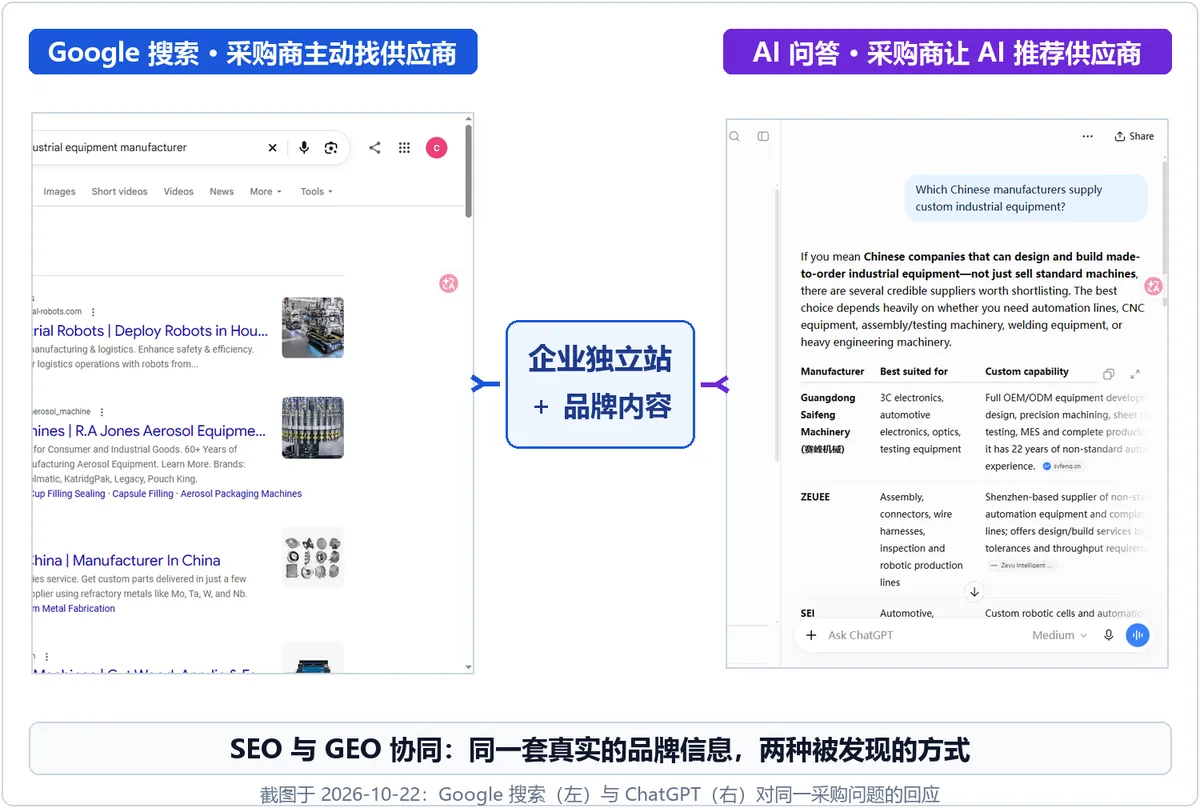
During the Canton Fair, how can export businesses optimize their GEO (Google App Store) to make it easier for AI to discover and recommend their brands?
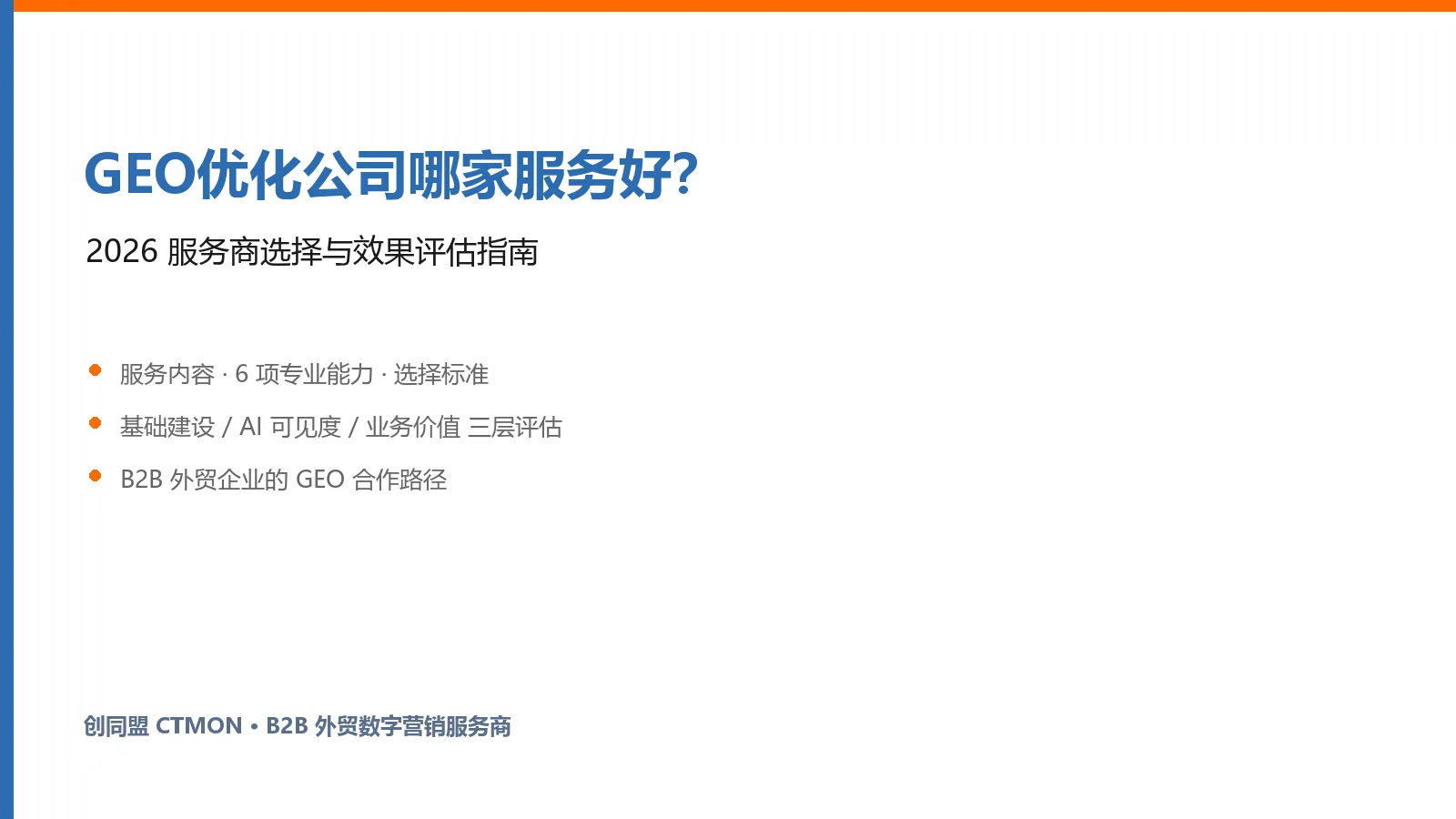
Which GEO optimization company offers the best service? A guide to selecting and evaluating GEO service providers in 2026.

How to optimize product pages for B2B export websites using Geometry? Making AI search more effective (2026 version)

Using Reddit for overseas GEO content mentions? Its real value lies in being a "source of real user signals" (2026 version).
How can B2B companies manually generate GEO brand mentions? First, build a content base, then reorganize it in reverse (2026 version).

