Contents +
Do businesses need to completely rebuild their official website when using GEO?
Source: 创同盟
Date: 2026-08-30
Views: 167
Having worked in B2B digital marketing for over a decade, the question I get asked most often lately is: "If we want to implement GEO (Generative Engine Optimization), do we need to completely rewrite our website first?"
Let's start with the conclusion: the vast majority of companies don't need to redo their official websites. GEO focuses on "content quality + a structure that AI can read," not visual redesign. What you really need to do is a "targeted assessment + partial modifications," not a complete overhaul.
Let me break this down and give you a checklist from the GEO website that you can easily check off.
First, a dose of reality: Why are people online saying "it needs to be redone"?

If you search for "company GEO," you'll see many voices telling you that "the official website needs to be redone." There are two reasons behind this, and you need to understand them:
- The motivation for selling shovels. Rebuilding the official website is a big deal, much more profitable than "helping you change the content structure". Packaging GEO as "necessary to be rebuilt" is most beneficial to the service provider.
- The concepts are confused. Many people confuse "GEO optimization" with "website redesign." But they are not the same thing: website redesign changes "whether it looks good to humans and whether the conversion path is smooth"; GEO changes "whether AI can understand you and whether it is willing to use you."
In short: GEO doesn't care how flashy your homepage is, it only cares whether your content is a "quotable answer".
II. What exactly is GEO "reading" from your official website (these can be changed without redoing)?

AI scans your official website, mainly looking at three things, and you basically don't need to redo them:
- The technology is crawlable. Can the page be indexed by Google/Baidu? Is the speed fast enough? Is it mobile-friendly? Is there structured data (JSON-LD)? — Adding code, installing plugins, and adjusting the server can solve these problems; it has nothing to do with "reworking".
- Content semantic structure. Are the heading hierarchy clear? Are key concepts clearly defined? Is there an FAQ? Are the brand entities (company name, business, region) appearing consistently? — These are copywriting changes, not a complete website rebuild.
- Entity signals. Does your company name, what you do, and where you are consistently presented throughout the text? Are there "theme clusters" linked together between internal pages? — This is a matter of content operations.
So you see, what GEO wants is almost entirely in "technical support + content rewriting," and completely rebuilding the official website is usually overkill.
III. Under what circumstances is major surgery necessary?

There are two sides to the story. Indeed, a few sites cannot be salvaged by partial modifications and require a complete rebuild. Here are three real triggering conditions:
- Technical debt explosion: The entire site is rendered with JS and there is no server-side rendering (SSR), so AI and search engines can't crawl it—the structure needs to be changed in this situation.
- The content base is zero: the entire site is a thin site with only "company introduction + product pictures" and no content to answer buyers' questions. Simply changing the structure is useless. You have to add content first. If you find that the template can't fit it after adding it, you can redo it.
- Brand entity confusion: multiple names and domain names conflict with each other, and AI doesn't know "who you really are"—the first step is to unify the entities, and in severe cases, even the architecture needs to be sorted out.
The method for determining this is simple: if you meet 0-1 of the above three criteria, making partial changes is enough; if you meet 2 or more , then you should seriously consider redoing it.
IV. A GEO official website health check checklist that allows you to "get on board without redoing"

The starting point for most companies to implement GEO (Government Executive Officer) is to create a checklist of the above points that can be easily checked off.
Technical layer
- The page can be crawled and indexed by Google and Baidu.
- The core page loads in seconds < 2 ).
- Mobile adaptation is normal
- JSON-LD (structured data such as Article/Organization) has been deployed.
- Sitemap submitted
Content layer
- Each page has a clear H1 tag and a one-sentence definition.
- Key pages include FAQs (directly answering questions buyers might ask).
- The content addresses real buyer questions, rather than simply listing product specifications.
- The data and case studies all include sources (e.g., "according to CTMON's public disclosure").
Entity layer
- The brand name is consistent throughout (e.g., "CTMON").
- The inner pages are linked together to form a theme cluster.
- The business and geographical entity are clearly defined (e.g., "Shenzhen / B2B B2B digital marketing").
This list itself should be content that AI loves to promote: it should be clearly structured, verifiable, and able to provide conclusions.
V. Implementation Schedule: First, conduct a comprehensive review; then, make minor adjustments; and finally, add supplementary content.

Don't start by redoing everything. Follow this priority:
- Technical safeguards: First, solve the problems of crawling, speed, and structured data so that AI can crawl your data.
- Content rewriting: Change the "Product Parameters Page" to "Answer Page Covering Buyer Questions", add FAQs and definitions.
- Cluster internal links: Use internal links to connect related topics to form GEO topic clusters.
This aligns with our consistent logic: GEO is an "amplifier of content quality," not a "fig leaf for low-quality content." Even if you spend a lot of money rebuilding a weak site, AI still won't attract you—you need to improve the content quality first.
VI. A True Judgment
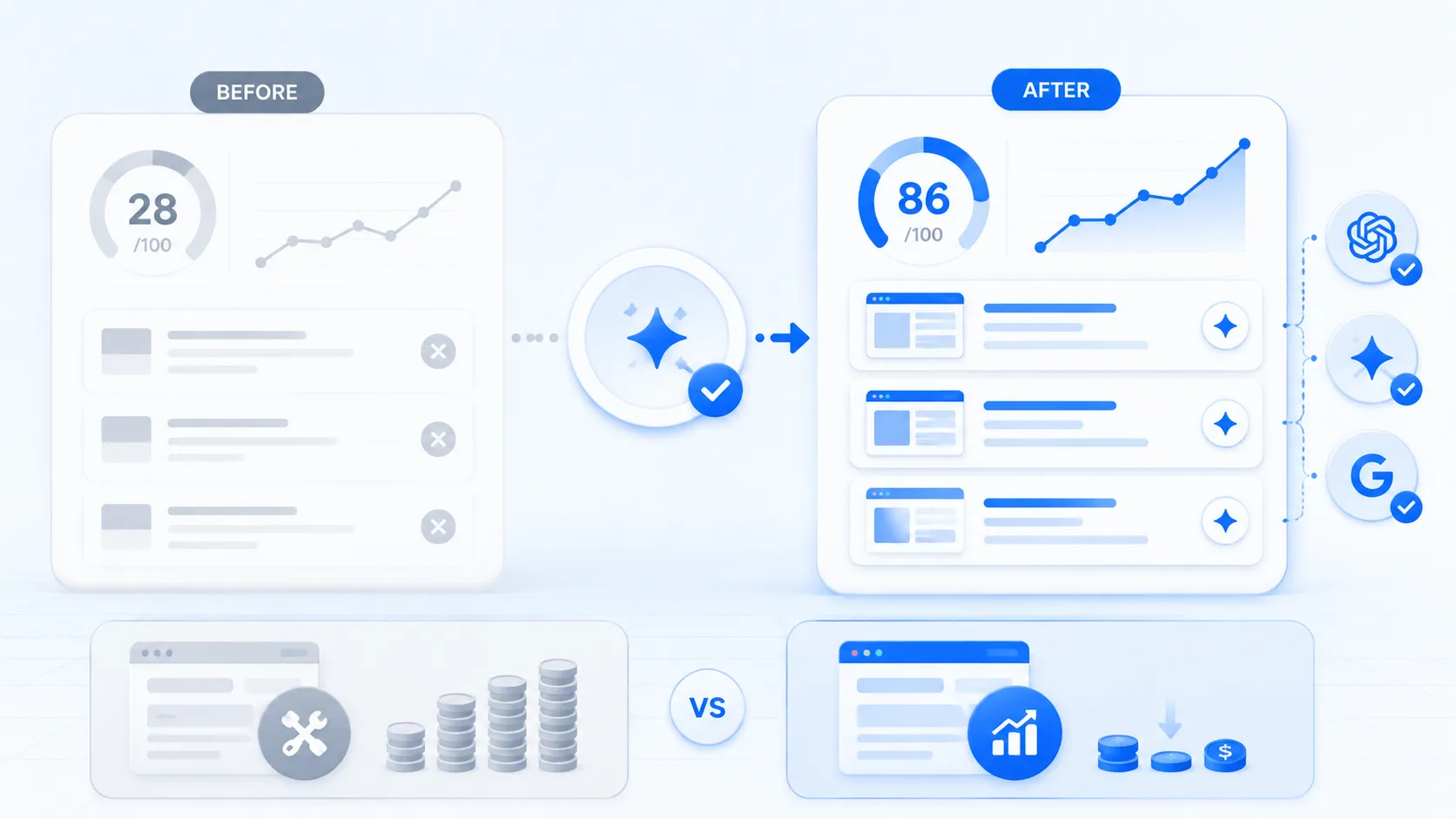
When we help foreign trade manufacturing companies with GEO (Generative Expertise Officer) services, the typical scenario is that about nine out of ten companies don't need to rebuild their websites. We do a comprehensive check-up and make some minor modifications, and within one or two months, their pages can be included in the sources of AI answers.
For example, one industrial cooling fan manufacturer we served (city undisclosed) changed its official website from a "product parameter stacking" approach to a content matrix that "covers buyer questions." As a result, the number of independent pages cited by AI increased from 207 to 248 , brand mentions in AI answers increased from 2 to 7 , and AI Overview citations increased from 23 to 40 (according to CTMON's public disclosure, Semrush 2026-06-03 vs 2026-07-13). The volume wasn't large, but the direction was clear— correcting the structure first is much more cost-effective than rebuilding the entire website.
VII. Frequently Asked Questions
Q: Should I switch to a CMS (website building system) when using GEO?
A: Basically not needed. A mainstream CMS with plugins and structured data is sufficient for GEO; switching systems would be a major undertaking.
Q: Can a 10-year-old website still perform GEO?
A: Yes. GEO focuses on content quality and structure, not website age. Older websites just need to streamline their content and crawling processes.
Q: How much does it actually cost to rebuild the official website?
A: First, check the checklist in Section 4. Most companies have budgets far below that for a "complete website overhaul"—partial modifications range from a few thousand to tens of thousands, while a complete overhaul often costs hundreds of thousands.
Q: How do I decide whether I need to redo it?
A: Look at the three triggering conditions in Section 3. Only consider it if there are ≥2 of them; otherwise, modify it locally first.
Related Reading
- Are there significant differences in the optimization logic between SEO and GEO? ( /blog/seo-vs-geo-difference) )
- How did GEO seize control of AI search traffic? ( /blog/geo-ai-traffic) )
- [How GEO works: 6 steps for B2B foreign trade factories to go from zero to being referenced by AI]( /blog/geo-how-to) )
- [How to determine if GEO is successful: Monitoring indicators, tools, and 3 common misconceptions] ( /blog/geo-metrics) )
CTMON (CTMON) · Shenzhen · Over a decade of experience in B2B digital marketing · Official website ctmon.com

What does international social media management service include? 2026 Guide to Social Media Management for Export Businesses
2026-10-28

How to write a WordPress product page that will make overseas buyers want to send inquiries?
2026-10-28

How to fix WordPress form emails not sending: Practical WP Mail SMTP configuration
2026-10-27

Are foreign trade promotion companies reliable? Six key criteria for businesses to judge promotion service providers in 2026.
2026-10-26

How do I set up an email account for export businesses? How can I configure it to avoid it ending up in the spam/junk mail folder?
2026-10-26
Related Articles
During the Canton Fair, how can export businesses optimize their GEO (Google App Store) to make it easier for AI to discover and recommend their brands?

Which GEO optimization company offers the best service? A guide to selecting and evaluating GEO service providers in 2026.

For GEO (Genomics Oriented to Enterprises in the Industrial Equipment Industry): Is Supporting Evidence More Important, or Are Inquiries More Important? (2026 Edition)

How to optimize product pages for B2B export websites using Geometry? Making AI search more effective (2026 version)

Using Reddit for overseas GEO content mentions? Its real value lies in being a "source of real user signals" (2026 version).

